Double-crested Cormorant (Plate 252)
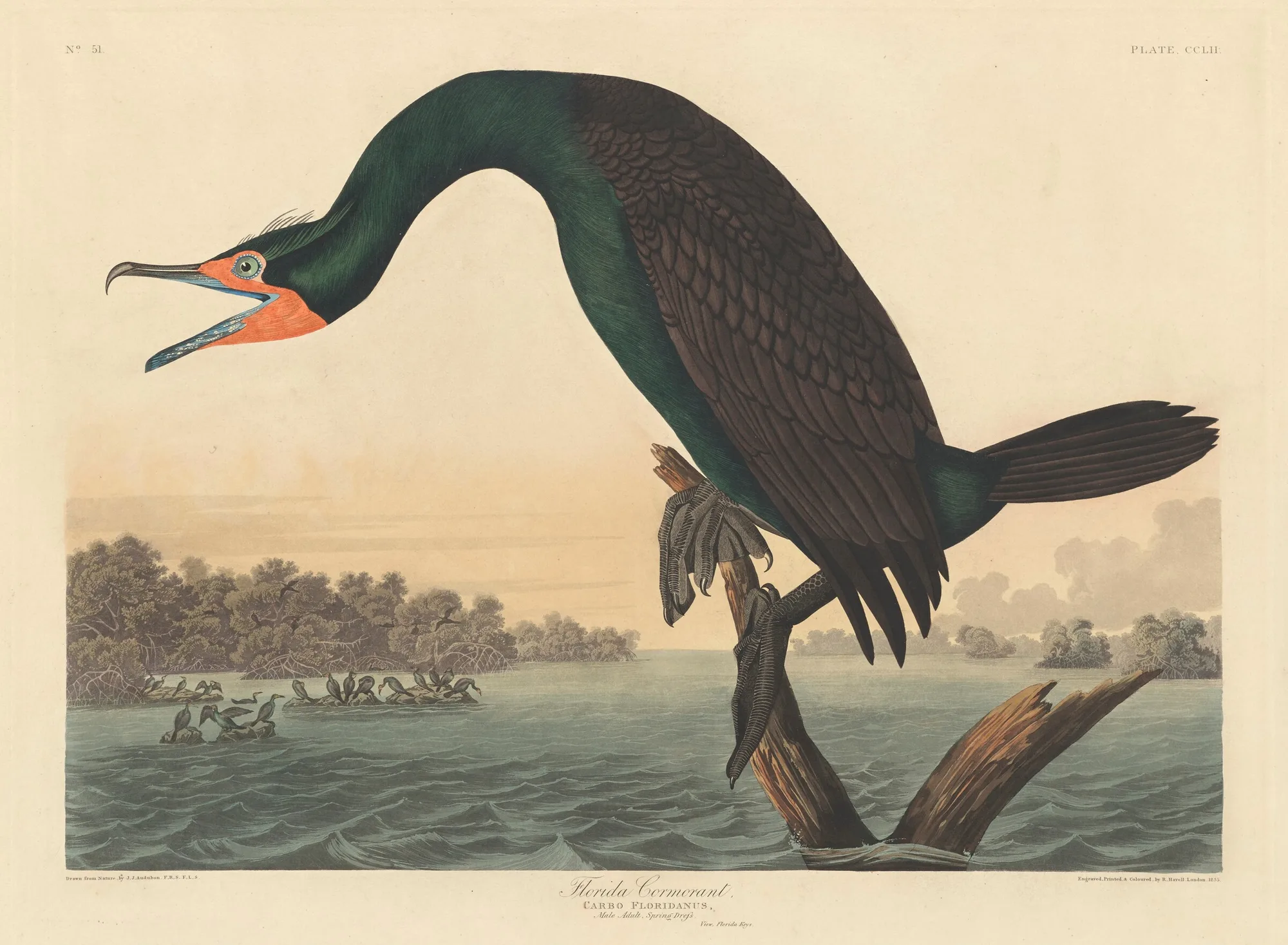
Audubon's “Florida Cormorant”, The Birds of America, plate CCLII
Click or press Enter to enlarge
Open the full-resolution image (4003 px, National Gallery of Art)
| Plate | 252 (CCLII) |
|---|---|
| Audubon's name | Florida Cormorant |
| Modern name | Double-crested Cormorant (Florida population) |
| Scientific name | Nannopterum auritum |
| Status | Least Concern |
| Engraved by | Robert Havell, after Audubon's watercolor |
| Date | 1835 |
| Medium | Hand-colored engraving and aquatint on Whatman wove paper |
| Collections | Seabirds, Florida and Wading Birds |
| This impression | National Gallery of Art, Washington, 1945.8.252; Gift of Mrs. Walter B. James |
About this plate
Plate 252 shows a male of what Audubon called the Florida Cormorant, a glossy black-green bird with an orange throat pouch, a hooked bill and green eyes.
Audubon believed it was a new species and gave it the name Phalacrocorax floridanus, explaining that he did so because no earlier description matched it. He wrote that it lived all year in southern Florida, breeding on the keys and along the salt-water inlets, and that some wandered to the Mississippi and the Ohio or north to Cape Hatteras. It seldom went more than five miles from land. He contrasted the nesting places of three cormorants: the Great Cormorant on high sea cliffs, the Double-crested on flat rocky islands, and the Florida bird in trees beside herons, frigatebirds and pigeons. His observations come from his visit to the Florida Keys in the spring of 1832.
The Florida Cormorant is now regarded as a southern population of the Double-crested Cormorant, which Audubon treated separately in plate 257. Its smaller size and tree nesting are normal variation within that species. In 2021 the American Ornithological Society moved the Double-crested Cormorant from Phalacrocorax to the genus Nannopterum.
The species breeds across much of North America and winters south to the Caribbean. It is listed as Least Concern. Florida birds remain largely resident and still nest in mangroves and other trees.
In Audubon's words
The P. Carbo appropriates to itself the upper shelves of the most rugged and elevated rocks, whose bases are washed by the sea; P. dilophus breeds on flat rocky islands at some distance from the shores of the mainland; and the Florida Cormorant nestles on trees. In the many breeding places of all these species which I have visited, I never found individuals of one intermingled with those of another, although the Large Cormorant did not seem averse from having the Peregrine Falcon in its vicinity, while the Double-crested allowed a few Gannets or Guillemots to nestle beside it, and the Florida Cormorant associated with Herons, Frigate Pelicans, Grakles, or Pigeons.
John James Audubon, Ornithological Biography, vol. 3 (1835), “The Florida Cormorant”. Read the full chapter.