Wilson's Phalarope (Plate 254)
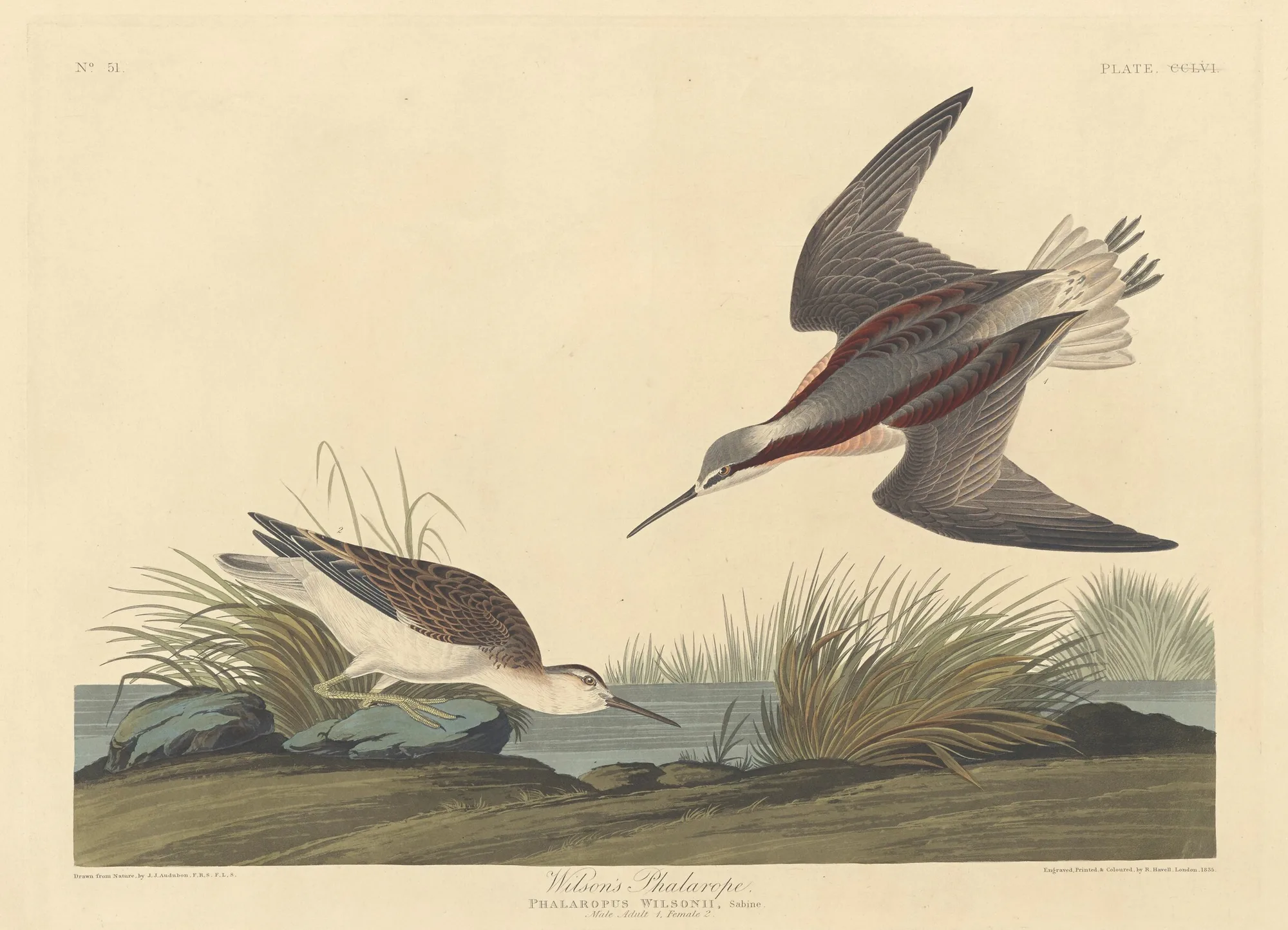
Audubon's “Wilson's Phalarope”, The Birds of America, plate CCLIV
Click or press Enter to enlarge
Open the full-resolution image (3322 px, National Gallery of Art)
| Plate | 254 (CCLIV) |
|---|---|
| Audubon's name | Wilson's Phalarope |
| Modern name | Wilson's Phalarope |
| Scientific name | Phalaropus tricolor |
| Status | Least Concern |
| Engraved by | Robert Havell, after Audubon's watercolor |
| Date | 1835 |
| Medium | Hand-colored engraving and aquatint on Whatman wove paper |
| Collections | Shorebirds, Rails and Cranes |
| This impression | National Gallery of Art, Washington, 1945.8.254; Gift of Mrs. Walter B. James |
About this plate
Plate 254 shows Wilson's Phalarope, a slender shorebird with a needle-like bill, labelled as a male and a young bird. Audubon drew the young bird in autumn plumage from a specimen given to him in New York by his friend Edward Harris.
Audubon wrote that he had never seen the nest or eggs. In June 1829, while staying with a fisherman gunner at Great Egg Harbour in New Jersey, he was brought a freshly killed pair. The man said they had pretended to be lame to lead him off, and the two men searched the island for the nest without success. Audubon judged from the female that she had been sitting. He also recorded birds shot near Buffalo Creek on Lake Erie in 1824 and two taken by his son at the Falls of the Ohio below Louisville.
Audubon's Phalaropus wilsoni is now Phalaropus tricolor. As in other phalaropes, the sexes reverse their usual roles. The female is larger and more brightly coloured, and she courts the male, who incubates the eggs and raises the chicks alone.
Wilson's Phalarope breeds in wetlands of the interior West and the prairies, not on the Atlantic coast, so the New Jersey birds were outside its normal range. After nesting, huge numbers gather to moult and feed at salt lakes such as Mono Lake and Great Salt Lake before flying to South America. It is listed as Least Concern.
In Audubon's words
While I was in the same neighbourhood, in the month of June 1829, a fisherman gunner, with whom I was at the time residing at Great Egg Harbour, brought me a pair which he had just killed. He represented them as very gentle and easily approached, and said that on going towards them they affected to be lame, and opened their wings as if to induce him to run after them; instead of doing which, however, he immediately fired and killed them both. Having put away the birds in a safe place, he and I took to his boat and went to the island where he had found them. He shewed me the spot on which they had been shot; but although we searched most diligently for the nest, we could not find it. On examining the birds when we returned, I saw that the female must have been sitting.
John James Audubon, Ornithological Biography, vol. 3 (1835), “Wilson's Phalarope”. Read the full chapter.