Double-crested Cormorant (Plate 257)
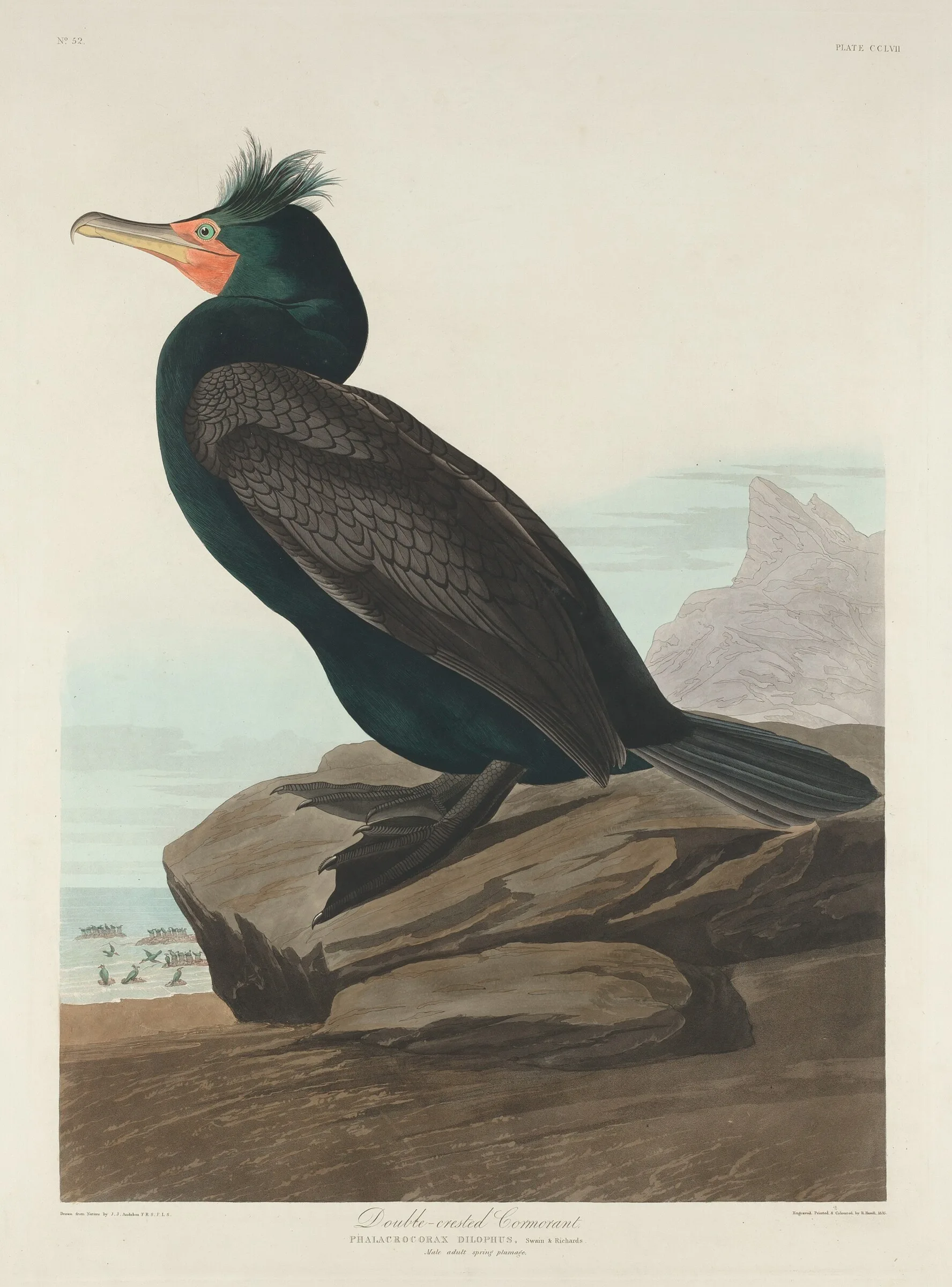
Audubon's “Double-crested Cormorant”, The Birds of America, plate CCLVII
Click or press Enter to enlarge
Open the full-resolution image (3556 px, National Gallery of Art)
| Plate | 257 (CCLVII) |
|---|---|
| Audubon's name | Double-crested Cormorant |
| Modern name | Double-crested Cormorant |
| Scientific name | Nannopterum auritum |
| Status | Least Concern |
| Engraved by | Robert Havell, after Audubon's watercolor |
| Date | 1835 |
| Medium | Hand-colored engraving and aquatint on Whatman wove paper |
| Collections | Seabirds |
| This impression | National Gallery of Art, Washington, 1945.8.257; Gift of Mrs. Walter B. James |
About this plate
Plate 257 shows a male Double-crested Cormorant in breeding plumage, glossy greenish black with an orange-yellow throat pouch, green eyes and the two curling tufts above the eyes that give the species its name.
Audubon opened the chapter with the approach to the southwest coast of Labrador in 1833: low islands crowded with nesting birds, a granite wall of cliffs, mossy valleys and blue lakes, and a silence he found melancholy. The cormorants came to those low islands each spring, about the beginning of May or as soon as the ice allowed. He wrote that they wintered along the Atlantic coast but seldom went south of the capes of North Carolina, where the Florida Cormorant took over. He also noted that John Richardson had described the species from the Arctic but without a figure, which his plate now supplied.
Audubon's Phalacrocorax dilophus is now Nannopterum auritum, moved to a new genus by the American Ornithological Society in 2021. Audubon's Florida Cormorant, plate 252, is now treated as part of the same species.
The Double-crested Cormorant breeds across North America, on coasts and inland lakes. Persecution and the pesticide DDT reduced it sharply by the 1960s. After protection and the DDT ban it increased dramatically, and it is now culled in some places because of conflicts with fisheries. It is listed as Least Concern.
In Audubon's words
In that land, man may for weeks, even months, seek for his kind in vain. The deep silence that reigns around him during a calm, seldom fails to bring sadness to his heart, as his eye grows dim with gazing on the wilderness. Should the northern gale issue from its snowy chambers, darkness follows in its train, and should its whole fury pour upon you, melancholy indeed must be your lot. To the low islands above alluded to, the beautiful Cormorant represented in the plate before you, resorts each spring, for the purpose of breeding. It arrives from the south about the beginning of May, or as soon as the waters of the Gulf are sufficiently free of ice to enable it to procure food. The winter it spends on our eastern coasts, but it rarely proceeds farther south than the Capes of North Carolina, about which it meets its southern friend the Florida Cormorant, on whose dominions, however, it does not venture.
John James Audubon, Ornithological Biography, vol. 3 (1835), “The Double-Crested Cormorant”. Read the full chapter.



