Reddish Egret (Plate 256)
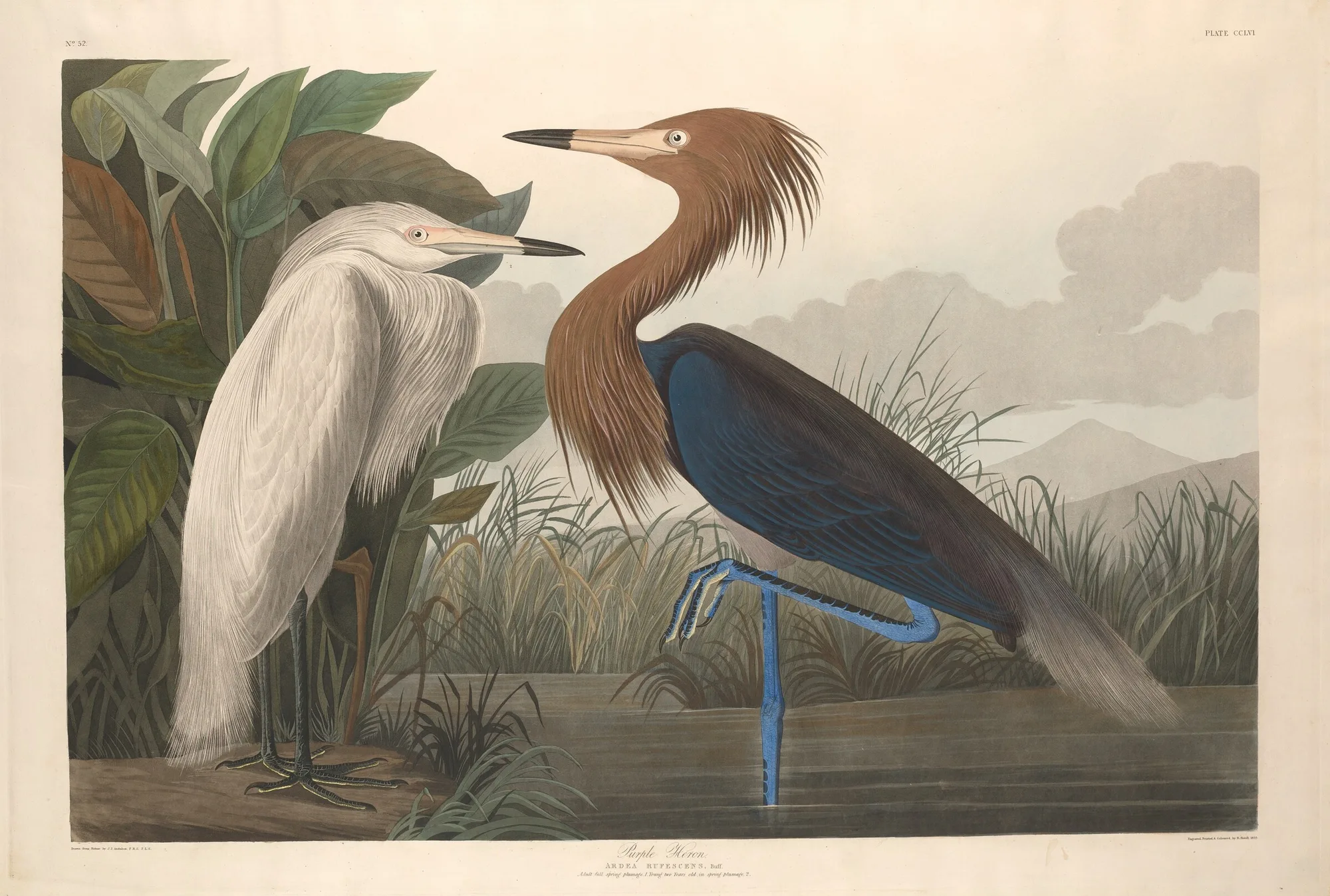
Audubon's “Purple Heron”, The Birds of America, plate CCLVI
Click or press Enter to enlarge
Open the full-resolution image (4428 px, National Gallery of Art)
| Plate | 256 (CCLVI) |
|---|---|
| Audubon's name | Purple Heron |
| Modern name | Reddish Egret |
| Scientific name | Egretta rufescens |
| Status | Near Threatened |
| Engraved by | Robert Havell, after Audubon's watercolor |
| Date | 1835 |
| Medium | Hand-colored engraving and aquatint on Whatman wove paper |
| Collections | Herons and Egrets, Florida and Wading Birds |
| This impression | National Gallery of Art, Washington, 1945.8.256; Gift of Mrs. Walter B. James |
About this plate
Plate 256 is engraved Purple Heron, but in the Ornithological Biography Audubon called the bird the Reddish Egret. It shows an adult in breeding plumage, slate grey with a shaggy rufous head and neck and a pink bill tipped black, and a young bird. The Purple Heron proper is a different, Old World species.
The chapter is set in the Florida Keys in 1832. Audubon asked the pilot Mr Egan, who knew the local birds, how many herons lived there. Egan counted on his fingers and said he knew twelve sorts, adding that their changing colours made them hard for any one man to learn without years of watching. Two of the birds he described were new to Audubon: a large white heron, which became Audubon's Great White Heron, and a grey and purple one. The pilot then promised to show him both.
Audubon's Ardea rufescens is now Egretta rufescens. The species has a dark morph, shown here, and an all-white morph. It is known for its active feeding: it runs, staggers and spins through shallow water with its wings raised to shade the surface and startle fish.
The Reddish Egret lives on the coasts of Florida, Texas, Mexico and the Caribbean. Plume hunters nearly wiped it out in Florida by the 1890s, and it is still scarce there. It is listed as Near Threatened and is the rarest heron in the United States.
In Audubon's words
No sooner had I been landed and formed an acquaintance with Mr Egan, the pilot of whom I have often spoken, who was well acquainted with the haunts of many of the birds of those islands, than I asked him respecting the various Herons which might be found there or on the shores of the mainland. Before answering me, he counted his fingers slowly, and then said that he could recollect only “twelve sorts;” “but,” added he, “these birds change their colours so curiously, that it is past wonder with me to believe that any one man could know them without watching them as I have done for many years.”
John James Audubon, Ornithological Biography, vol. 3 (1835), “The Reddish Egret”. Read the full chapter.