Hudsonian Godwit (Plate 258)
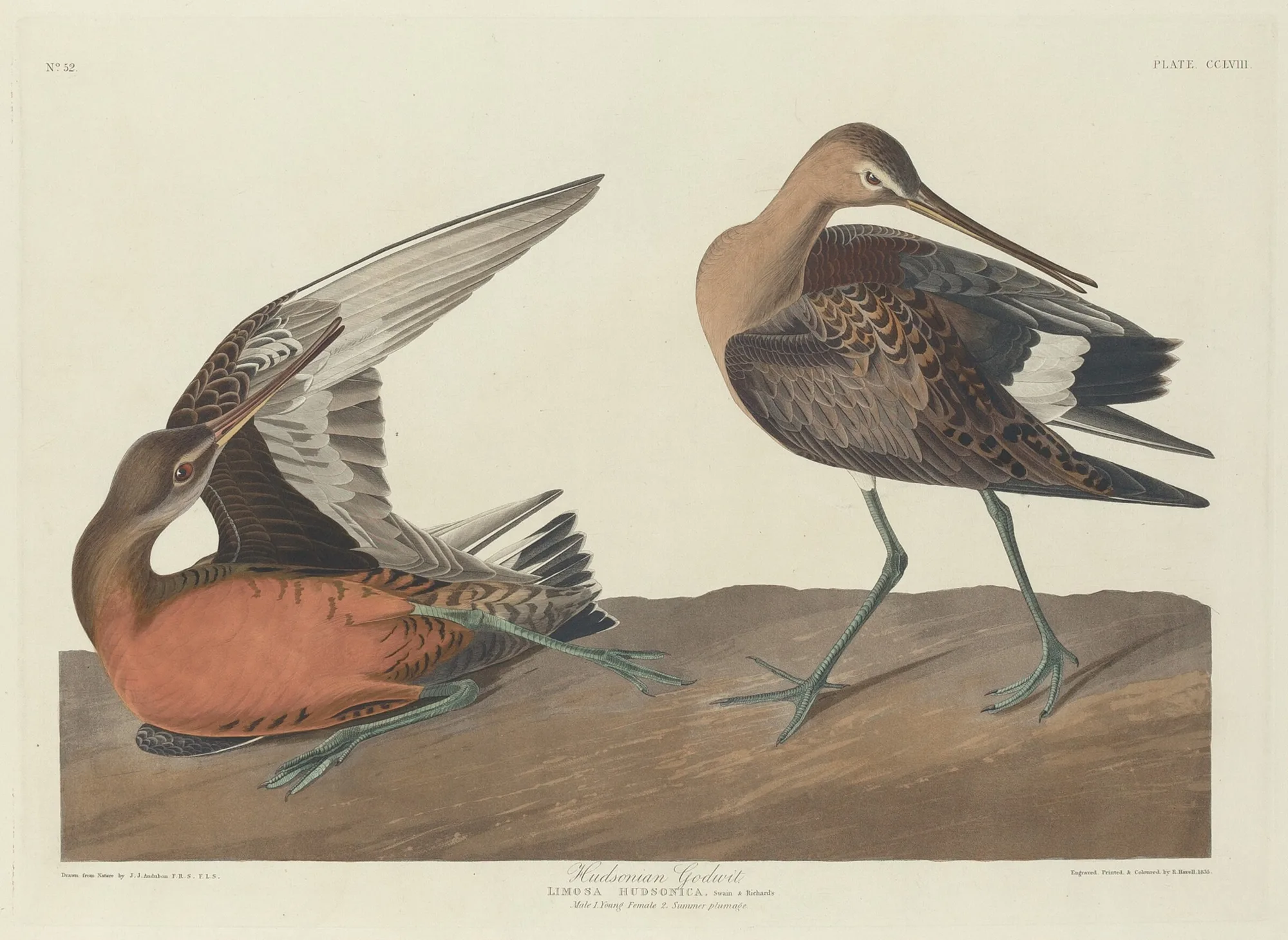
Audubon's “Hudsonian Godwit”, The Birds of America, plate CCLVIII
Click or press Enter to enlarge
Open the full-resolution image (2422 px, National Gallery of Art)
| Plate | 258 (CCLVIII) |
|---|---|
| Audubon's name | Hudsonian Godwit |
| Modern name | Hudsonian Godwit |
| Scientific name | Limosa haemastica |
| Status | Least Concern |
| Engraved by | Robert Havell, after Audubon's watercolor |
| Date | 1835 |
| Medium | Hand-colored engraving and aquatint on Whatman wove paper |
| Collections | Shorebirds, Rails and Cranes |
| This impression | National Gallery of Art, Washington, 1945.8.258; Gift of Mrs. Walter B. James |
About this plate
Plate 258 shows an adult male Hudsonian Godwit in breeding plumage, with deep chestnut underparts, and a young female in plain grey winter dress. Audubon explained that he drew the adult lying down to show the black underwing coverts, which separate this species from the Black-tailed Godwit of Europe, whose underwing is white.
He had never seen the bird in the flesh until he visited Boston in 1832, where he found young birds in the market in late September. An old gunner brought him eight or ten in a month, and his son drew the young bird in the plate from one of them. At Pictou in Nova Scotia, Professor Thomas McCulloch gave him a pair of adults in fine plumage. On the Magdalen Islands, fishermen who called godwits curlews told him the species bred in marshes at the end of the main island. Audubon wrote that nothing was known of its nest or eggs.
Audubon's Limosa hudsonica is now Limosa haemastica. Its breeding grounds were found much later, in scattered wet tundra and muskeg in Alaska, the Mackenzie Delta and around Hudson Bay. It does not breed on the Magdalen Islands.
The Hudsonian Godwit makes one of the longest migrations of any shorebird, flying from the Arctic to southern Chile and Argentina, partly in nonstop flights of several thousand kilometres. Most of the population depends on a few staging and wintering sites. It is listed as Least Concern, though counts at key wintering sites have fallen.
In Audubon's words
I had never seen it in the flesh, until I went to Boston in 1832, when I found specimens of it in the market late in September. An old gunner in my employ brought me eight or ten in the course of a month, but they were all young birds. From one of them my son drew the figure in the plate. While I was at Pictou Professor MacCulloch presented me with a pair of adult birds in beautiful plumage. When we were on our way towards Labrador, the fishermen and inhabitants of the Magdeleine Islands, who gave the name of Curlews to the Godwits, assured me that this species breeds there in some marshes at the extremity of the principal island, and that they were in the habit of killing them as soon as they were able to fly, when they were considered excellent food.
John James Audubon, Ornithological Biography, vol. 3 (1835), “The Hudsonian Godwit”. Read the full chapter.



