Horned Grebe (Plate 259)
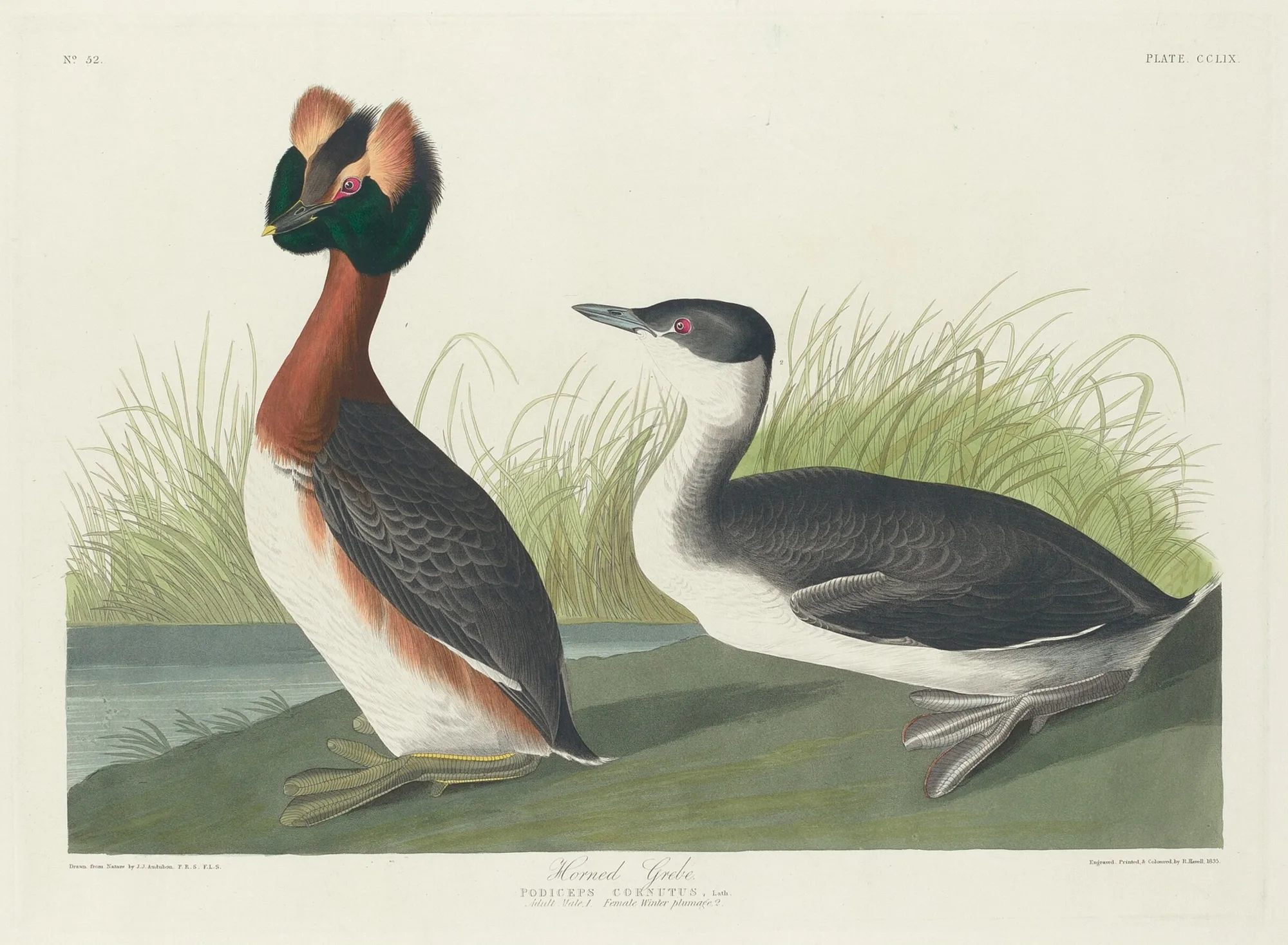
Audubon's “Horned Grebe”, The Birds of America, plate CCLIX
Click or press Enter to enlarge
Open the full-resolution image (2427 px, National Gallery of Art)
| Plate | 259 (CCLIX) |
|---|---|
| Audubon's name | Horned Grebe |
| Modern name | Horned Grebe |
| Scientific name | Podiceps auritus |
| Status | Vulnerable |
| Engraved by | Robert Havell, after Audubon's watercolor |
| Date | 1835 |
| Medium | Hand-colored engraving and aquatint on Whatman wove paper |
| Collections | Seabirds |
| This impression | National Gallery of Art, Washington, 1945.8.259; Gift of Mrs. Walter B. James |
About this plate
Plate 259 shows a male Horned Grebe in breeding plumage, with a black head, golden-buff tufts behind the eyes and a chestnut neck and flanks, together with a young bird in grey and white. The National Gallery of Art record gives this plate the title Greenshank, but the plate and the Ornithological Biography chapter are the Horned Grebe. The Greenshank is plate 269.
Audubon used the chapter to attack the common belief that grebes migrated by swimming. He described an evening on the Ohio on 14 October 1820, when he was floating in a small boat and heard a whistling overhead like a hawk stooping. A flock of about thirty grebes dropped toward the river, flew on out of sight, returned and landed all together, then began washing and preening. He shot four: three young and one adult moulting into winter plumage. He added that the birds arrived on the western rivers each October, flying high and following the streams.
Audubon's Podiceps cornutus is now Podiceps auritus. In Britain it is called the Slavonian Grebe. It breeds on small ponds and marshes in Alaska, western Canada and the northern Great Plains, and across northern Europe and Asia, and winters mainly on coastal waters.
The Horned Grebe is listed as Vulnerable because of large declines in both North America and Europe, linked to the loss of prairie wetlands and other pressures.
In Audubon's words
Towards evening, on the 14th of October 1820, I was floating in a small boat on the Ohio. The weather was perfectly calm, and I was startled by a whistling sound over head, resembling that of a Hawk stooping on its prey, when, on looking up, I saw a flock of Grebes, about thirty in number, gliding towards the water as if about to alight within a quarter of a mile from me. In a few minutes they had come within a few yards of the surface of the water, when suddenly checking their speed, they pursued their course until out of sight; but in a short time I saw them returning towards me, and in less than a minute they all passed at a distance of forty or fifty yards, took a round and alighted pell-mell. The next moment, they were all engaged in washing and trimming themselves, in the manner of Ducks, Cormorants, and other aquatic birds.
John James Audubon, Ornithological Biography, vol. 3 (1835), “The Horned Grebe”. Read the full chapter.