Leach's Storm-Petrel (Plate 260)
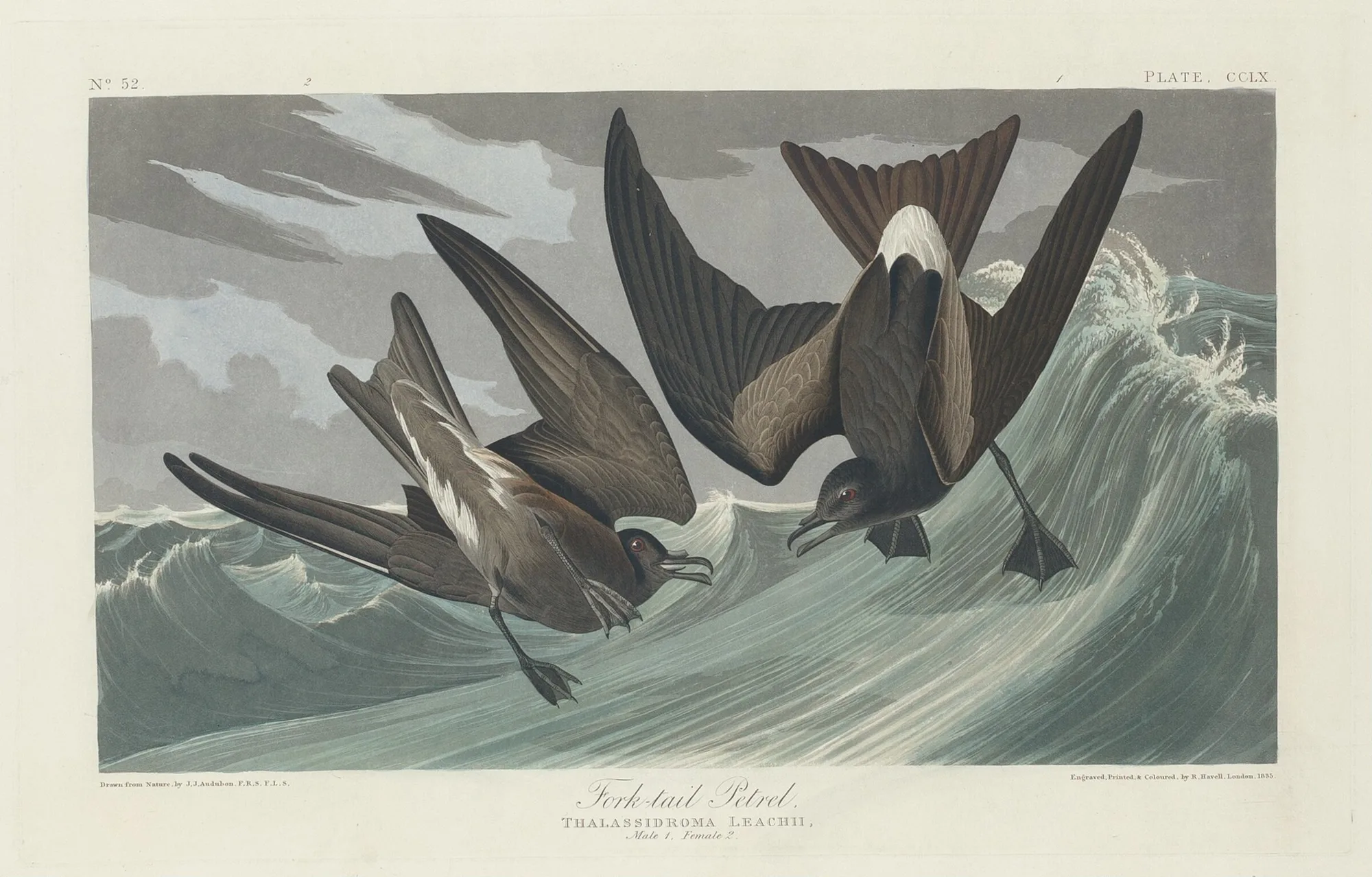
Audubon's “Fork-tailed Petrel”, The Birds of America, plate CCLX
Click or press Enter to enlarge
Open the full-resolution image (2315 px, National Gallery of Art)
| Plate | 260 (CCLX) |
|---|---|
| Audubon's name | Fork-tailed Petrel |
| Modern name | Leach's Storm-Petrel |
| Scientific name | Hydrobates leucorhous |
| Status | Vulnerable |
| Engraved by | Robert Havell, after Audubon's watercolor |
| Date | 1835 |
| Medium | Hand-colored engraving and aquatint on Whatman wove paper |
| Collections | Seabirds |
| This impression | National Gallery of Art, Washington, 1945.8.260; Gift of Mrs. Walter B. James |
About this plate
Plate 260 shows a male and female of the bird Audubon called the Fork-tailed Petrel, now Leach's Storm-Petrel: small, sooty brown seabirds with a pale bar across the wing, a white rump divided by a faint dark line, and a notched tail.
Audubon opened by sorting out three storm-petrels that occur off American coasts, of which this is the largest. He then told the story of a calm in August 1831 on the Banks of Newfoundland, aboard the packet ship Columbia under his friend Captain Joseph Delano. Though seasick, he asked for a boat and went out with his assistant Henry Ward, an officer and two sailors. In about an hour they shot twenty-five or thirty petrels and some fulmars. He had to lean over the side after each shot, and on returning he had to be hoisted aboard in a chair.
Audubon's Thalassidroma leachii is now Hydrobates leucorhous. The species nests in burrows on offshore islands in the North Atlantic and North Pacific and visits its colonies only at night, to avoid gulls. The largest colony in the world is on Baccalieu Island, Newfoundland.
Leach's Storm-Petrel is listed as Vulnerable. Atlantic colonies have declined sharply, with predation by gulls and mammals, collisions with lit structures offshore and changes in food supply among the suspected causes.
In Audubon's words
This was granted, guns and ammunition were placed in the yawl, and my assistant Mr Henry Ward of London, an officer, and two sailors, accompanied me. We had three guns which were alternately loaded and handed to me. In the course of about an hour twenty-five or thirty Petrels were shot, together with some Fulmars. Had you been looking on, you might perhaps have laughed at me on seeing that the moment after I fired, I was obliged to lean over the side of the bark to relieve myself from the distressing state of my stomach. On returning to the ship, my companions nimbly ascended the chains; but although when on land I am pretty firm and active, I was now quite unfit for service, and therefore was hoisted in a chair.
John James Audubon, Ornithological Biography, vol. 3 (1835), “The Forked-Tailed Petrel”. Read the full chapter.



