Sandhill Crane (Plate 261)
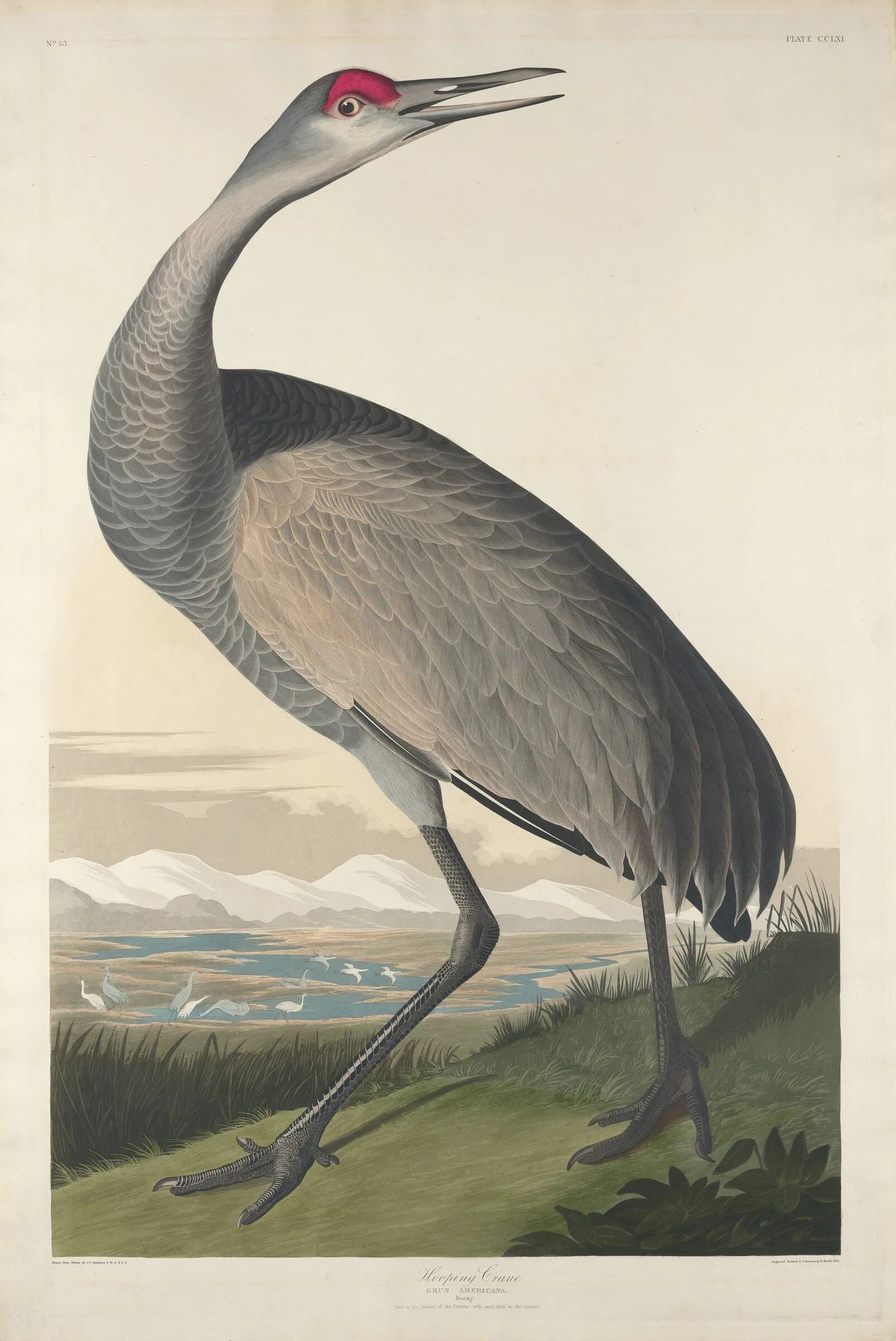
Audubon's “Hooping Crane”, The Birds of America, plate CCLXI
Click or press Enter to enlarge
Open the full-resolution image (4709 px, National Gallery of Art)
| Plate | 261 (CCLXI) |
|---|---|
| Audubon's name | Hooping Crane |
| Modern name | Sandhill Crane (Audubon's young Whooping Crane) |
| Scientific name | Antigone canadensis |
| Status | Least Concern |
| Engraved by | Robert Havell, after Audubon's watercolor |
| Date | 1835 |
| Medium | Hand-colored engraving and aquatint on Whatman wove paper |
| Size | plate: 97 x 64.8 cm (38 3/16 x 25 1/2 in.) sheet: 100.7 x 68.2 cm (39 5/8 x 26 7/8 in.) |
| Collections | Shorebirds, Rails and Cranes |
| This impression | National Gallery of Art, Washington, 1945.8.261; Gift of Mrs. Walter B. James |
About this plate
Plate 261 carries the same title as plate 226, Hooping Crane, and is presented as the young of that species. The bird is grey washed with rusty brown, with a bare red crown. It is in fact a Sandhill Crane, a separate species.
Audubon knew that other naturalists treated the brown bird as a species of its own, the Brown or Canada Crane, Grus canadensis, and he said so in his short chapter. He nonetheless held that it was the Whooping Crane in immature plumage. The specimen he drew had been given to him by a captain and was described earlier in the volume. He added a note from his Gulf of Mexico journal about one of these cranes that came aboard a ship on a dark night, fell into the yawl at the stern, and refused all food until it died a few days later.
The mistake is understandable, since both cranes winter in the same southern marshes, but it is a clear error. Young Whooping Cranes are white mottled with cinnamon, not grey. Adult Whooping Cranes are white, so the plate pairs two different birds under one name.
The Sandhill Crane, now Antigone canadensis, is the most numerous crane in the world. It breeds from Siberia and Alaska across Canada to the northern United States, with resident populations in Florida, Mississippi and Cuba. Hundreds of thousands gather each spring on the Platte River in Nebraska. It is listed as Least Concern.
In Audubon's words
In this state, the Whooping Crane has been considered as a distinct species, to which the name of Brown or Canada Crane, Grus canadensis, has been given. On referring to one of my journals, written on the Gulf of Mexico, I find it stated that one of these birds came on board one dark night, and, after passing the man at the helm, fell into the yawl hanging at the stern of the ship, where in the morning it was discovered and secured. Although to appearance in good health, it refused every kind of food, and in a few days died. Knowing the great power of flight of this species, I could only conjecture that some disease operating powerfully at the moment, had caused the bird to take refuge in the boat.
John James Audubon, Ornithological Biography, vol. 3 (1835), “The Whooping Crane”. Read the full chapter.