Northern Fulmar (Plate 264)
Audubon's “Fulmer Petrel”, The Birds of America, plate CCLXIV
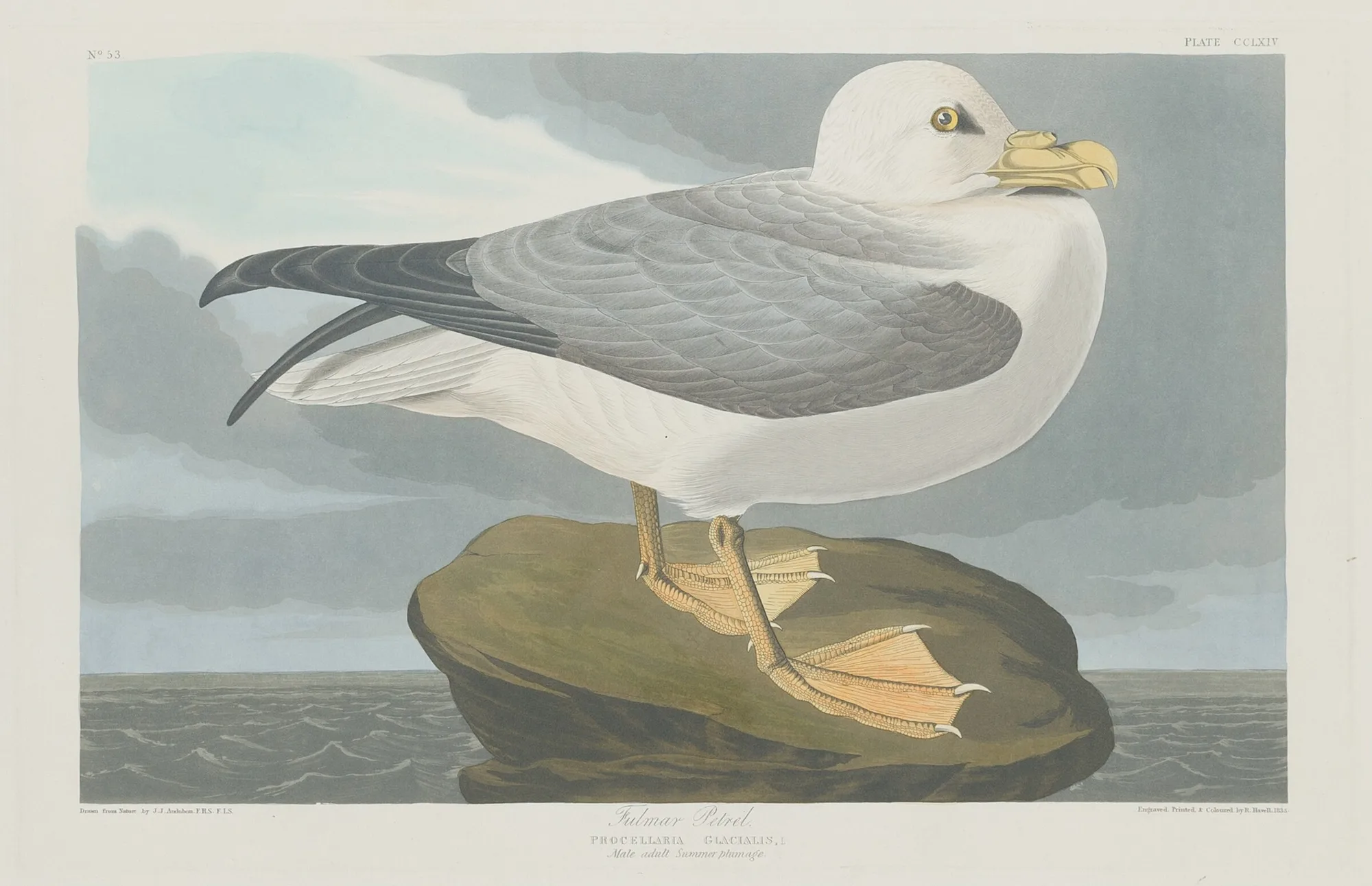
Click or press Enter to enlarge
Open the full-resolution image (2412 px, National Gallery of Art)
| Plate | 264 (CCLXIV) |
|---|---|
| Audubon's name | Fulmer Petrel |
| Modern name | Northern Fulmar |
| Scientific name | Fulmarus glacialis |
| Status | Least Concern |
| Engraved by | Robert Havell, after Audubon's watercolor |
| Date | 1835 |
| Medium | Hand-colored engraving and aquatint on Whatman wove paper |
| Collections | Seabirds |
| This impression | National Gallery of Art, Washington, 1945.8.264; Gift of Mrs. Walter B. James |
About this plate
Plate 264 shows a male Northern Fulmar in its pale form, white on the head and body with grey wings and back, a dark smudge before the eye and a thick yellowish bill with tube nostrils on top.
Audubon wrote that the fulmar visited the coasts of the northeastern United States from September to May and was common on the Banks of Newfoundland, where it fed on offal thrown from the cod-fishing boats. He collected several on a calm day in August 1831 on his voyage from England to New York, the same day he described in his chapter on Leach's Storm-Petrel. The birds came to the boat whenever anything was thrown overboard, and wounded birds ejected oily matter from the nostrils but did not try to bite. He had expected to find them breeding in Labrador but did not.
Audubon's Procellaria glacialis is now Fulmarus glacialis. Though it looks like a gull, the fulmar is a tubenose, related to petrels and albatrosses. It glides low on stiff wings, and at the nest it defends itself by spitting a foul stomach oil that can mat the feathers of attacking birds.
The fulmar breeds on sea cliffs across the North Atlantic and North Pacific. During the nineteenth and twentieth centuries it spread greatly around Britain and Iceland, helped by waste from fishing fleets. It is listed as Least Concern.
In Audubon's words
One calm day in August, when on a voyage from England to New York, of which I have already spoken when describing the Forked-tailed Petrel, I procured several Fulmars. They came up and alighted near the boat, whenever we threw any thing overboard, and did not seem to be in the least alarmed by the report of a gun. In one instance I shot one on the water, when it was so near that I could distinctly see the colour of its eye. A great number of them were swimming in small detached flocks of eight or ten, their colour at a distance appearing as if pure white, and contrasting beautifully with the dark blue of the sea. They floated very buoyantly, some swimming about with great ease, others to appearance sound asleep.
John James Audubon, Ornithological Biography, vol. 3 (1835), “The Fulmar Petrel”. Read the full chapter.



