Buff-breasted Sandpiper (Plate 265)
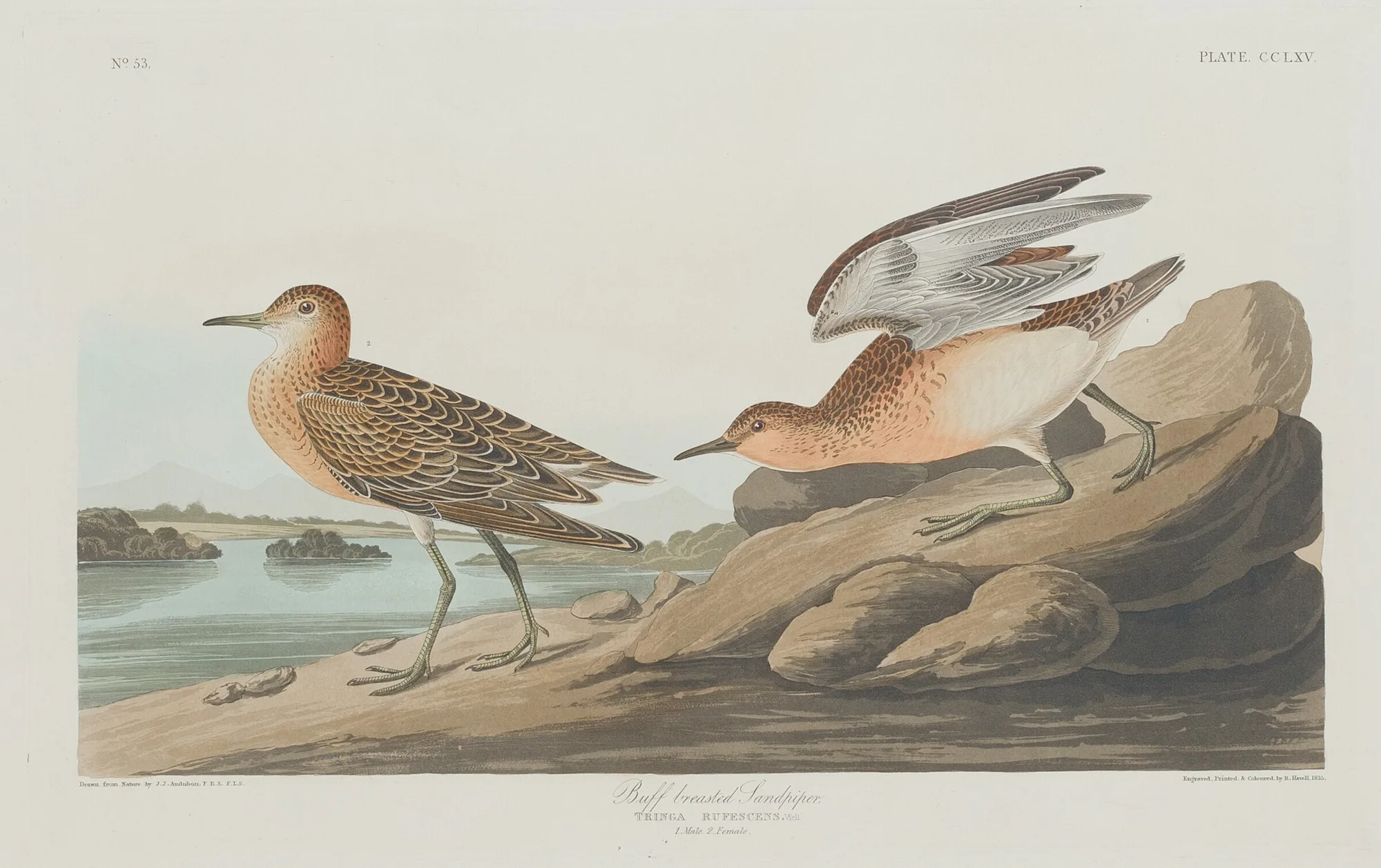
Audubon's “Buff-breasted Sandpiper”, The Birds of America, plate CCLXV
Click or press Enter to enlarge
Open the full-resolution image (2425 px, National Gallery of Art)
| Plate | 265 (CCLXV) |
|---|---|
| Audubon's name | Buff-breasted Sandpiper |
| Modern name | Buff-breasted Sandpiper |
| Scientific name | Calidris subruficollis |
| Status | Near Threatened |
| Engraved by | Robert Havell, after Audubon's watercolor |
| Date | 1835 |
| Medium | Hand-colored engraving and aquatint on Whatman wove paper |
| Collections | Shorebirds, Rails and Cranes |
| This impression | National Gallery of Art, Washington, 1945.8.265; Gift of Mrs. Walter B. James |
About this plate
Plate 265 shows a male and female Buff-breasted Sandpiper, small, buff-faced shorebirds with scaly brown backs, short bills and yellow legs. One is drawn raising its wings to take flight.
Audubon wrote that although the bird was not rare at certain seasons on the eastern coast, it had been unknown to Alexander Wilson and Charles Bonaparte, and to himself until William Yarrell found it in England. Louis Vieillot had first described it from Louisiana. Audubon drew the figure taking wing from Yarrell's English specimen and the other from a bird obtained in Boston. He knew nothing of its habits. Because Captain James Clark Ross had a wing that his sailors found in the Arctic, he guessed that it bred near the Arctic Circle.
Audubon's Tringa rufescens is now Calidris subruficollis. His guess was right. The species breeds on the high Arctic tundra of Alaska and Canada, where males display at leks by raising their white-lined wings. It migrates mostly through the Great Plains to winter on the grasslands of Argentina, Uruguay and southern Brazil, and it favours short grass, sod farms and fields rather than mudflats.
Market hunting in the late nineteenth century cut its numbers drastically. It is listed as Near Threatened, and the loss of South American grasslands remains a concern.
In Audubon's words
It is a curious fact that although this beautiful bird is by no means rare, at particular periods, along the shores of our Eastern Districts, it remained unknown to Wilson, Bonaparte, and, until found in England by Mr Yarrell, to myself. It was first discovered by Vieillot in Louisiana, where, however, I never met with it. My friend Nuttall, who has also described it, states that it is often seen near Boston, in company with the Pectoral Sandpiper, and is not uncommon in the market there. To my friend Mr Yarrell I am indebted for the use of his specimen, from which I made the figure in the act of starting on wing. The other figure was taken from an American specimen, procured at Boston, and now in my possession.
John James Audubon, Ornithological Biography, vol. 3 (1835), “The Buff-Breasted Sandpiper”. Read the full chapter.