Curlew Sandpiper (Plate 263)
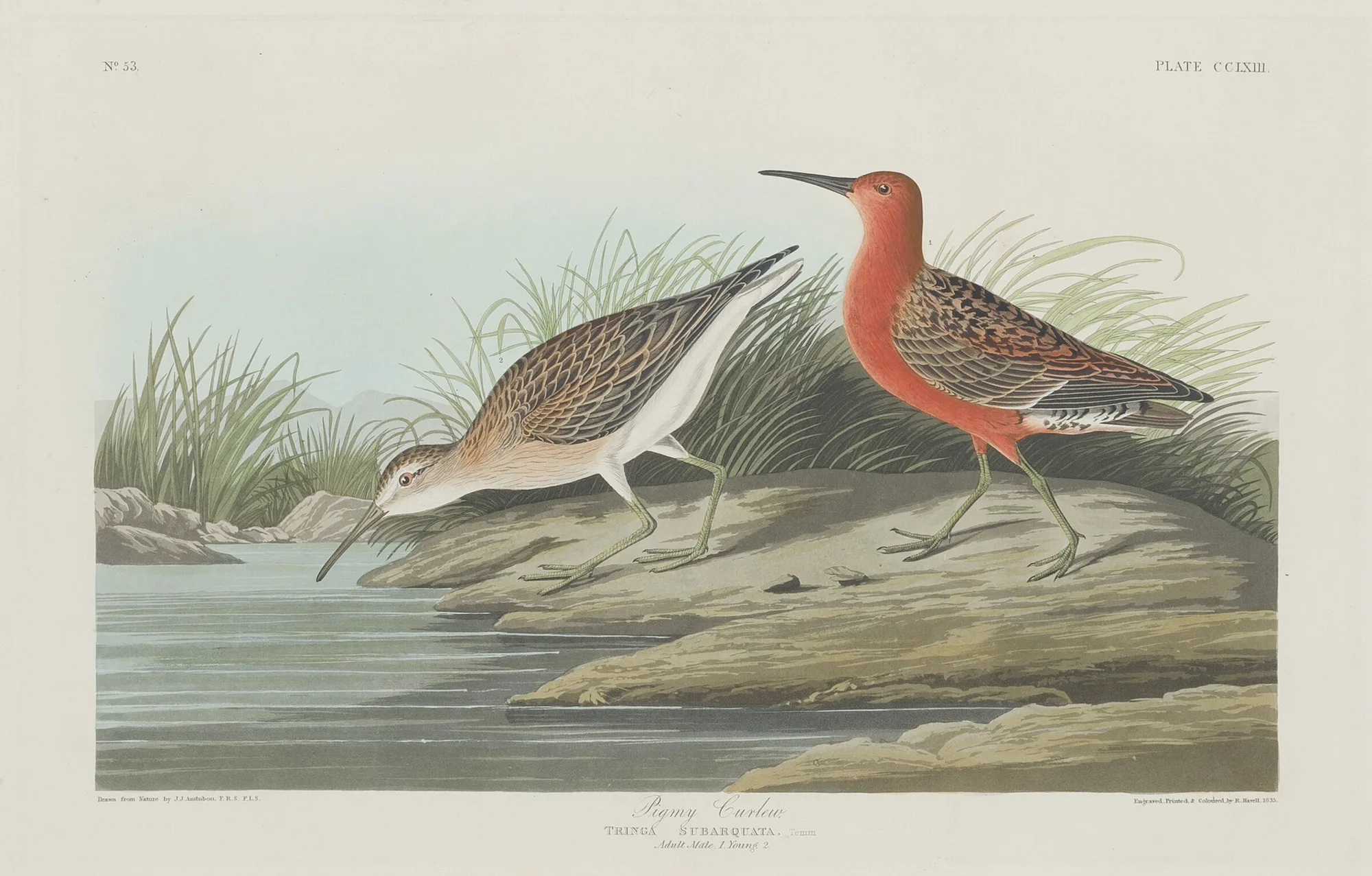
Audubon's “Pigmy Curlew”, The Birds of America, plate CCLXIII
Click or press Enter to enlarge
Open the full-resolution image (2401 px, National Gallery of Art)
| Plate | 263 (CCLXIII) |
|---|---|
| Audubon's name | Pigmy Curlew |
| Modern name | Curlew Sandpiper |
| Scientific name | Calidris ferruginea |
| Status | Near Threatened |
| Engraved by | Robert Havell, after Audubon's watercolor |
| Date | 1835 |
| Medium | Hand-colored engraving and aquatint on Whatman wove paper |
| Collections | Shorebirds, Rails and Cranes |
| This impression | National Gallery of Art, Washington, 1945.8.263; Gift of Mrs. Walter B. James |
About this plate
Plate 263 shows a male Curlew Sandpiper in breeding plumage, deep chestnut below with a slender down-curved bill, and a young bird in plain grey and white. Audubon titled it the Pigmy Curlew, an old English name, though it is a sandpiper.
He wrote that he had seen only three of these birds in all his travels and thought it the rarest of its genus in America. Two were shot at Great Egg Harbour in New Jersey in the spring of 1829 and one on the shore near Sandy Hook. They were wading knee-deep and picking up sand worms, and he found small shells, red worms and bits of marine plants in their stomachs. The figure engraved in the plate was made from the bird near Sandy Hook, a male in full plumage. He also knew of a few specimens in New York and Boston and one or two in John Bachman's collection.
Audubon used Temminck's Tringa subarquata. The species is now Calidris ferruginea. It breeds on the tundra of Arctic Siberia and winters in Africa, southern Asia and Australia. In North America it is a rare visitor, mostly on the Atlantic coast, which matches Audubon's experience.
The Curlew Sandpiper is listed as Near Threatened. Its numbers have fallen as tidal flats used on migration, especially around the Yellow Sea, have been reclaimed.
In Audubon's words
In the course of my extensive rambles along our coasts and in the interior, I have seen only three birds of this species, all of which I have kept with care, considering the Cape Sandpiper or Pigmy Curlew as the rarest of its genus with us. It appears to resort to particular districts; two of my birds were shot at Great Egg Harbour in New Jersey, in the spring of 1829, the other on Long Island near Sandy Hook. No other birds were near them, and I approached them without much difficulty. They were wading along the shores up to the knees, picking up floating garbage and sand worms. In their stomachs I found fragments of minute shells, slender red worms, and bits of marine plants. The one killed on Long Island was a fine male in full plumage, and from it I made the figure that has been engraved in the plate.
John James Audubon, Ornithological Biography, vol. 3 (1835), “The Curlew Sandpiper”. Read the full chapter.