Great Cormorant (Plate 266)
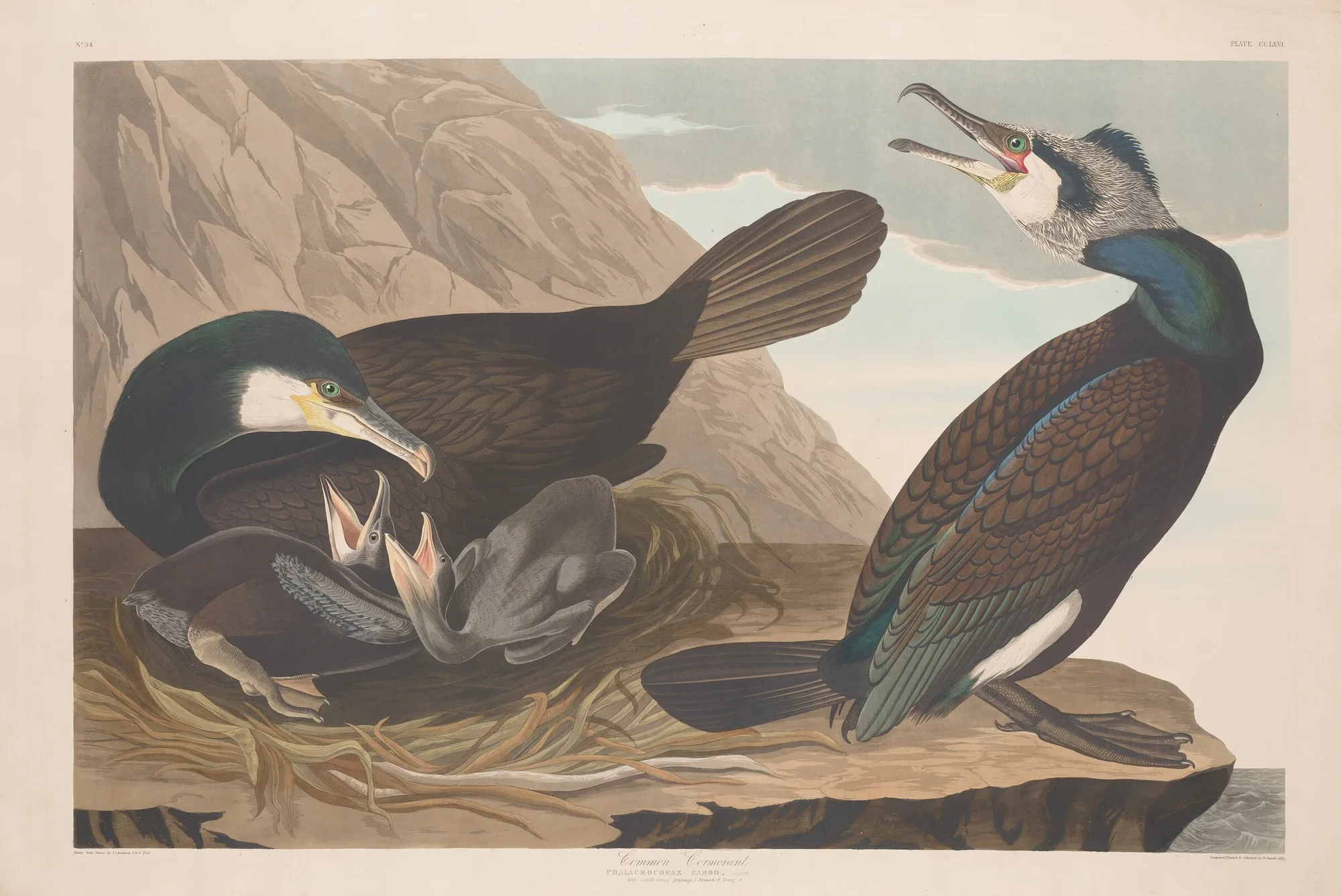
Audubon's “Common Cormorant”, The Birds of America, plate CCLXVI
Click or press Enter to enlarge
Open the full-resolution image (4678 px, National Gallery of Art)
| Plate | 266 (CCLXVI) |
|---|---|
| Audubon's name | Common Cormorant |
| Modern name | Great Cormorant |
| Scientific name | Phalacrocorax carbo |
| Status | Least Concern |
| Engraved by | Robert Havell, after Audubon's watercolor |
| Date | 1835 |
| Medium | Hand-colored engraving and aquatint on Whatman wove paper |
| Plants and setting | Sea-cliff ledge |
| Collections | Seabirds |
| This impression | National Gallery of Art, Washington, 1945.8.266; Gift of Mrs. Walter B. James |
About this plate
Plate 266 shows a male, a female and young Great Cormorants. The adults are black with a bronze sheen, a white throat patch and, in breeding season, white flank patches. The female stands over her dark, downy young on a rock ledge.
Audubon opened the chapter by inviting the reader to look at the mother and her young in the plate. He then described lying flat on the edge of a cliff in Labrador, hundreds of feet above the St Lawrence, and crawling close enough to watch a mother caress her chicks with her bill while they rubbed their heads against hers. When she saw him she launched into the air with a croak and flew past again and again in a strange, laboured way, and all her neighbours rose with her. The chicks crept into a crevice. He wrote that this species took the highest ledges of sea cliffs and never mixed its colonies with other cormorants.
Audubon's Phalacrocorax carbo keeps its name. It is the largest cormorant in North America, where it is the Great Cormorant, though in Britain it is simply the Cormorant. It is found across Europe, Asia, Africa and Australia as well.
In North America it breeds on rocky coasts from Nova Scotia and the Gulf of St Lawrence north to Greenland and winters south along the Atlantic coast to the Carolinas. It is listed as Least Concern.
In Audubon's words
Look at the birds before you, and mark the affectionate glance of the mother, as she stands beside her beloved younglings! I wish you could have witnessed the actions of such groups as I did while in Labrador. Methinks I still see the high rolling billows of the St Lawrence breaking in foaming masses against the huge cliffs, on the shelves of which the Cormorant places its nest. I lie flat on the edge of the precipice some hundred feet above the turbulent waters, and now crawling along with all care, I find myself only a few yards above the spot on which the parent bird and her young are fondling each other, quite unconscious of my being near. How delighted I am to witness their affectionate gratulations, hear their lisping notes, mark the tremulous motions of their expanded throats, and the curious vacillations of their heads and necks! The kind mother gently caresses each alternately with her bill: the little ones draw nearer to her, and, as if anxious to evince their gratitude, rub their heads against hers.
John James Audubon, Ornithological Biography, vol. 3 (1835), “The Common Cormorant”. Read the full chapter.



