Long-tailed Jaeger (Plate 267)
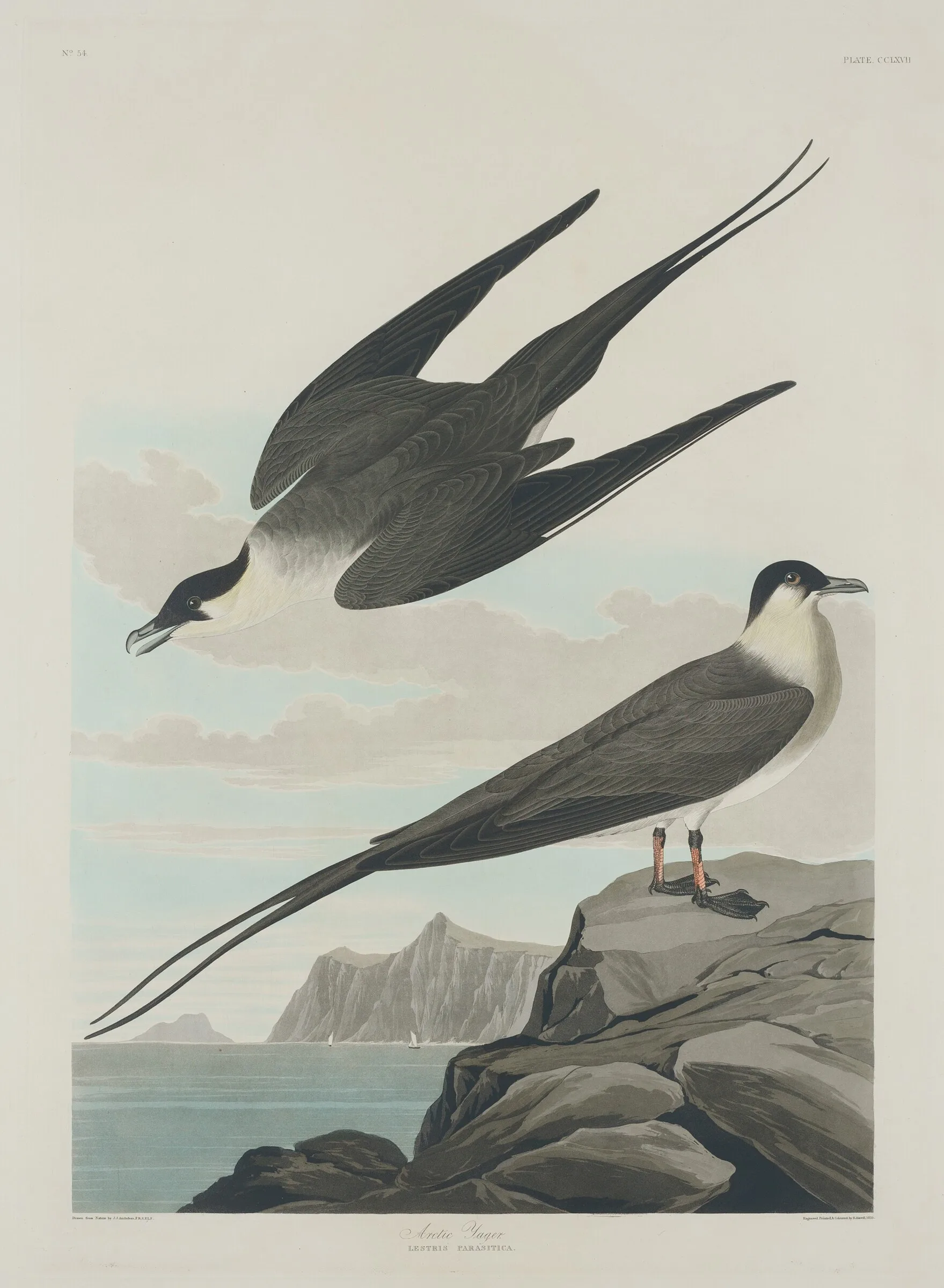
Audubon's “Arctic Jager”, The Birds of America, plate CCLXVII
Click or press Enter to enlarge
Open the full-resolution image (3752 px, National Gallery of Art)
| Plate | 267 (CCLXVII) |
|---|---|
| Audubon's name | Arctic Jager |
| Modern name | Long-tailed Jaeger |
| Scientific name | Stercorarius longicaudus |
| Status | Least Concern |
| Engraved by | Robert Havell, after Audubon's watercolor |
| Date | 1835 |
| Medium | Hand-colored engraving and aquatint on Whatman wove paper |
| Collections | Seabirds |
| This impression | National Gallery of Art, Washington, 1945.8.267; Gift of Mrs. Walter B. James |
About this plate
Plate 267 shows a male and female jaeger with grey-brown backs, black caps, pale underparts and long, pointed central tail feathers. The plate is usually identified as the Long-tailed Jaeger. The engraved title appears as Arctic Yager in some lists.
Audubon described a bird that chased gulls along the southern coasts in winter, as far as the Gulf of Mexico and the Florida shore. It flew at fifty or sixty yards, picked out a gull that had caught a fish, and harried it with the speed of a Peregrine Falcon until the gull dropped its food. He compared its sudden turns, steered by lashes of the long tail, to a greyhound chasing a hare. He had expected to find it breeding in Labrador and Newfoundland but never saw one there in summer.
Audubon used the name Lestris parasiticus. The Long-tailed Jaeger is now Stercorarius longicaudus, while the name parasiticus belongs to the Parasitic Jaeger, which Audubon showed as Richardson's Jager in plate 272. The jaegers were poorly understood in his day, and the winter habits he describes, close inshore along the Gulf coast, fit the Parasitic Jaeger better than the Long-tailed, which winters far out in the southern oceans.
The Long-tailed Jaeger breeds on Arctic tundra around the world, where it hunts lemmings and insects. It is the smallest and most graceful of the jaegers and is listed as Least Concern.
In Audubon's words
No sooner has it observed that one of them has secured a fish, than it immediately flies toward it and gives chase. It is almost impossible for the Gull to escape, for the warrior with repeated jerkings of his firm pinions sweeps towards it, with the rapidity of a Peregrine Falcon pouncing on a Duck. Each cut and turn of the Gull only irritates him the more and whets his keen appetite, until by two or three sudden dashes, he forces it to disgorge the food it had so lately swallowed. This done, the poor Gull may go in search of more; the Lestris is now for a while contented, and alights on the water to feed at leisure.
John James Audubon, Ornithological Biography, vol. 3 (1835), “The Arctic Jager”. Read the full chapter.



