American Woodcock (Plate 268)
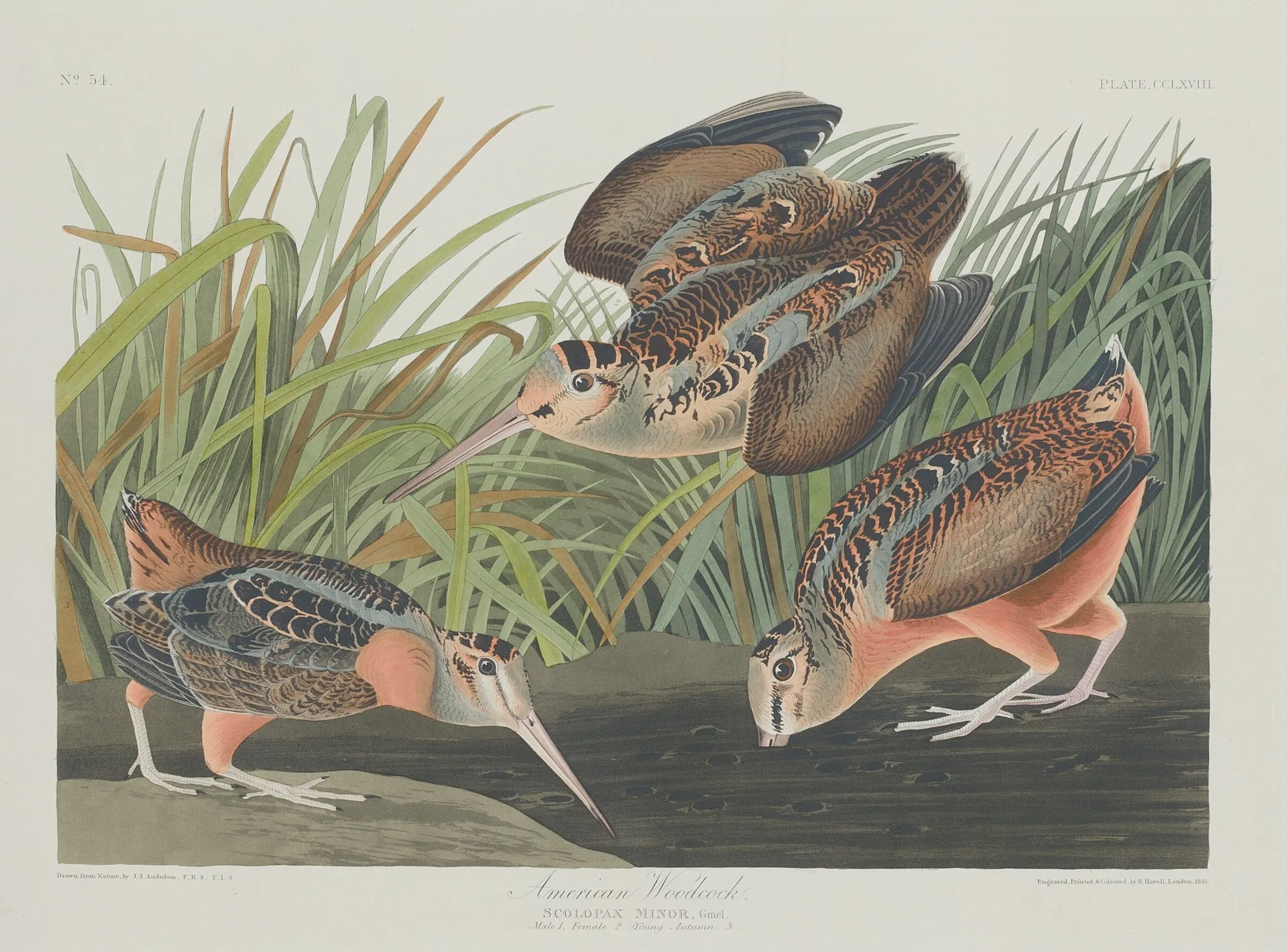
Audubon's “American Woodcock”, The Birds of America, plate CCLXVIII
Click or press Enter to enlarge
Open the full-resolution image (2488 px, National Gallery of Art)
| Plate | 268 (CCLXVIII) |
|---|---|
| Audubon's name | American Woodcock |
| Modern name | American Woodcock |
| Scientific name | Scolopax minor |
| Status | Least Concern |
| Engraved by | Robert Havell, after Audubon's watercolor |
| Date | 1835 |
| Medium | Hand-colored engraving and aquatint on Whatman wove paper |
| Collections | Shorebirds, Rails and Cranes |
| This impression | National Gallery of Art, Washington, 1945.8.268; Gift of Mrs. Walter B. James |
About this plate
Plate 268 shows a male, a female and a young American Woodcock: plump, short-legged birds with long straight bills, large eyes set far back on the head, and leaf-coloured plumage barred across the crown.
Audubon opened the chapter with a scene he had witnessed. A female woodcock lay down in the middle of a road as if dead while her five chicks tried to escape a pack of boys, who had already caught one and were kicking it in the dust. Audubon stepped out of the thicket and put a stop to it. He wrote that the mother does not limp or flutter as many birds do, but moves to and fro with half-open wings, murmuring to hurry her young away. He contrasted the woodcock with the snipe, describing it as gentler and more nocturnal, and recorded that on the sugar and cotton plantations of the South men killed them at night by torchlight.
The scientific name, Scolopax minor, is unchanged. Although it is a sandpiper, the woodcock lives in young forest and damp thickets and probes moist soil for earthworms. Its eyes are placed so that it can see behind as well as in front.
In spring the male performs a twilight sky dance, spiralling high over a clearing with twittering wings and dropping back with a liquid chirping song. The species breeds across eastern North America and winters in the Southeast. It is listed as Least Concern, but its numbers have declined as young forest has matured or been cleared.
In Audubon's words
Regardless of her own danger, she would to all appearance gladly suffer herself to be seized, could she be assured that by such a sacrifice she might ensure the safety of her brood. On an occasion of this kind, I saw a female Woodcock lay herself down on the middle of a road, as if she were dead, while her little ones, five in number, were endeavouring on feeble legs to escape from a pack of naughty boys, who had already caught one of them, and were kicking it over the dust in barbarous sport. The mother might have shared the same fate, had I not happened to issue from the thicket, and interpose in her behalf.
John James Audubon, Ornithological Biography, vol. 3 (1835), “The American Woodcock”. Read the full chapter.