Wilson's Storm-Petrel (Plate 270)
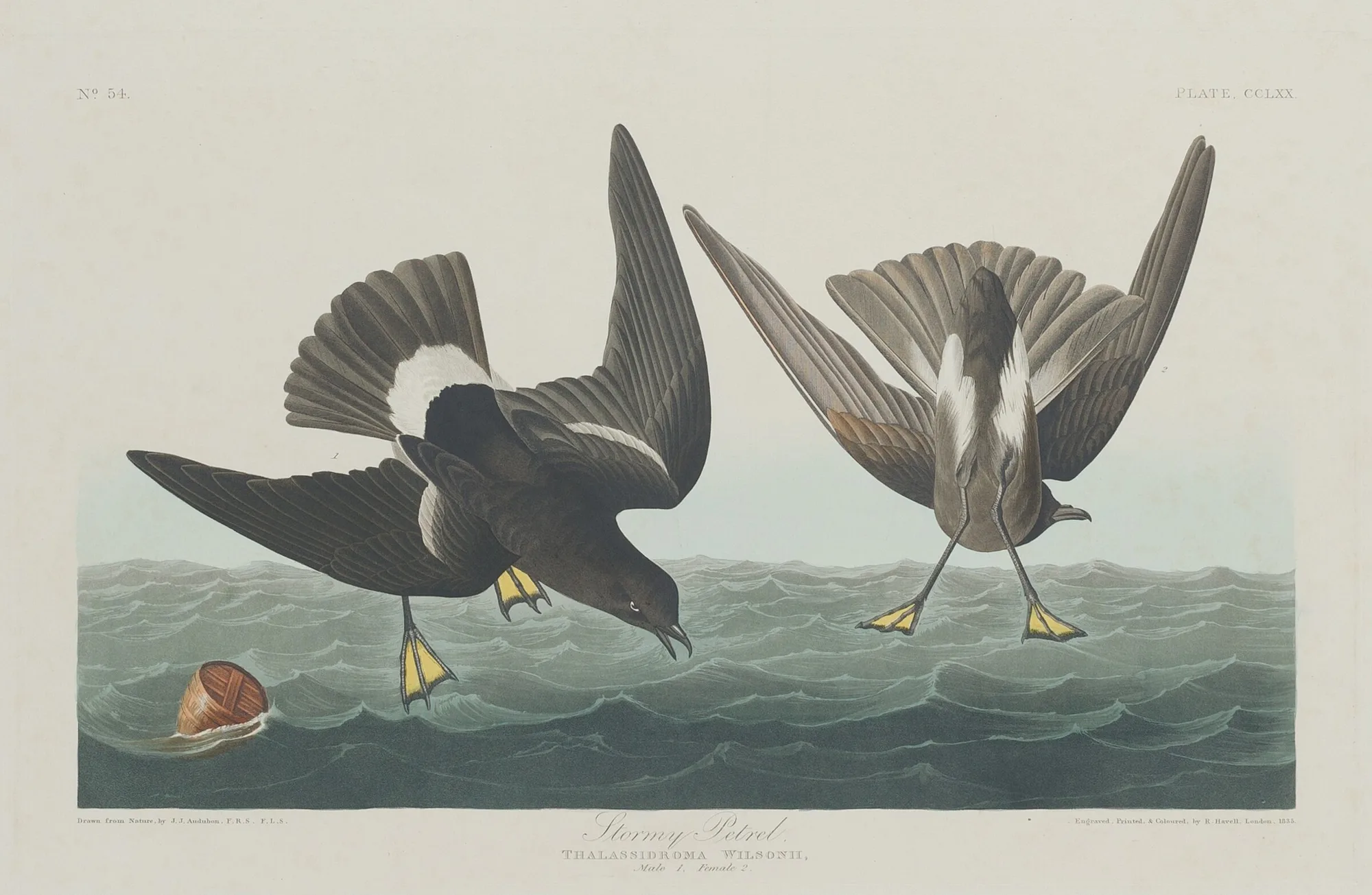
Audubon's “Stormy Petrel”, The Birds of America, plate CCLXX
Click or press Enter to enlarge
Open the full-resolution image (2406 px, National Gallery of Art)
| Plate | 270 (CCLXX) |
|---|---|
| Audubon's name | Stormy Petrel |
| Modern name | Wilson's Storm-Petrel |
| Scientific name | Oceanites oceanicus |
| Status | Least Concern |
| Engraved by | Robert Havell, after Audubon's watercolor |
| Date | 1835 |
| Medium | Hand-colored engraving and aquatint on Whatman wove paper |
| Collections | Seabirds |
| This impression | National Gallery of Art, Washington, 1945.8.270; Gift of Mrs. Walter B. James |
About this plate
Plate 270 is engraved Stormy Petrel, but the Ornithological Biography chapter for it is headed Wilson's Petrel, and the birds are Wilson's Storm-Petrels: a male and female, sooty brown with a bright white rump, short square tail and long legs with yellow-webbed feet. The European Storm-Petrel, the true Stormy Petrel, is a different species.
Audubon began with his own misery at sea. He described staggering on deck at dawn like a newly hatched bird, too seasick to join his fellow passengers, and finding comfort in the little petrels that followed the ship, pattering over the waves and twittering as they found food. He threw scraps over the stern for them and admired how they shared without quarrelling. The chapter then follows them through a gale, feeding on whatever the storm brings to the surface.
Audubon's Thalassidroma wilsonii, named for Alexander Wilson, is now Oceanites oceanicus. When feeding it hovers with its feet dangling and appears to walk on the water, a habit that may have given petrels their name, after Saint Peter.
Wilson's Storm-Petrel nests in burrows and rock crevices in Antarctica and on subantarctic islands and spends the southern winter in the North Atlantic and other northern oceans. It is the storm-petrel most often seen off the eastern United States in summer and is thought to be among the most numerous birds in the world. It is listed as Least Concern.
In Audubon's words
But now, ever flapping its winglets, I have marked the little bird, dusky all over save a single spot, the whiteness of which contrasts with the dark hue of the waters and the deep tone of the clear sky. Full of life and joy it moves to and fro, advances toward the ship, then shoots far away, gambols over the swelling waves, dives into their hollows, and twitters with delight as it perceives an object that will alleviate its hunger. Never fatigued, the tiny Petrels seldom alight, although at times their frail legs and feet seem to touch the crest of the foaming wave. I love to give every creature all the pleasure I can confer upon it, and towards the little things I cast over the stern such objects as I know they will most prize.
John James Audubon, Ornithological Biography, vol. 3 (1835), “Wilson's Petrel”. Read the full chapter.



