Common Greenshank (Plate 269)
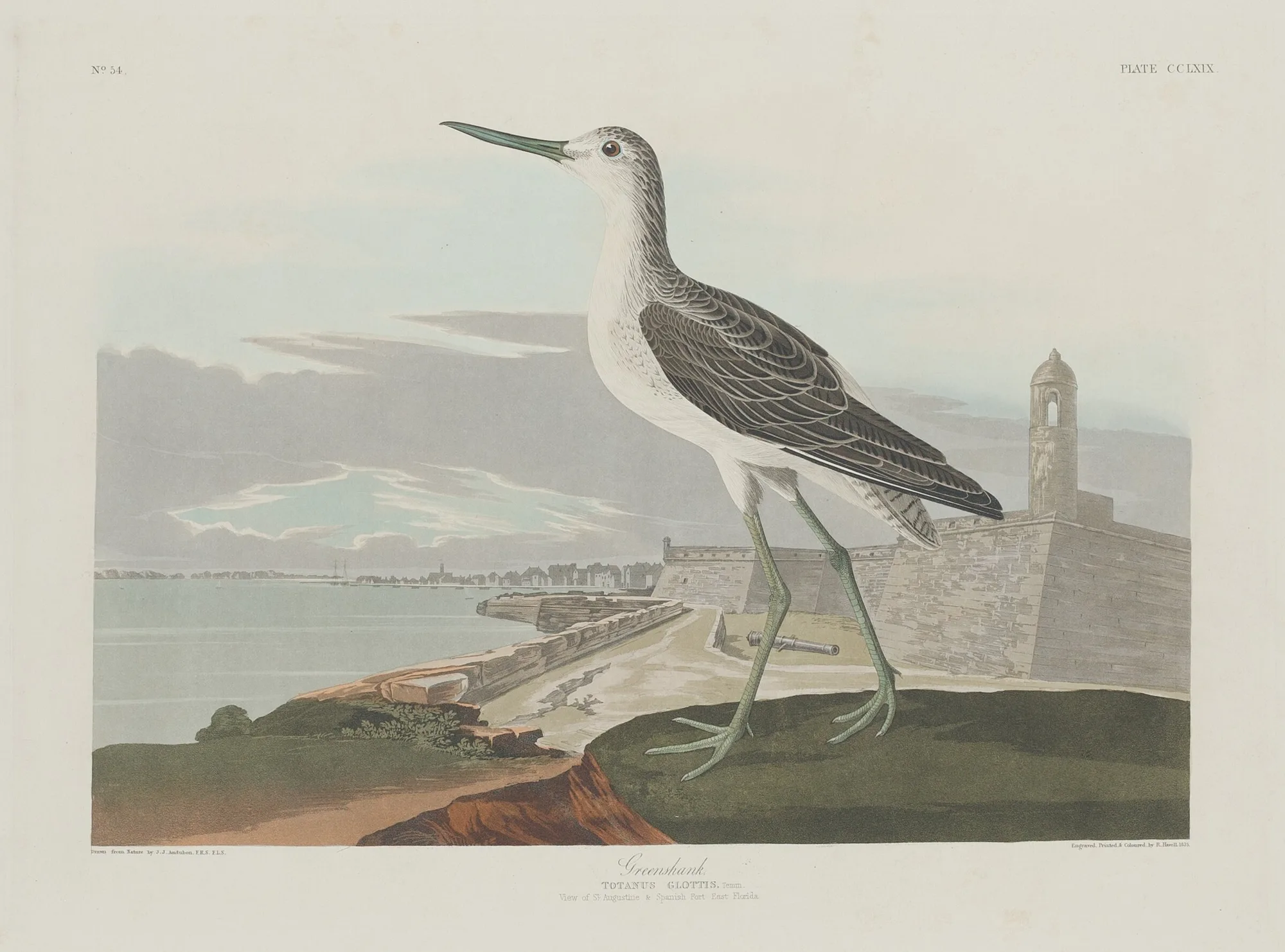
Audubon's “Greenshank”, The Birds of America, plate CCLXIX
Click or press Enter to enlarge
Open the full-resolution image (2538 px, National Gallery of Art)
| Plate | 269 (CCLXIX) |
|---|---|
| Audubon's name | Greenshank |
| Modern name | Common Greenshank |
| Scientific name | Tringa nebularia |
| Status | Least Concern |
| Engraved by | Robert Havell, after Audubon's watercolor |
| Date | 1835 |
| Medium | Hand-colored engraving and aquatint on Whatman wove paper |
| Collections | Shorebirds, Rails and Cranes, Florida and Wading Birds |
| This impression | National Gallery of Art, Washington, 1945.8.269; Gift of Mrs. Walter B. James |
About this plate
Plate 269 shows a male Common Greenshank in summer plumage, a tall grey and white sandpiper with long greenish legs and a long, slightly upturned bill. This is the Greenshank plate; the National Gallery of Art title Greenshank belongs here, not on plate 259, which is the Horned Grebe.
Audubon wrote that on 28 May 1832, on Sand Key about six miles from Cape Sable in Florida, he shot three birds he first took for Greater Yellowlegs, which he called Tell-tale Godwits. His assistant Henry Ward, who knew the European Greenshank, identified them, and Audubon later confirmed this by comparing specimens. All three were males, which surprised him at a season when most birds were nesting. Knowing nothing of the bird's habits, he filled out the chapter with notes from William MacGillivray on Greenshanks in the Outer Hebrides.
Audubon's Totanus glottis is now Tringa nebularia. The species breeds in the boreal zone from Scotland and Scandinavia across Siberia and winters in Africa, southern Asia and Australia.
In North America the Greenshank is a rare vagrant, recorded mainly in western Alaska and occasionally on the Atlantic coast. A group of three in southern Florida would be extraordinary, and later ornithologists have treated Audubon's record with doubt. It is listed as Least Concern.
In Audubon's words
While on Sand Key, which is about six miles distant from Cape Sable of the Floridas, in lat. 24° 57′ north, and 81° 45’ long. west of Greenwich, I shot three birds of this species on the 28th of May 1832. I had at first supposed them to be Tell-tale Godwits, as they walked on the bars and into the shallows much in the same manner, and, on obtaining them, imagined they were new; but on shewing them to my assistant Mr Ward, who was acquainted with the Greenshank of Europe, he pronounced them to be of that species, and I have since ascertained the fact by a comparison of specimens.
John James Audubon, Ornithological Biography, vol. 3 (1835), “The Greenshank”. Read the full chapter.