Magnificent Frigatebird (Plate 271)
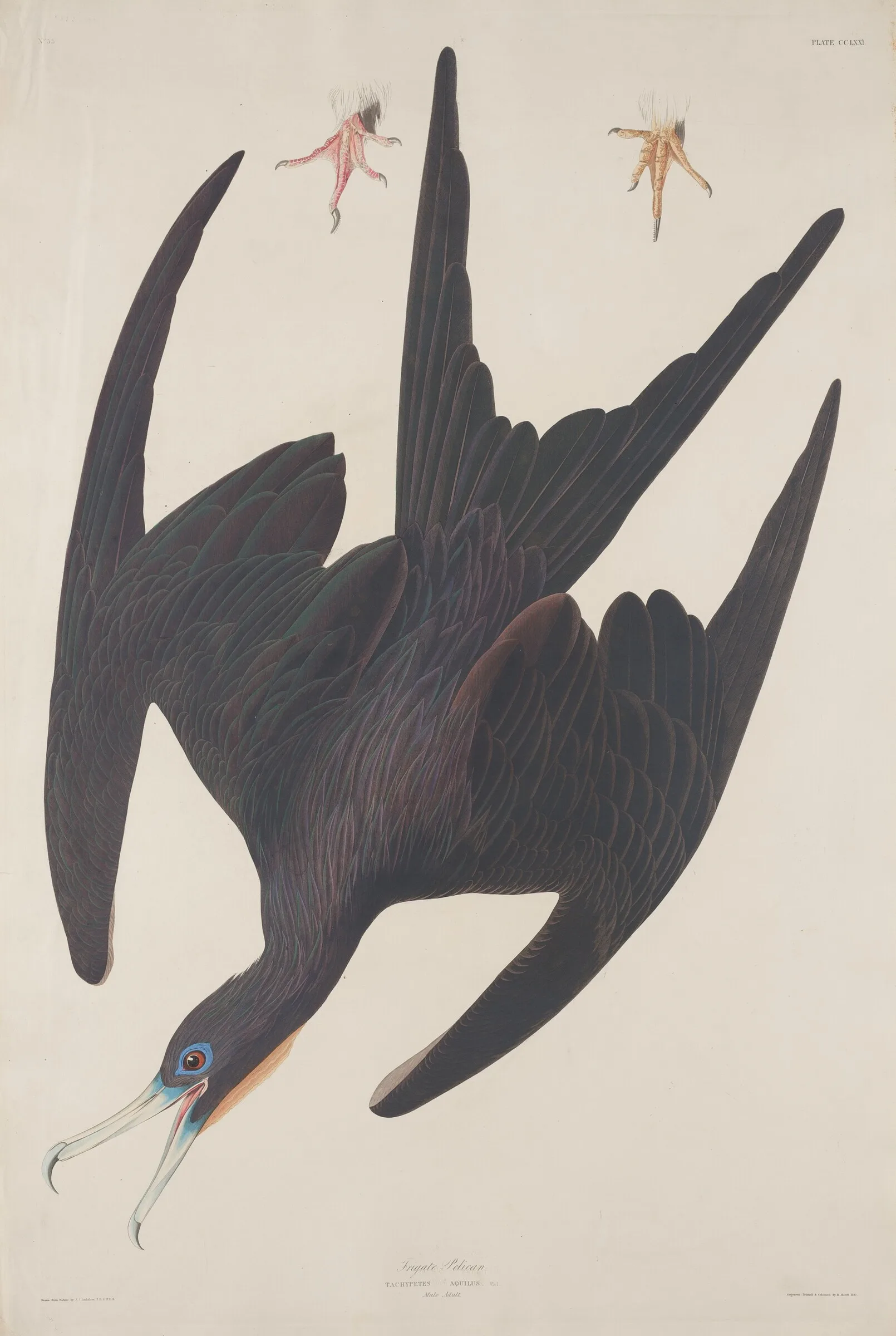
Audubon's “Frigate Pelican”, The Birds of America, plate CCLXXI
Click or press Enter to enlarge
Open the full-resolution image (4674 px, National Gallery of Art)
| Plate | 271 (CCLXXI) |
|---|---|
| Audubon's name | Frigate Pelican |
| Modern name | Magnificent Frigatebird |
| Scientific name | Fregata magnificens |
| Status | Least Concern |
| Engraved by | Robert Havell, after Audubon's watercolor |
| Date | 1835 |
| Medium | Hand-colored engraving and aquatint on Whatman wove paper |
| Collections | Seabirds, Florida and Wading Birds |
| This impression | National Gallery of Art, Washington, 1945.8.271; Gift of Mrs. Walter B. James |
About this plate
Plate 271 shows an adult Magnificent Frigatebird, a long-winged black seabird with a deeply forked tail and a long bill hooked at the tip. The title Frigate Pelican reflects the old placement of the frigatebirds in the pelican genus.
Audubon saw only a few distant frigatebirds on the Gulf of Mexico before his 1832 visit to the Florida Keys. Near Indian Key they became common, and their numbers grew as he went south, though he saw few at the Tortugas. He called them marine vultures: gregarious, lazy and tyrannical, spending the day on the wing and robbing weaker birds. In mid-May he watched flocks of fifty to five hundred pairs courting high over their old nesting islands, then settling in the mangroves to repair nests, stealing sticks from one another and snapping dry twigs from trees in flight.
Audubon's Tachypetes aquilus is now Fregata magnificens. Frigatebirds cannot swim or walk well, and their feathers are not waterproof, so they feed by snatching fish and squid from the surface or by chasing boobies and terns until they drop their catch. In courtship the male inflates a bright red throat pouch like a balloon.
The species ranges over tropical Atlantic and Pacific coasts of the Americas. In the United States the only regular nesting colony is in the Dry Tortugas. It is listed as Least Concern.
In Audubon's words
About the middle of May, a period which to me appeared very late for birds found in so warm a climate as that of the Florida Keys, the Frigate Pelicans assemble in flocks of from fifty to five hundred pairs or more. They are seen flying at a great height over the islands on which they have bred many previous seasons, courting for hours together; after which they return towards the mangroves, alight on them, and at once begin to repair the old nests or construct new ones. They pillage each other’s nests of their materials, and make excursions for more to the nearest keys. They break the dry twigs of trees with ease, passing swiftly on wing, and snapping them off by a single grasp of their powerful bill.
John James Audubon, Ornithological Biography, vol. 3 (1835), “The Frigate Pelican”. Read the full chapter.