Parasitic Jaeger (Plate 272)
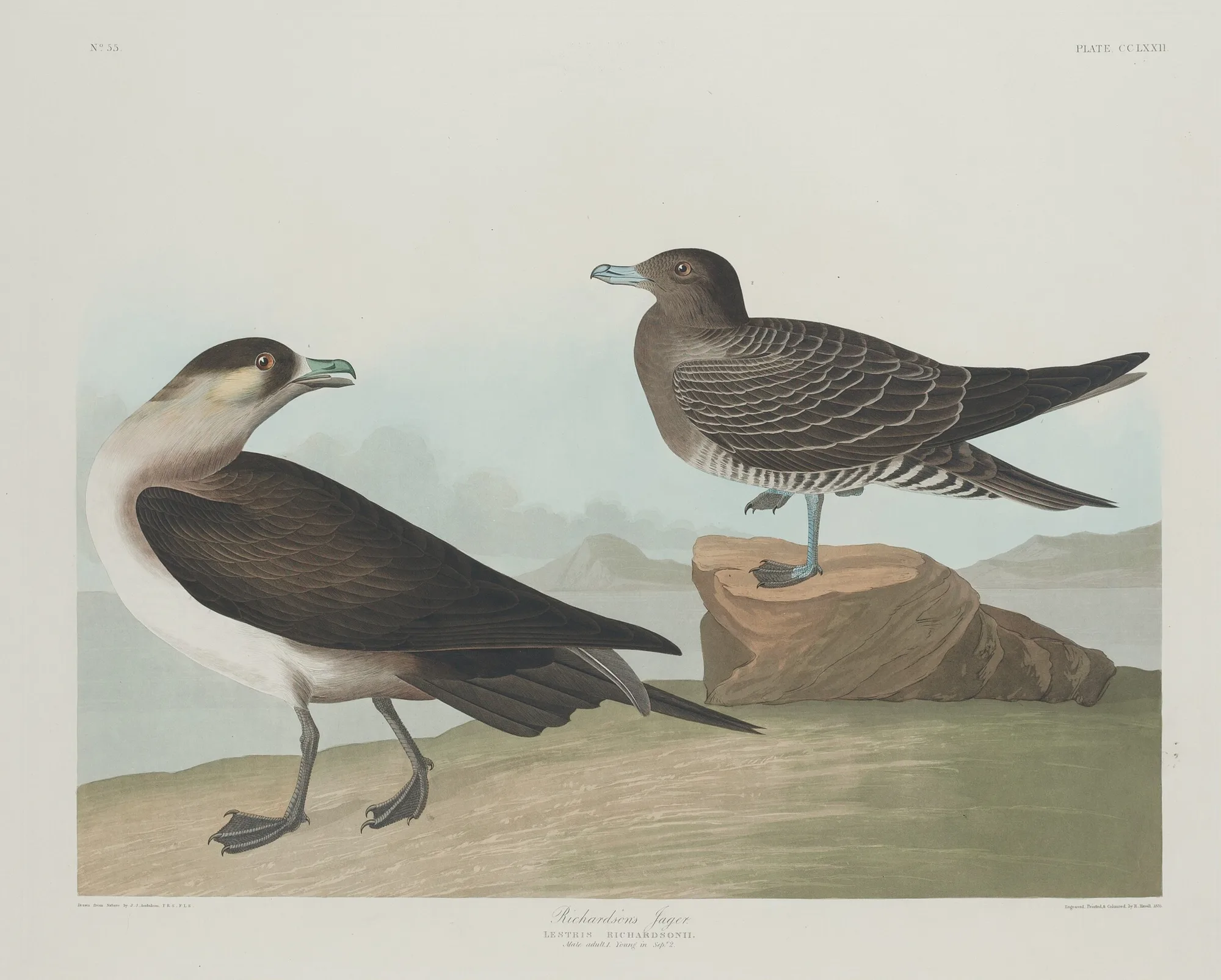
Audubon's “Richardson's Jager”, The Birds of America, plate CCLXXII
Click or press Enter to enlarge
Open the full-resolution image (3209 px, National Gallery of Art)
| Plate | 272 (CCLXXII) |
|---|---|
| Audubon's name | Richardson's Jager |
| Modern name | Parasitic Jaeger |
| Scientific name | Stercorarius parasiticus |
| Status | Least Concern |
| Engraved by | Robert Havell, after Audubon's watercolor |
| Date | 1835 |
| Medium | Hand-colored engraving and aquatint on Whatman wove paper |
| Collections | Seabirds |
| This impression | National Gallery of Art, Washington, 1945.8.272; Gift of Mrs. Walter B. James |
About this plate
Plate 272 shows an adult male in spring and a young bird in September of the jaeger Audubon called Richardson's Jager. The adult is dark, with pointed central tail feathers, and the young bird is brown and barred.
Audubon admitted he knew little of it. He wrote that it was rare on the coast of the United States but visited the bays of Massachusetts and Maine in winter, where it was shyer than the Pomarine Jaeger and, like the others, harried gulls and terns until they gave up their food. He quoted John Richardson that it bred in numbers on the barren grounds of the far north. He described eggs he had obtained, dull greyish-yellow patched with umber. He also wrote that he doubted it was a species distinct from what he called Lestris parasiticus.
His doubt was justified. Richardson's Jager was based on dark-morph birds, and it is now included in the Parasitic Jaeger, Stercorarius parasiticus. This species comes in light, intermediate and dark forms. Audubon's own Arctic Jager in plate 267, which he labelled parasiticus, is usually identified as the Long-tailed Jaeger, so the names in his two plates are in effect reversed.
The Parasitic Jaeger breeds on tundra and moorland around the Arctic, south to northern Scotland, and winters at sea off South America, Africa and Australia. It is the jaeger most often seen from shore in North America. It is listed as Least Concern.
In Audubon's words
This bird, though rare on the coast of the United States, visits the shores of Massachusetts and Maine, where, during winter, it is seen over the bays and inlets, to which various species of Gulls also resort at the same season. It is more shy and difficult to be approached than the Pomarine Jager. Its flight is rapid and greatly protracted; and, like the other species of this genus, it harasses the smaller Gulls and Terns, forcing them to disgorge their food. Dr Richardson informs us that it breeds in considerable numbers in the barren grounds, at a distance from the coast, and that it feeds on testaceous mollusca, which are plentiful in the small lakes of the fur countries.
John James Audubon, Ornithological Biography, vol. 3 (1835), “Richardson's Jager”. Read the full chapter.