Royal Tern (Plate 273)
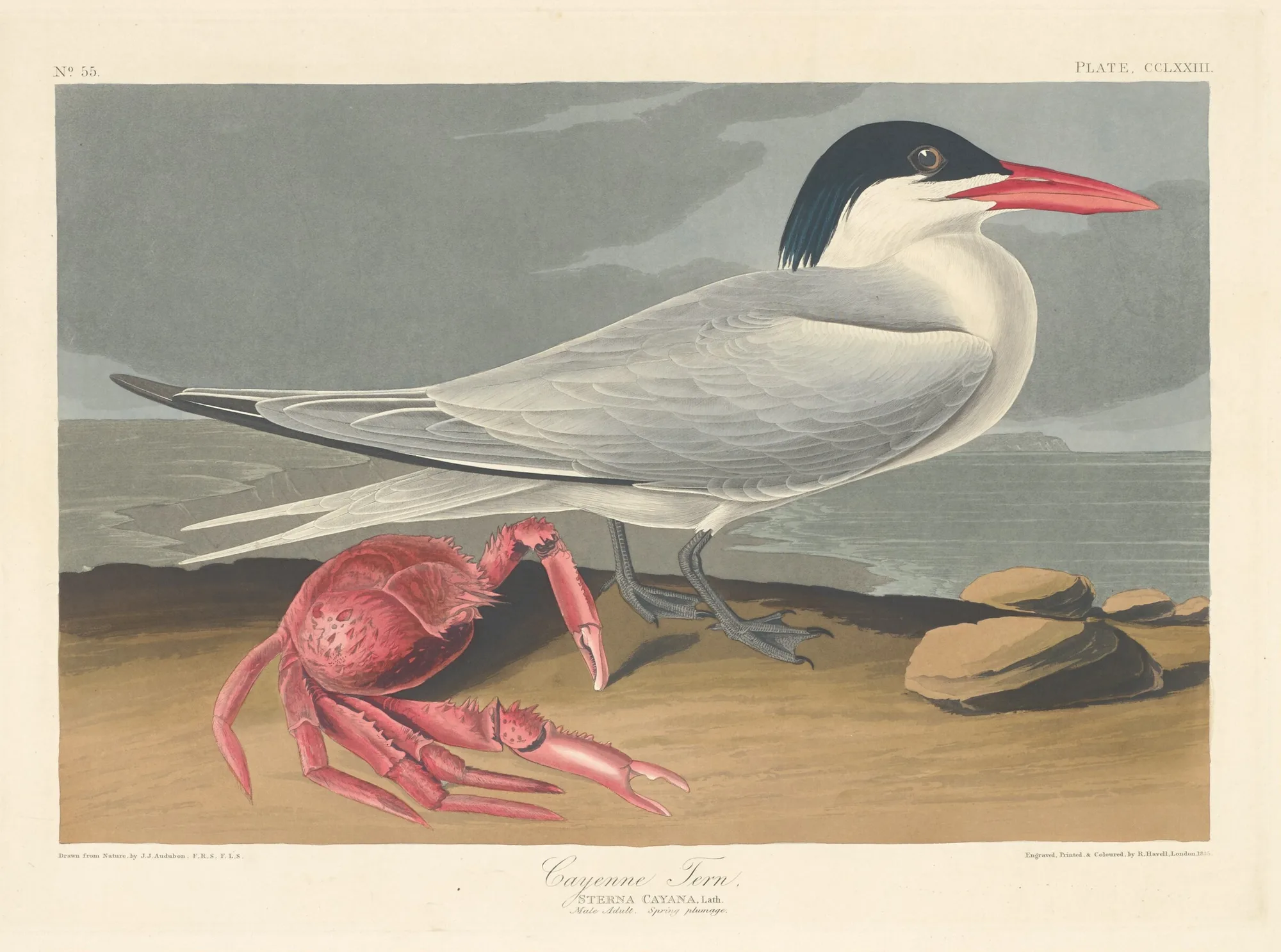
Audubon's “Cayenne Tern”, The Birds of America, plate CCLXXIII
Click or press Enter to enlarge
Open the full-resolution image (2943 px, National Gallery of Art)
| Plate | 273 (CCLXXIII) |
|---|---|
| Audubon's name | Cayenne Tern |
| Modern name | Royal Tern |
| Scientific name | Thalasseus maximus |
| Status | Least Concern |
| Engraved by | Robert Havell, after Audubon's watercolor |
| Date | 1835 |
| Medium | Hand-colored engraving and aquatint on Whatman wove paper |
| Collections | Seabirds, Florida and Wading Birds |
| This impression | National Gallery of Art, Washington, 1945.8.273; Gift of Mrs. Walter B. James |
About this plate
Plate 273 shows a male of the bird Audubon called the Cayenne Tern, now identified as the Royal Tern: a large pale grey and white tern with a shaggy black crest and a thick orange bill.
Audubon described meeting large numbers at the entrance to the harbour of St Augustine in East Florida, and later among the Keys. He was surprised by their shyness and studied them through a glass. At low tide they rested on a sand bar in the channel in parallel lines beside flocks of Black Skimmers, which he called Razor-billed Shearwaters, the two species keeping apart. Only after several days of failure did he send boats toward the bar from several sides. When birds fell, the others dived at the gunners. He noted that large shot was needed for so tough a bird.
Audubon's Sterna cayana is now Thalasseus maximus. The name Cayenne Tern is used today for a yellow-billed form of the Sandwich Tern found in South America, which is a different bird. Audubon called his the largest tern of the Atlantic coast, though the Caspian Tern is larger.
The Royal Tern nests in dense colonies on sandy islands from Maryland to Texas, in the Caribbean and on the coasts of West Africa, and winters south to Argentina. It feeds by plunging for fish just offshore and is a common sight on southern beaches. It is listed as Least Concern.
In Audubon's words
On reaching the entrance of the little port of St Augustine in East Florida, I observed more Cayenne Terns together than I had ever before seen. I had afterwards good opportunities of watching them both during that season and the following, about the Keys. Their shyness surprised me not a little, especially as they are very seldom molested, and it was such that I could study their habits only with the aid of a good glass. I found them at first in great flocks, composed of several hundred individuals, along with Razor-billed Shearwaters, which also congregated there in great numbers. During low water, both species resorted to a large flat sand-bar in the middle of the channel, where they reposed until the return of the tide, sitting close together, in an easy posture, with their heads facing the breeze. They kept separate, however, placing themselves in parallel lines twenty or thirty paces asunder, and either lay flat on the sand, or stood up and plumed themselves.
John James Audubon, Ornithological Biography, vol. 3 (1835), “The Cayenne Tern”. Read the full chapter.