King Eider (Plate 276)
Audubon's “King Duck”, The Birds of America, plate CCLXXVI
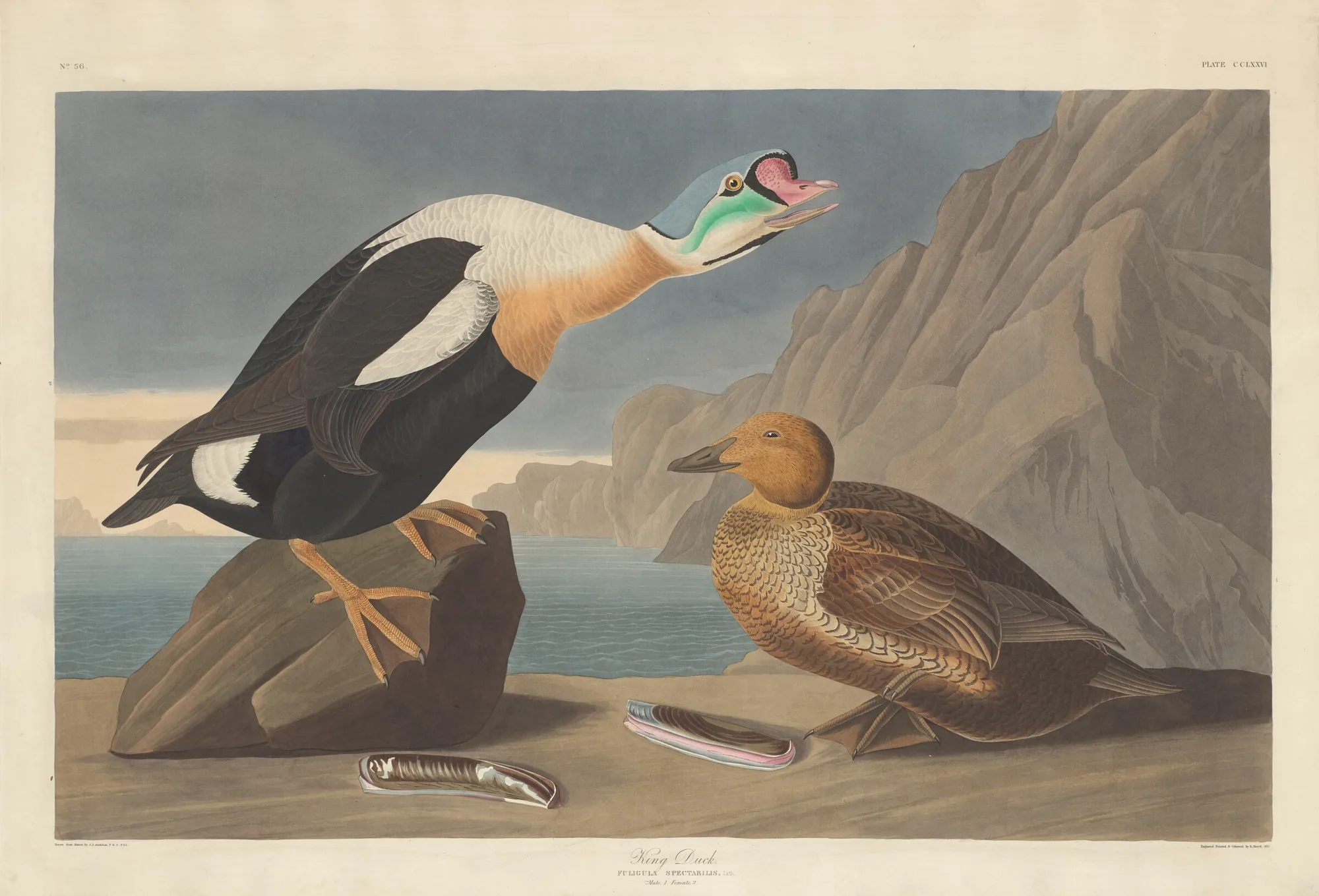
Click or press Enter to enlarge
Open the full-resolution image (5363 px, National Gallery of Art)
| Plate | 276 (CCLXXVI) |
|---|---|
| Audubon's name | King Duck |
| Modern name | King Eider |
| Scientific name | Somateria spectabilis |
| Status | Least Concern |
| Engraved by | Robert Havell, after Audubon's watercolor |
| Date | 1835 |
| Medium | Hand-colored engraving and aquatint on Whatman wove paper |
| Collections | Ducks, Geese and Swans |
| This impression | National Gallery of Art, Washington, 1945.8.276; Gift of Mrs. Walter B. James |
About this plate
Plate 276 shows a pair of King Eiders. The male carries the breeding plumage that gives the bird its name: a pale blue-grey crown and nape, green cheeks, and a swollen orange shield on the forehead above the red bill. The female is a warm, barred brown, plain beside him. The Ornithological Biography chapter is short and says nothing about the setting.
Audubon called it the King Duck and Bonaparte's name, Fuligula spectabilis, placed it with the scaups. Today it is Somateria spectabilis, a close relative of the Common Eider. The forehead shield is a fleshy extension of the bill, and it is larger in the King Eider than in any other eider.
The species breeds on Arctic tundra around the pole, from Alaska and Canada to Greenland and Siberia. It winters at sea at the edge of the ice and in open northern water, in the Bering Sea and the North Atlantic. Flocks can be very large, and the birds dive deep for mollusks and other bottom animals. The IUCN lists it as Least Concern.
Audubon admitted he knew little of its habits. Old gunners told him it had once wintered near Boston and even bred with the eiders on that coast. When he reached Labrador in 1833 most had already moved north. He saw some, found no nests, and took his egg measurements from eggs collected by Captain James Clark Ross.
In Audubon's words
This beautiful species rarely advances farther south along our eastern coast than the neighbourhood of the Bay of Boston. I have, however, been assured by old and trustworthy gunners that the King Duck, about thirty years ago, was by no means of rare occurrence there during winter, and that a few had been known to breed in company with the Eider along the coast. At the period of my arrival at Labrador, the greater number of the King Ducks had proceeded farther north; and although some were seen there, we found none of their nests. I can say nothing of the habits of this bird, which, although they may be similar to those of the Eider, must yet differ in many particulars, as is the case with all birds that are nearly allied in form.
John James Audubon, Ornithological Biography, vol. 3 (1835), “The King Duck”. Read the full chapter.