Brown Noddy (Plate 275)
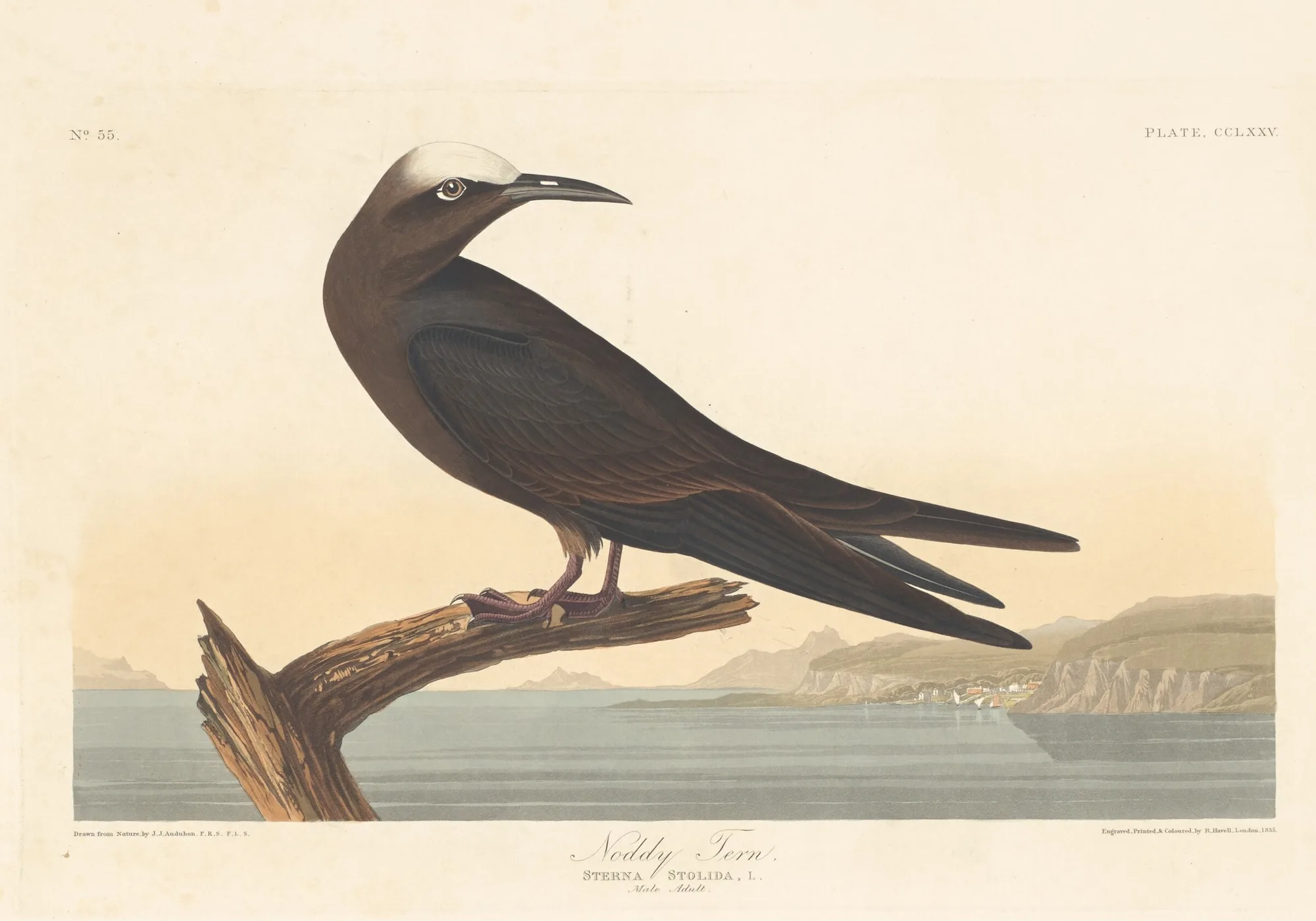
Audubon's “Noddy Tern”, The Birds of America, plate CCLXXV
Click or press Enter to enlarge
Open the full-resolution image (2746 px, National Gallery of Art)
| Plate | 275 (CCLXXV) |
|---|---|
| Audubon's name | Noddy Tern |
| Modern name | Brown Noddy |
| Scientific name | Anous stolidus |
| Status | Least Concern |
| Engraved by | Robert Havell, after Audubon's watercolor |
| Date | 1835 |
| Medium | Hand-colored engraving and aquatint on Whatman wove paper |
| Collections | Seabirds, Florida and Wading Birds |
| This impression | National Gallery of Art, Washington, 1945.8.275; Gift of Mrs. Walter B. James |
About this plate
Plate 275 shows an adult male Brown Noddy, a dark chocolate-brown tern with a pale grey-white forehead and crown, a slender black bill and a wedge-shaped tail.
Audubon visited the noddy colony on one of the Tortugas, which he called Noddy Key, on 11 May 1832. He found the birds building nests of twigs and dry grass in bushes and low trees, never on the ground, some repairing old nests into piles nearly two feet high. They kept working as his party of nine or ten walked through the bushes, and some flew so low that the men caught them by hand. He wrote that the noddies nearly equalled the Sooty Terns, which nested on a nearby island, in number. In his Sooty Tern chapter he gave the pilot's explanation that noddies were so called because they alighted on the yards of vessels at night and slept there.
Audubon's Sterna stolida is now Anous stolidus. The noddies are terns, but unlike most terns they have dark plumage with a pale cap. The name refers to the nodding of their heads during courtship as well as to their reputation for tameness.
The Brown Noddy nests on tropical islands around the world. In the United States it breeds only in the Dry Tortugas, mostly on Bush Key alongside the Sooty Terns, much as Audubon found it. It is listed as Least Concern.
In Audubon's words
On visiting their island on the 11th of May 1832, I was surprised to see that many of them were repairing and augmenting nests that had remained through the winter, while others were employed in constructing new ones, and some were already sitting on their eggs. In a great many instances, the repaired nests formed masses nearly two feet in height, and yet all of them had only a slight hollow for the eggs, broken shells of which were found among the entire ones, as if they had been purposely placed there. The birds did not discontinue their labours, although there were nine or ten of us walking among the bushes, and when we had gone a few yards into the thicket, thousands of them flew quite low over us, some at times coming so close as to enable us to catch a few of them with the hand.
John James Audubon, Ornithological Biography, vol. 3 (1835), “The Noddy Tern”. Read the full chapter.