Cackling Goose (Plate 277)
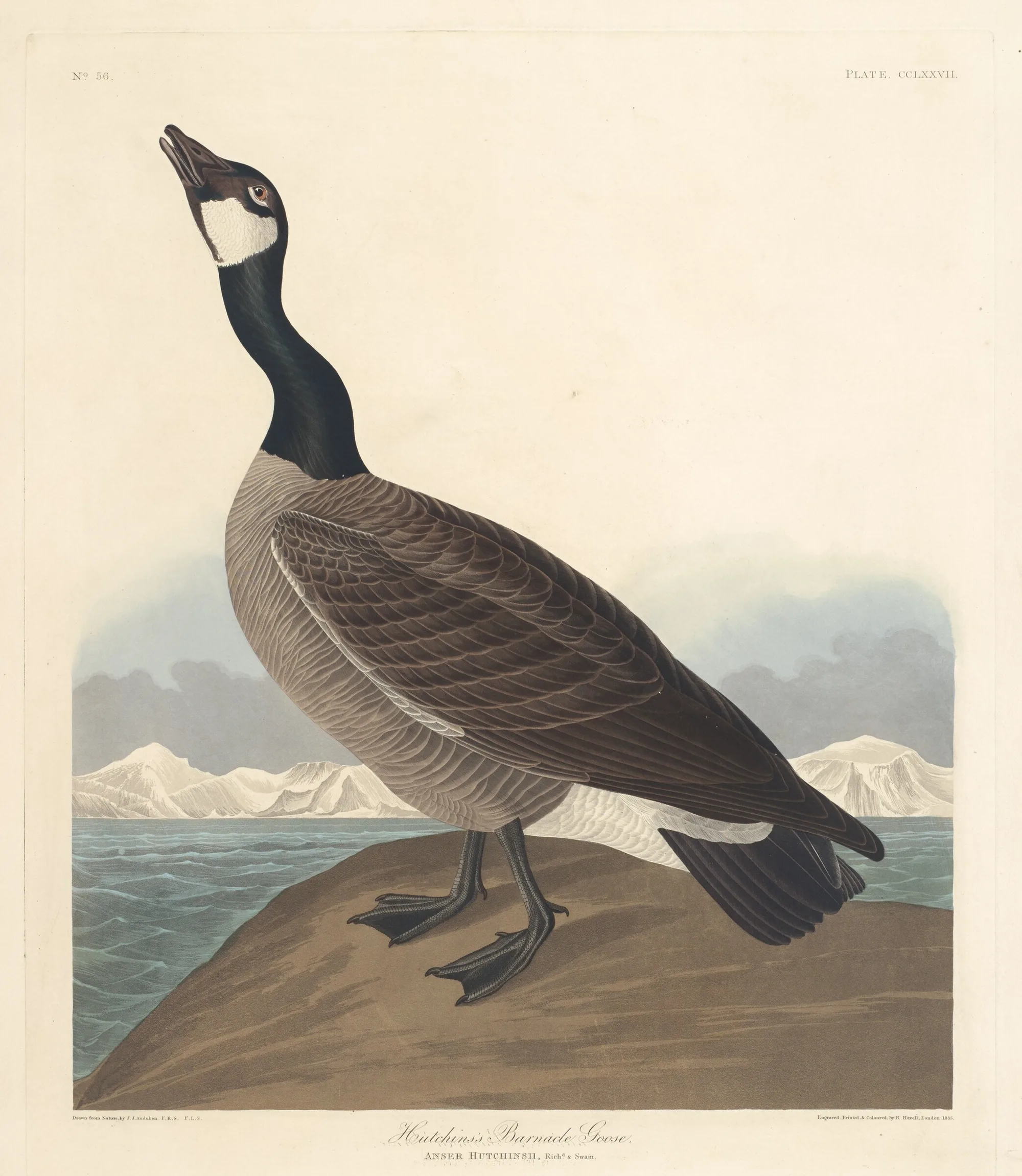
Audubon's “Hutchin's Barnacle Goose”, The Birds of America, plate CCLXXVII
Click or press Enter to enlarge
Open the full-resolution image (3746 px, National Gallery of Art)
| Plate | 277 (CCLXXVII) |
|---|---|
| Audubon's name | Hutchin's Barnacle Goose |
| Modern name | Cackling Goose |
| Scientific name | Branta hutchinsii |
| Status | Least Concern |
| Engraved by | Robert Havell, after Audubon's watercolor |
| Date | 1835 |
| Medium | Hand-colored engraving and aquatint on Whatman wove paper |
| Collections | Ducks, Geese and Swans |
| This impression | National Gallery of Art, Washington, 1945.8.277; Gift of Mrs. Walter B. James |
About this plate
Plate 277 shows one adult goose that looks like a small Canada Goose, with the same black neck and white cheek patch. Audubon believed his figure was the first published picture of the bird. He drew it from a single worn skin given to him by Captain James Clark Ross.
Ross had carried that skin for fifteen months after his uncle John Ross abandoned the ship Victory in the Arctic, until the party was picked up by the whaler Isabella in 1833. Ross's letter, printed in the chapter, says the geese arrived near Felix Harbour in mid-June and nested on rock ledges below cliffs used by Dovekies, gulls and Gyrfalcons. Audubon received the letter in Edinburgh some weeks after he finished the drawing.
Audubon's name honours Thomas Hutchins of the Hudson's Bay Company, and Richardson had named the bird Anser hutchinsii. For most of the twentieth century it was treated as a small race of the Canada Goose. In 2004 the AOU split the small, short-necked tundra forms off as a separate species, the Cackling Goose, Branta hutchinsii, so Audubon's name is now the scientific name of the species.
Cackling Geese breed on Arctic tundra from Alaska to Baffin Island and winter mainly in the western and central United States. They are about the size of a Mallard, with a stubby bill. The IUCN lists the species as Least Concern.
In Audubon's words
These birds arrived in flocks about the middle of June, in the neighbourhood of Felix Harbour, and soon dispersed in pairs to their breeding place. At Igloolik, the only place where we had before met with them, their nests were found in the marshes near the sea; but on this occasion several pairs constructed their nests on a ledge of rock near the foot of a high precipice; immediately above them the Dovekies, Loons, several species of Gulls, and near its summit, the Jer-Falcon and Raven, built their nests. From three to four eggs were found in each nest, of a pure white, and of an oval form, measuring 3.1 inches by 2.1, and weighing from 1800 to 2000 grains.
John James Audubon, Ornithological Biography, vol. 3 (1835), “Hutchins's Goose”. Read the full chapter.