White-rumped Sandpiper (Plate 278)
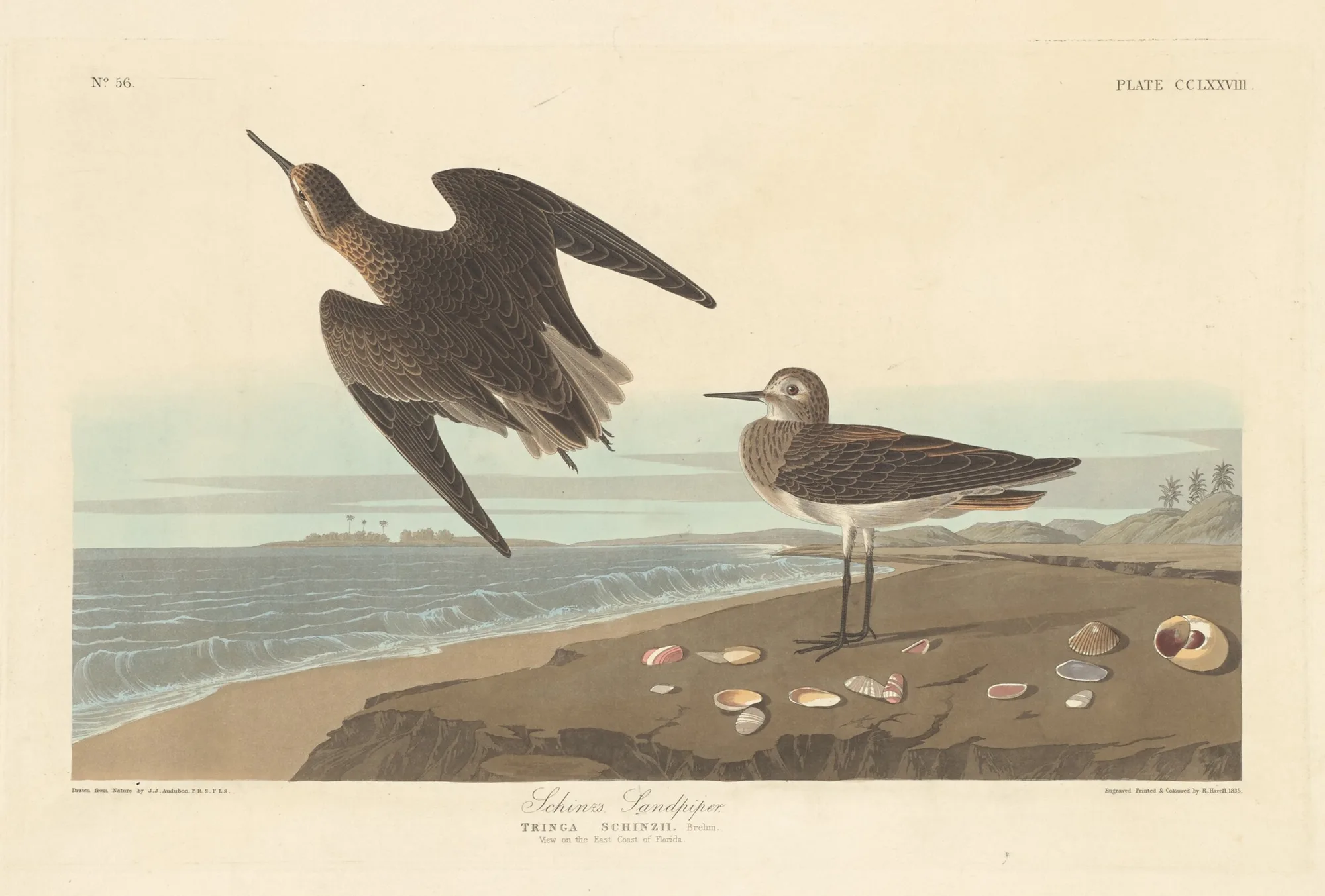
Audubon's “Schinz's Sandpiper”, The Birds of America, plate CCLXXVIII
Click or press Enter to enlarge
Open the full-resolution image (2779 px, National Gallery of Art)
| Plate | 278 (CCLXXVIII) |
|---|---|
| Audubon's name | Schinz's Sandpiper |
| Modern name | White-rumped Sandpiper |
| Scientific name | Calidris fuscicollis |
| Status | Least Concern |
| Engraved by | Robert Havell, after Audubon's watercolor |
| Date | 1835 |
| Medium | Hand-colored engraving and aquatint on Whatman wove paper |
| Collections | Shorebirds, Rails and Cranes, Florida and Wading Birds |
| This impression | National Gallery of Art, Washington, 1945.8.278; Gift of Mrs. Walter B. James |
About this plate
Plate 278 shows two small sandpipers in plain grey winter plumage. Audubon says he drew both at St Augustine in East Florida, where he collected them on 2 December 1831, during his winter stay on the Florida coast.
Audubon followed Bonaparte in calling the bird Tringa schinzii, Schinz's Sandpiper. That name belonged to a European form of the Dunlin, and the American birds were a different species. The plate is now identified as the White-rumped Sandpiper, Calidris fuscicollis. In the field it is told from similar small sandpipers by its long wings, which reach past the tail, and by the white band across the rump that shows in flight.
White-rumped Sandpipers make one of the longest migrations of any American shorebird. They breed on high Arctic tundra in Canada and Alaska and winter mainly in southern South America, as far as Tierra del Fuego. Most pass through the eastern and central United States in spring and autumn. Audubon's statement that he met them only in late autumn and winter fits a bird he saw on passage. The IUCN lists the species as Least Concern.
Audubon wrote that he found this sandpiper gentler and less shy than others of its genus. He met it in Kentucky, along the coast from Florida to Maine and in Labrador, where the birds shot in early August were all young ones about to leave.
In Audubon's words
My drawing of the two individuals represented in the plate was made at St Augustine in East Florida, where I procured them on the 2d December 1831. I have always found these birds gentle and less shy than any other species of the genus. They fly at a considerable height with rapidity, deviating alternately to either side, and plunge toward the ground in a manner somewhat resembling that of the Solitary Sandpiper. When accidentally surprised, they start with a repeated weet, less sonorous than that of the bird just mentioned. They search for food along the margins of pools, creeks and rivers, or by the edges of sand-bars, and mix with other species.
John James Audubon, Ornithological Biography, vol. 3 (1835), “Schinz's Sandpiper”. Read the full chapter.