Black Tern (Plate 280)
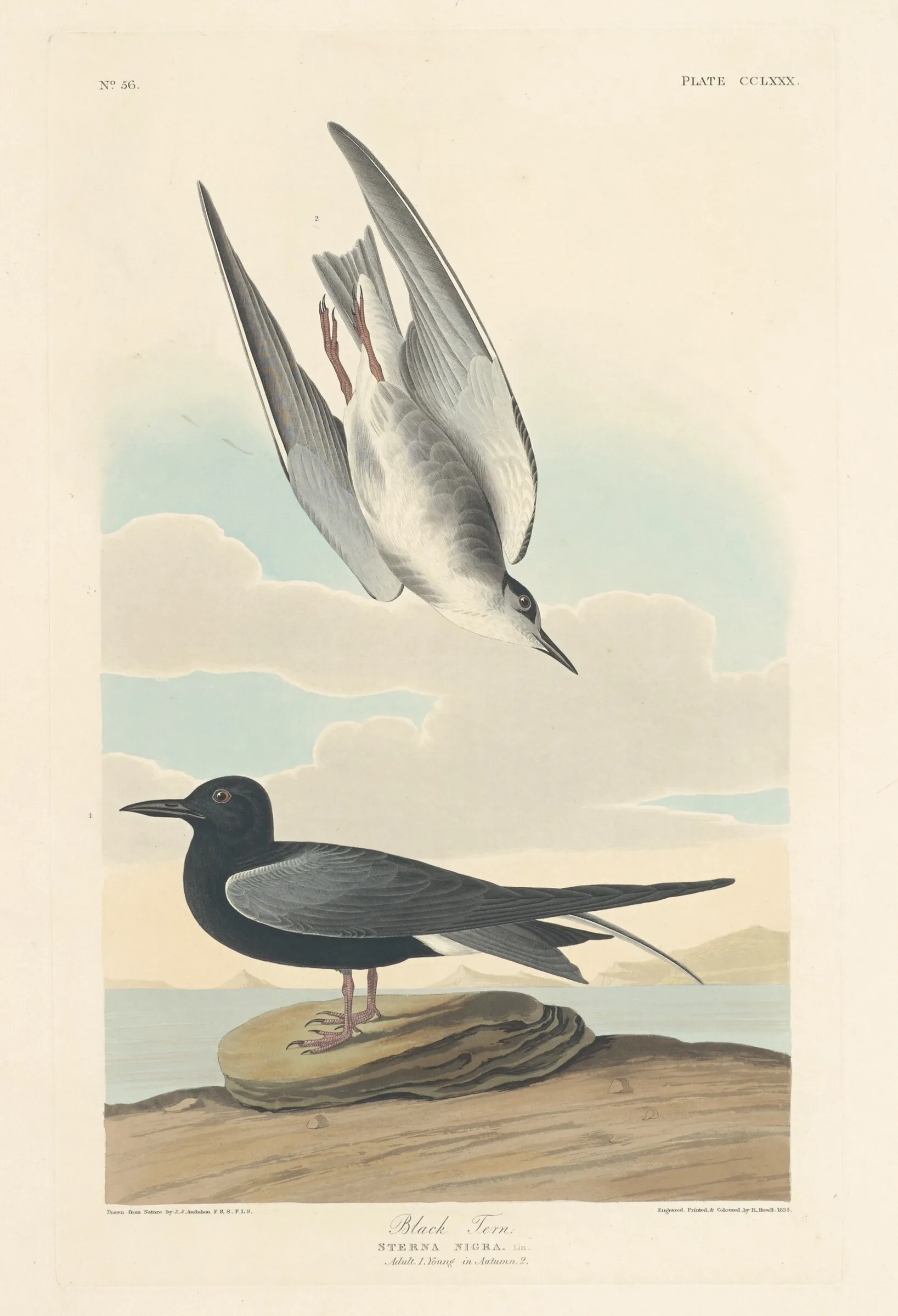
Audubon's “Black Tern”, The Birds of America, plate CCLXXX
Click or press Enter to enlarge
Open the full-resolution image (2928 px, National Gallery of Art)
| Plate | 280 (CCLXXX) |
|---|---|
| Audubon's name | Black Tern |
| Modern name | Black Tern |
| Scientific name | Chlidonias niger |
| Status | Least Concern |
| Engraved by | Robert Havell, after Audubon's watercolor |
| Date | 1835 |
| Medium | Hand-colored engraving and aquatint on Whatman wove paper |
| Collections | Seabirds |
| This impression | National Gallery of Art, Washington, 1945.8.280; Gift of Mrs. Walter B. James |
About this plate
Plate 280 shows an adult male Black Tern in breeding plumage, with a black head and body and grey wings. Beside it is a young bird in its pale first plumage. The two plumages look so different that early writers sometimes treated them as separate birds.
The bird is Chlidonias niger, one of the marsh terns. It nests on inland marshes and ponds rather than on beaches. Its nest is a floating or low mound of wet plants, and it feeds on insects caught in the air as well as small fish. It breeds across the northern United States and southern Canada and in Europe and Asia. The American birds winter along the coasts of northern South America. Numbers in North America have fallen with the loss of marshes, but the IUCN lists it as Least Concern.
Audubon knew it best from his years at Louisville. He watched flocks from the house of his brother-in-law Nicholas Berthoud at Shippingport, flying over the falls of the Ohio in May. He found them nesting on ponds near the river and near Vincennes, Indiana. He counted more than seventy nests around one pond, later called Hope-Distillery Pond. By the 1830s it was mostly drained and surrounded by buildings.
He also recorded that he showed old nests at that pond to Alexander Wilson, who did not know the bird and thought they were the nests of a rail.
In Audubon's words
Often have I watched their graceful light and rapid flight, as they advanced and passed over in groups of twenty, thirty or more, from the delightful residence of my worthy friend and kind relative Nicholas Berthoud, Esq. of Shippingport, during the month of May, when Nature, opening her stores anew, benignly smiled upon the favoured land of Kentucky. The gay birds were seen ranging from the basin at the foot of the rapids to the lower part of the narrow channel which separates Sandy Island from the shore, up the clear stream and down again, plunging at short intervals into the water to seize their prey, and continuing their pleasing occupations through the whole day.
John James Audubon, Ornithological Biography, vol. 3 (1835), “The Black Tern”. Read the full chapter.



