Sandwich Tern (Plate 279)
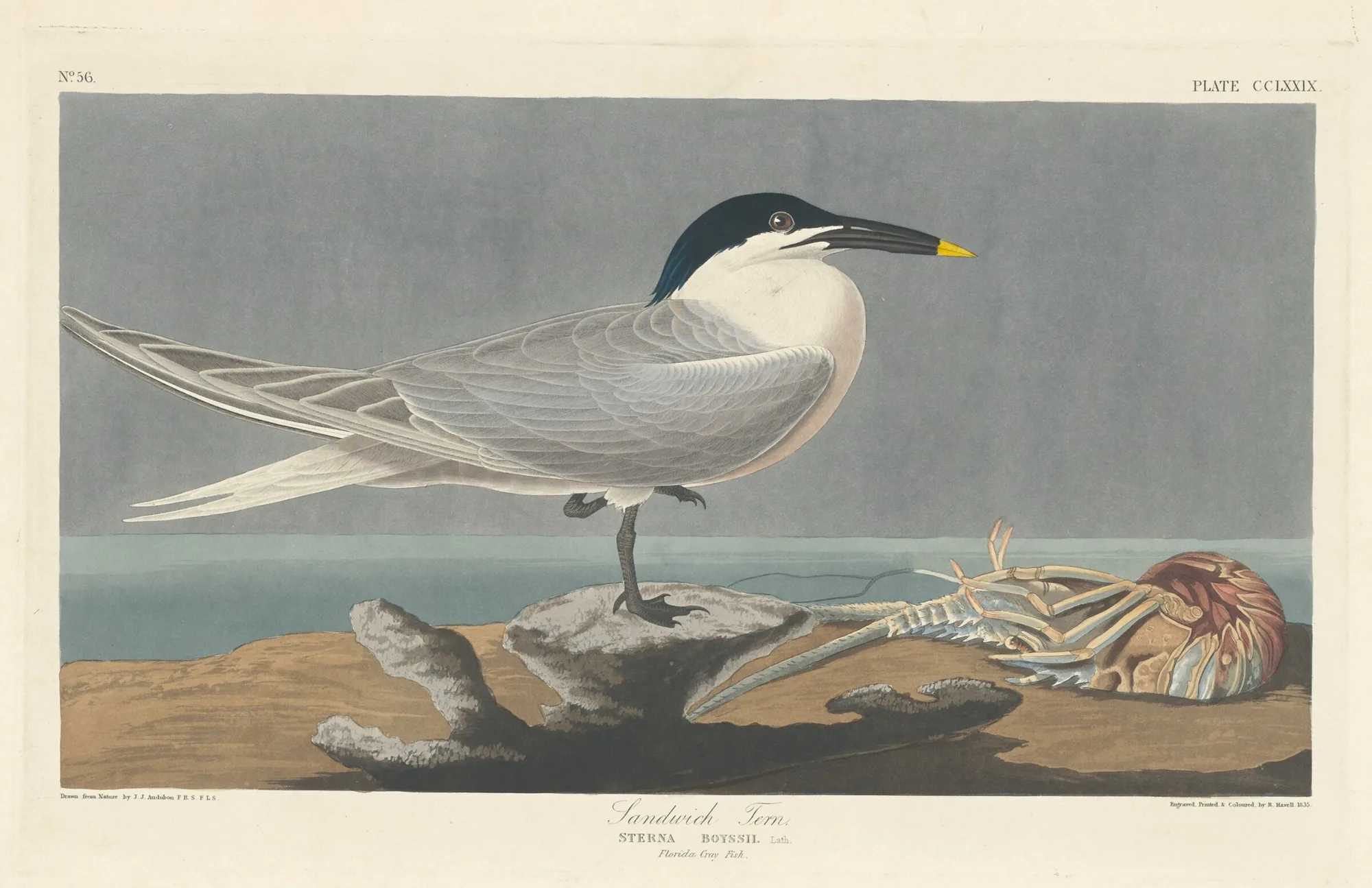
Audubon's “Sandwich Tern”, The Birds of America, plate CCLXXIX
Click or press Enter to enlarge
Open the full-resolution image (2824 px, National Gallery of Art)
| Plate | 279 (CCLXXIX) |
|---|---|
| Audubon's name | Sandwich Tern |
| Modern name | Sandwich Tern |
| Scientific name | Thalasseus sandvicensis |
| Status | Least Concern |
| Engraved by | Robert Havell, after Audubon's watercolor |
| Date | 1835 |
| Medium | Hand-colored engraving and aquatint on Whatman wove paper |
| Collections | Seabirds, Florida and Wading Birds |
| This impression | National Gallery of Art, Washington, 1945.8.279; Gift of Mrs. Walter B. James |
About this plate
Plate 279 shows an adult Sandwich Tern with a young bird. The adult has the shaggy black crest and the long black bill with a yellow tip that Audubon noticed the moment the first bird was picked from the water.
Audubon met the species on 26 May 1832, sailing the Florida Keys in Mr Thruston's barge with the pilot and his assistant. He took the flock at first for Marsh Terns, now Gull-billed Terns, until their flight looked different. The party shot a large basket of birds. He called out that it was a new bird for the American fauna, and wrote that no one before him had found it on that coast. A few days later he found the colony, with eggs laid on bare sand in full sun, three to a nest.
The species is Thalasseus sandvicensis. The AOS keeps the American and European birds in one species. The IOC now separates the American populations as Cabot's Tern, Thalasseus acuflavidus, and Audubon's birds from the Keys would fall there. In the Americas it breeds on sandy islands from Virginia to the Gulf coast and the Caribbean, and winters south to South America. It is a plunge diver that takes small fish. The IUCN lists the Sandwich Tern as Least Concern.
Audubon admired its strength on the wing. He compared its steady wingbeats to a lone Passenger Pigeon in a hurry. He also noted the harsh cries it aims at anyone who walks into a breeding colony.
In Audubon's words
A nod and a wink from the pilot satisfied me that no time should be lost, and in a few minutes all the guns on board were in requisition. The birds fell around us; but as those that had not been injured remained hovering over their dead and dying companions, we continued to shoot until we procured a very considerable number. On examining the first individual picked up from the water, I perceived from the yellow point of its bill that it was different from any that I had previously seen, and accordingly shouted "A prize! a prize! a new bird to the American Fauna!" And so it was, good Reader, for no person before had found the Sandwich Tern on any part of our coast.
John James Audubon, Ornithological Biography, vol. 3 (1835), “The Sandwich Tern”. Read the full chapter.