Great White Heron (Plate 281)
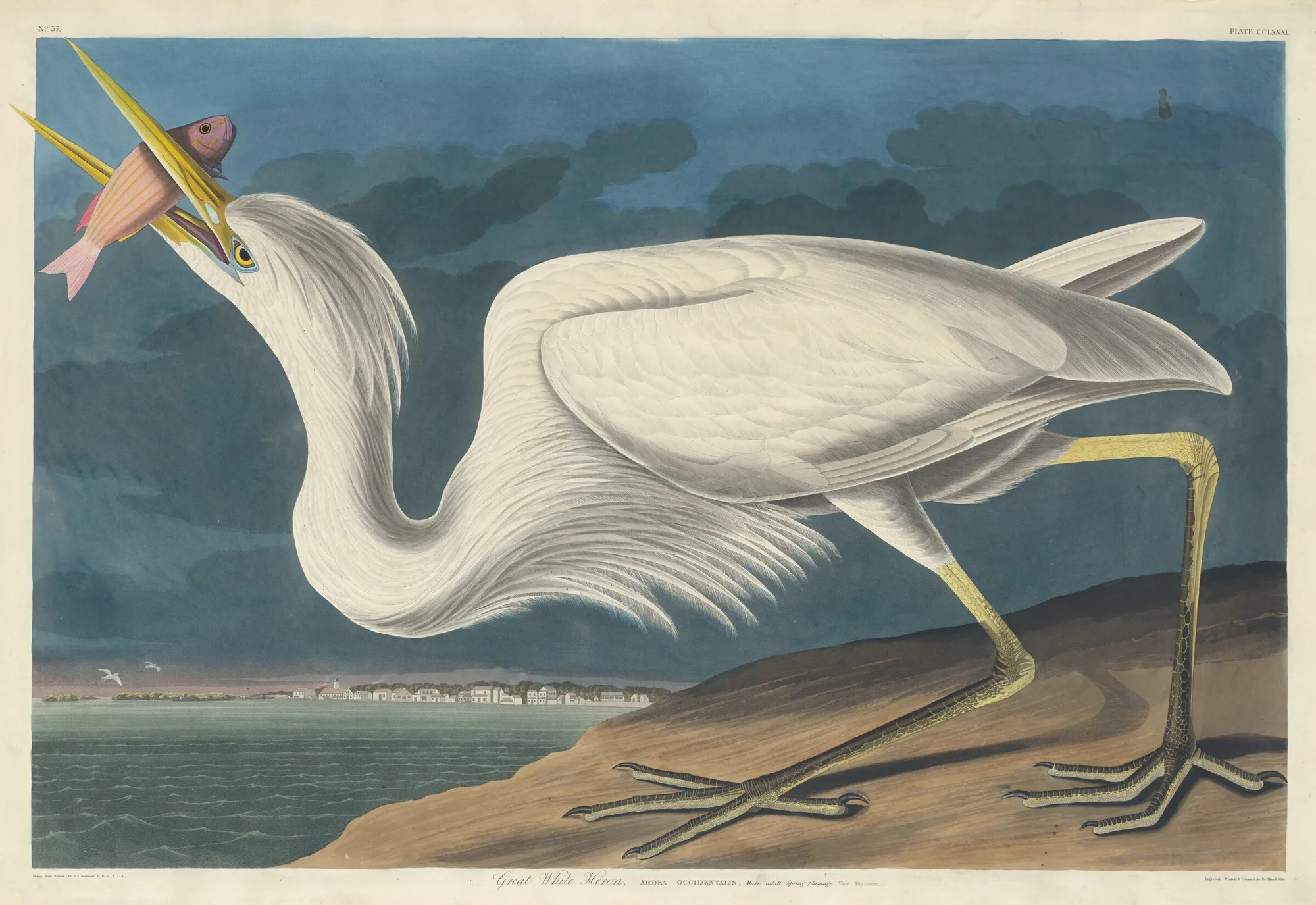
Audubon's “Great White Heron”, The Birds of America, plate CCLXXXI
Click or press Enter to enlarge
Open the full-resolution image (5364 px, National Gallery of Art)
| Plate | 281 (CCLXXXI) |
|---|---|
| Audubon's name | Great White Heron |
| Modern name | Great Blue Heron (white morph, "Great White Heron") |
| Scientific name | Ardea herodias occidentalis |
| Status | Least Concern |
| Engraved by | Robert Havell, after Audubon's watercolor |
| Date | 1835 |
| Medium | Hand-colored engraving and aquatint on Whatman wove paper |
| Size | plate: 65.6 x 97.4 cm (25 13/16 x 38 3/8 in.) sheet: 67.4 x 101 cm (26 9/16 x 39 3/4 in.) |
| Plants and setting | Key West townscape and shoreline in the background |
| Collections | Herons and Egrets, Florida and Wading Birds |
| This impression | National Gallery of Art, Washington, 1945.8.281; Gift of Mrs. Walter B. James |
About this plate
Plate 281 shows one adult Great White Heron at life size, bent low over the water with a fish in its bill. Behind it is a view of Key West, with low buildings along the shore. The background is usually credited to George Lehman, who travelled with Audubon on the 1832 Florida trip.
Audubon called it the largest heron in the United States and pure white at every age. He named it Ardea occidentalis as a new species, against writers who held that no true heron was white. Ornithologists now treat it as a white form of the Great Blue Heron, Ardea herodias, found mainly in the Florida Keys and the Caribbean. Some authorities still debate whether it should be a full species. Birds with mixed traits, once called Würdemann's Heron, occur where the two forms meet.
The white birds live in mangrove keys and shallow flats of Florida Bay and the lower Keys. They nest in mangroves and feed on fish. Hunting cut their numbers badly by the late nineteenth century, and the Great White Heron National Wildlife Refuge was set up in the Keys in 1938 to protect them. The Great Blue Heron as a whole is listed by the IUCN as Least Concern.
The chapter tells how Mr Egan of Indian Key brought Audubon two live young in April 1832. When Audubon's Newfoundland dog Plato came close, the larger chick seized him by the nose. Audubon left them with Mrs Egan, and later hunted adults among the keys from the revenue cutter Marion.
In Audubon's words
The nest with the two live birds was placed in the yard. The young Herons seemed quite unconcerned when a person approached them, although on displaying one's hand to them, they at once endeavoured to strike it with their bill. My Newfoundland dog, a well-trained and most sagacious animal, was whistled for and came up; on which the birds rose partially on their legs, ruffled all their feathers, spread their wings, opened their bills, and clicked their mandibles in great anger, but without attempting to leave the nest. I ordered the dog to go near them, but not to hurt them. They waited until he went within striking distance, when the largest suddenly hit him with its bill, and hung to his nose. Plato, however, took it all in good part, and merely brought the bird towards me, when I seized it by the wings, which made it let go its hold.
John James Audubon, Ornithological Biography, vol. 3 (1835), “The Great White Heron”. Read the full chapter.