Iceland Gull (Plate 282)
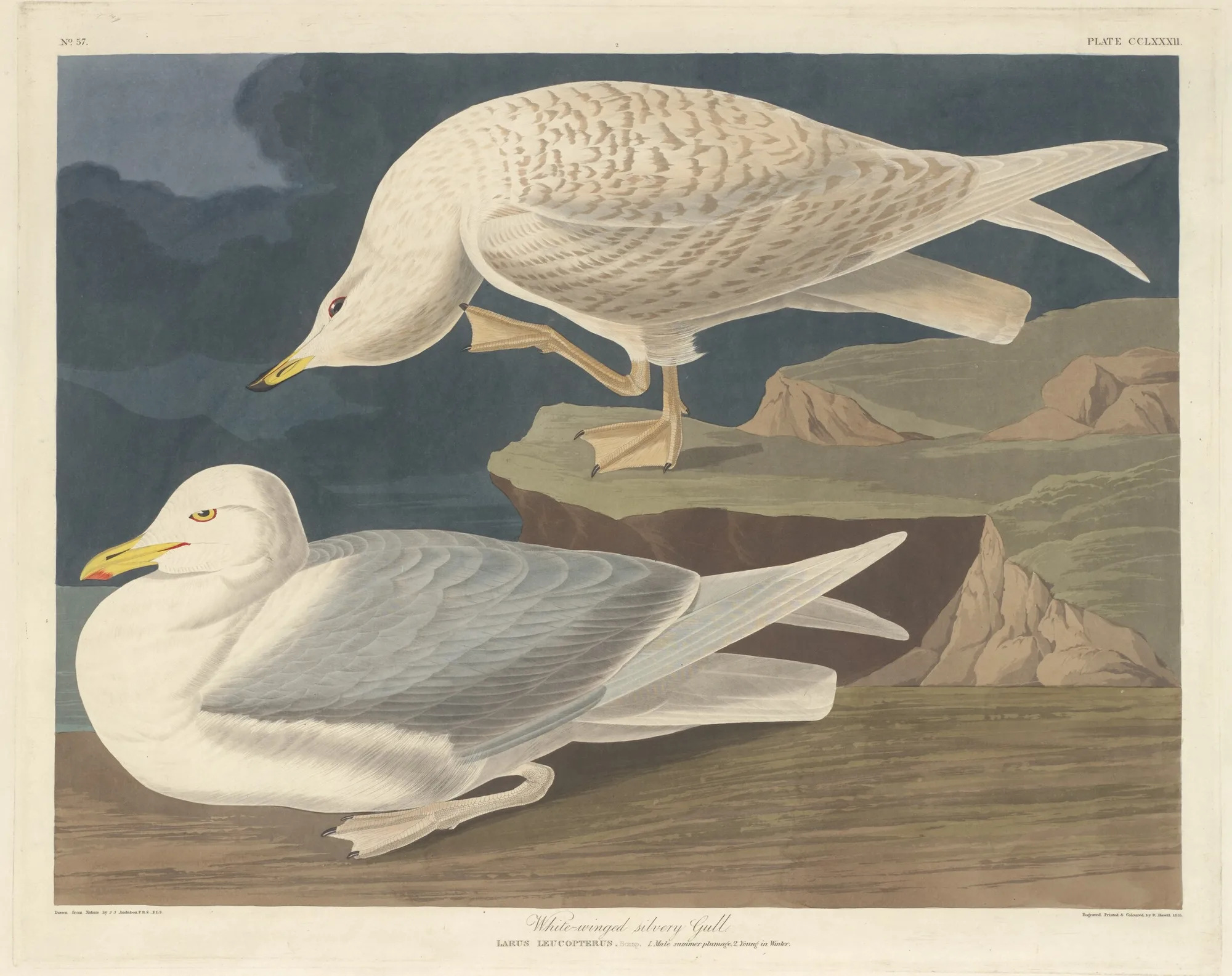
Audubon's “White-winged Silvery Gull”, The Birds of America, plate CCLXXXII
Click or press Enter to enlarge
Open the full-resolution image (3753 px, National Gallery of Art)
| Plate | 282 (CCLXXXII) |
|---|---|
| Audubon's name | White-winged Silvery Gull |
| Modern name | Iceland Gull |
| Scientific name | Larus glaucoides |
| Status | Least Concern |
| Engraved by | Robert Havell, after Audubon's watercolor |
| Date | 1835 |
| Medium | Hand-colored engraving and aquatint on Whatman wove paper |
| Collections | Seabirds |
| This impression | National Gallery of Art, Washington, 1945.8.282; Gift of Mrs. Walter B. James |
About this plate
Plate 282 shows an adult gull with a pale grey back and white wingtips, and a young bird in mottled brown plumage. The figures line names adult males and young. Audubon's notes are short and give no setting.
Audubon used Faber's name Larus leucopterus, the white-winged gull. The bird is now the Iceland Gull, Larus glaucoides. Its lack of black in the wingtips sets it apart from the Herring Gull, which it otherwise resembles. In 2017 the AOS merged Thayer's Gull into the Iceland Gull, so the species now covers a range of forms, from very pale birds in Greenland to darker-winged birds in Arctic Canada. Despite its name it does not breed in Iceland. It only winters there.
Iceland Gulls breed on cliffs in Greenland and the Canadian Arctic. They winter along the North Atlantic coasts, south to New England and the Great Lakes, and along the Pacific coast in the case of the Thayer's form. The IUCN lists the species as Least Concern.
Audubon never found it farther south than New York Bay. He saw it in winter around Boston, and at Portland, Maine, he watched birds picking up garbage in the harbour with Herring Gulls. On the 1833 Labrador voyage he saw only a few and found no nests.
In Audubon's words
The flight of this species so much resembles that of the Herring Gull, that were it not for its smaller size, and the different colour of its wings, it could not be distinguished from the other. It is less shy, however, proceeds farther up the rivers and salt-water creeks, and alights oftener on the water as well as on the salt-meadows, than that species. While at Portland in Maine, I observed a good number of these Gulls flying over the inner harbour close to the shores, descending towards the water, and picking up garbage in the manner of the Herring Gulls, with which they associated. Their notes were not so loud, nor so often heard.
John James Audubon, Ornithological Biography, vol. 3 (1835), “The White-winged Silvery Gull”. Read the full chapter.



