Great Shearwater (Plate 283)
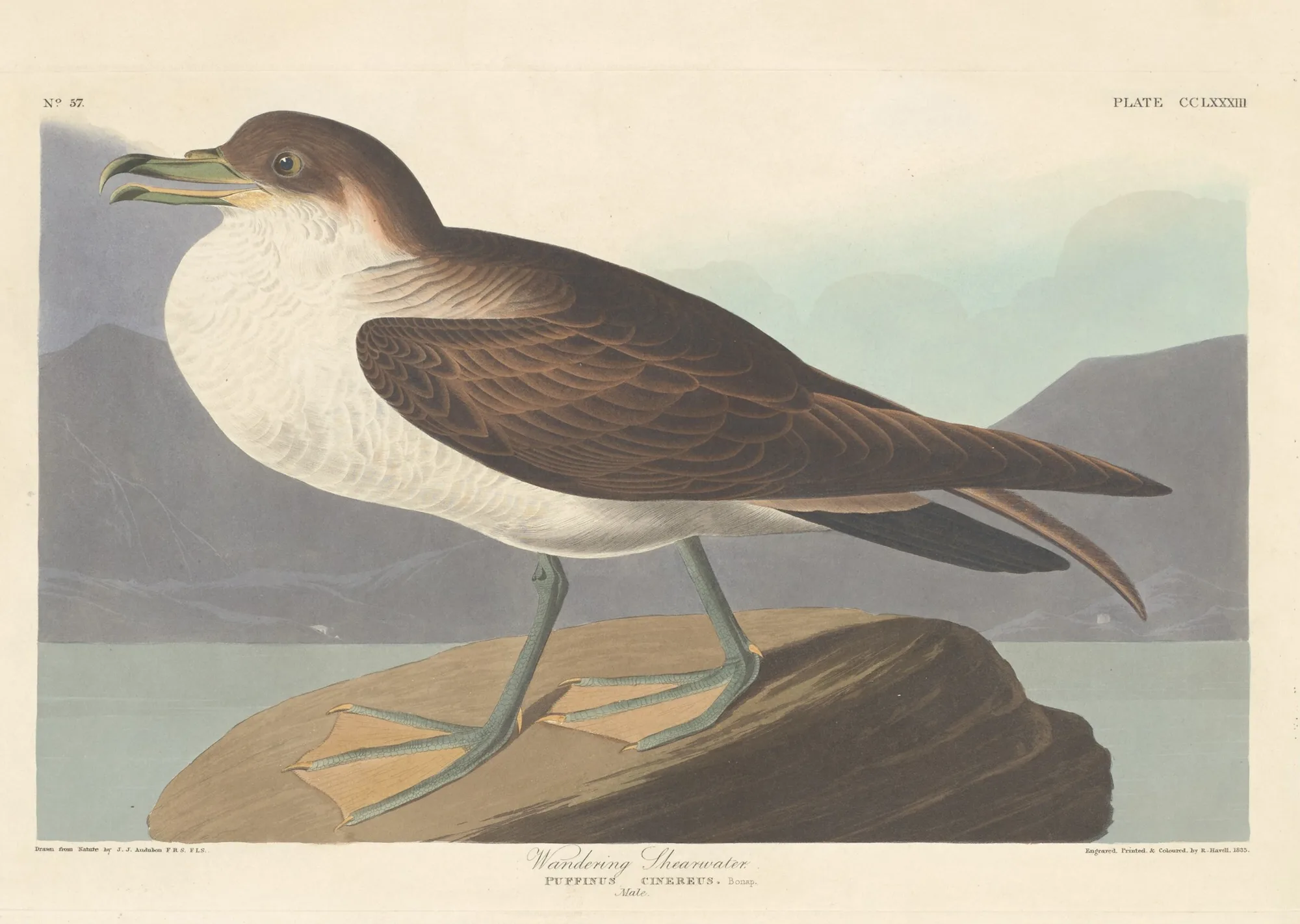
Audubon's “Wandering Shearwater”, The Birds of America, plate CCLXXXIII
Click or press Enter to enlarge
Open the full-resolution image (2724 px, National Gallery of Art)
| Plate | 283 (CCLXXXIII) |
|---|---|
| Audubon's name | Wandering Shearwater |
| Modern name | Great Shearwater |
| Scientific name | Ardenna gravis |
| Status | Least Concern |
| Engraved by | Robert Havell, after Audubon's watercolor |
| Date | 1835 |
| Medium | Hand-colored engraving and aquatint on Whatman wove paper |
| Collections | Seabirds |
| This impression | National Gallery of Art, Washington, 1945.8.283; Gift of Mrs. Walter B. James |
About this plate
Plate 283 shows one male shearwater on the water's edge, dark brown above with a dark cap and white below. Audubon's chapter describes the bird at sea and in the hand but does not describe the setting of the drawing.
Audubon labelled it Puffinus cinereus, a name that has been applied to more than one shearwater. His bird is identified today as the Great Shearwater, Ardenna gravis, formerly Puffinus gravis. Fishermen in the North Atlantic called it the hag or hagdon.
Audubon guessed that the birds he saw leaving the rocky shores of Nova Scotia at dusk in June were breeding there. That was wrong. Great Shearwaters nest almost entirely on Tristan da Cunha and Gough Island in the South Atlantic, in burrows, in the southern summer. After breeding they make a loop migration up the western Atlantic to the waters off Newfoundland and Labrador, then cross east and return south. The June birds Audubon saw were non-breeders on that summer visit. The IUCN lists the species as Least Concern.
The chapter records two birds caught on hooks during the voyage. They walked well, squirted oil from their nostrils when handled, and refused food. When set free they dived and bathed before flying off.
In Audubon's words
In calm weather, they are fond of alighting on the water, in company with the Fulmars, and are then easily approached. They swim buoyantly, and have a graceful appearance while playing among themselves. Two that had been caught with hooks, walked as well as Ducks, and made no pretence of sitting on their rumps, as some writers have said they do. On being approached, they opened their bills, raised their feathers, and squirted an oily substance through their nostrils, which they continued to do when held in the hand, at the same time scratching with their sharp claws and bills. They refused all sorts of food; and as they were unpleasant pets, they were set at liberty. To my great surprise, instead of flying directly off, as I expected, they launched toward the water, dived several yards obliquely, and on coming to the surface, splashed and washed themselves for several minutes before they took to wing, when they flew away with their usual ease and grace.
John James Audubon, Ornithological Biography, vol. 3 (1835), “The Wandering Shearwater”. Read the full chapter.