Purple Sandpiper (Plate 284)
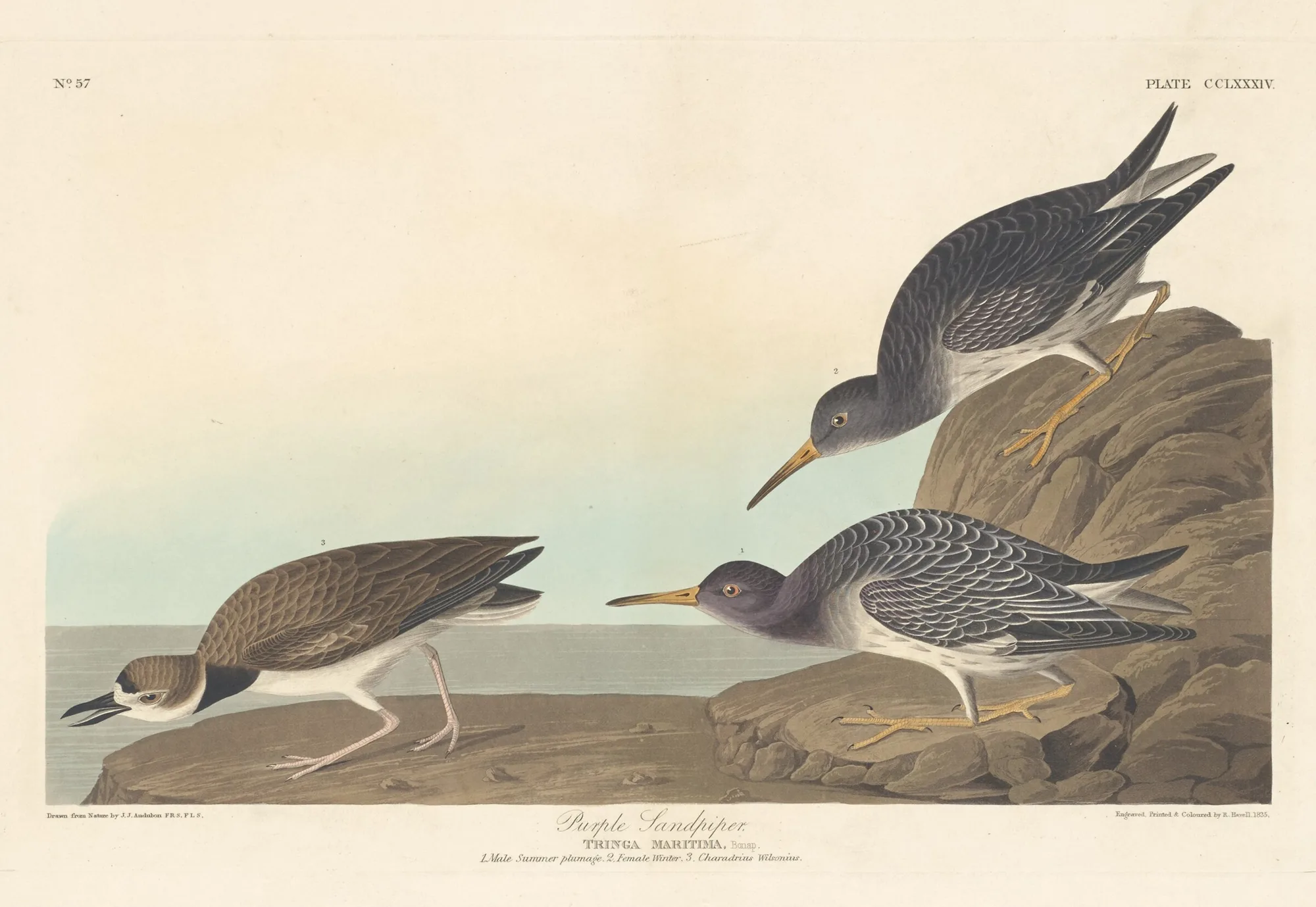
Audubon's “Purple Sandpiper”, The Birds of America, plate CCLXXXIV
Click or press Enter to enlarge
Open the full-resolution image (2782 px, National Gallery of Art)
| Plate | 284 (CCLXXXIV) |
|---|---|
| Audubon's name | Purple Sandpiper |
| Modern name | Purple Sandpiper |
| Scientific name | Calidris maritima |
| Status | Least Concern |
| Engraved by | Robert Havell, after Audubon's watercolor |
| Date | 1835 |
| Medium | Hand-colored engraving and aquatint on Whatman wove paper |
| Collections | Shorebirds, Rails and Cranes |
| This impression | National Gallery of Art, Washington, 1945.8.284; Gift of Mrs. Walter B. James |
About this plate
Plate 284 shows two Purple Sandpipers, one in summer plumage and one in winter. The winter bird is a dark slate grey with orange-yellow at the base of the bill and on the legs. The summer bird is browner and more streaked. The rocky ground fits the bird's strong preference for rock over sand, which Audubon stressed.
The species is Calidris maritima. It keeps its old name, though the purple gloss on the back is faint and seen only in good light. Audubon reported that gunners on the New England coast called it the Rock Snipe. It should not be confused with the Rock Sandpiper of the Pacific, a close relative.
Purple Sandpipers breed on Arctic tundra from northeastern Canada to Greenland, Iceland, Scandinavia and Siberia. They winter farther north than any other American shorebird, on wave-washed rocks, jetties and breakwaters from Newfoundland south to about the Carolinas. There they pick snails, small mussels and crustaceans from seaweed between the waves. The IUCN lists the species as Least Concern.
Audubon disputed Thomas Nuttall's claim that the bird was rare in the United States. In Boston he had a gunner bring him several dozen in one afternoon, and he saw them sold in the markets of Boston and New York. He watched flocks heading north across the Bay of Fundy in May but found none breeding in Labrador.
In Audubon's words
Their flight is pretty rapid, and when necessary sustained, for I have observed them flying in compact bodies across the Gulf of St Lawrence. When started along the shores, they emit a feeble weet, which is repeated two or three times, take a sweep over the water, and return to the same spot or near it, somewhat in the manner of the Spotted Sandpiper. They are generally very busy while searching for food, run nimbly with the body lowered on the legs, which are much bent, go to the edge of the water, seize on small shell-fish, shrimps and worms, and search industriously among the sea-weeds for marine insects. Their marked predilection for rocky shores has caused them to be named "Rock Snipes" by the gunners of our eastern coast. In autumn and winter the young birds become fat, and afford delicate eating.
John James Audubon, Ornithological Biography, vol. 3 (1835), “The Purple Sandpiper”. Read the full chapter.