Lesser Yellowlegs (Plate 288)
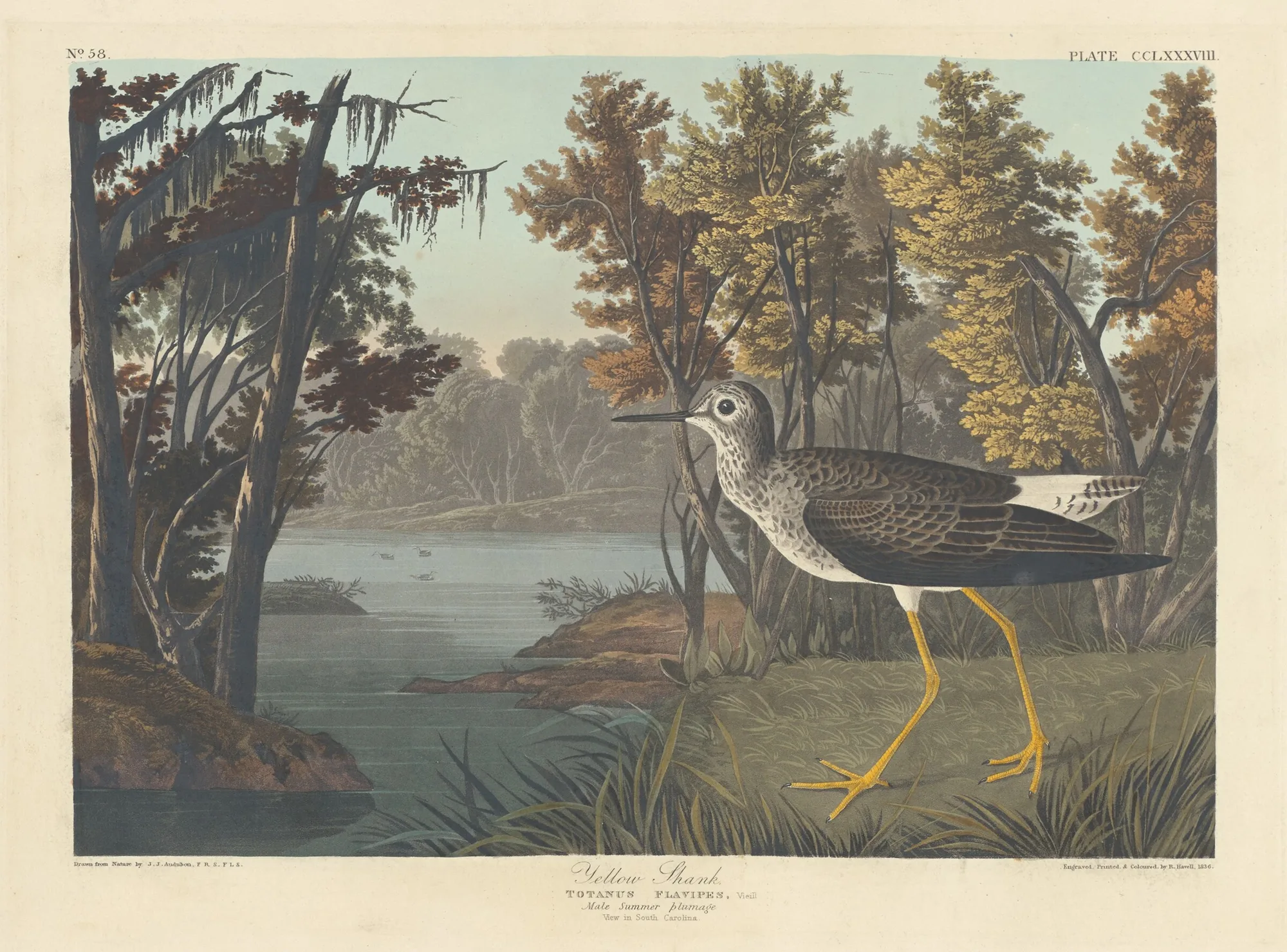
Audubon's “Yellow Shank”, The Birds of America, plate CCLXXXVIII
Click or press Enter to enlarge
Open the full-resolution image (2928 px, National Gallery of Art)
| Plate | 288 (CCLXXXVIII) |
|---|---|
| Audubon's name | Yellow Shank |
| Modern name | Lesser Yellowlegs |
| Scientific name | Tringa flavipes |
| Status | Least Concern |
| Engraved by | Robert Havell, after Audubon's watercolor |
| Date | 1836 |
| Medium | Hand-colored engraving and aquatint on Whatman wove paper |
| Collections | Shorebirds, Rails and Cranes |
| This impression | National Gallery of Art, Washington, 1945.8.288; Gift of Mrs. Walter B. James |
About this plate
Plate 288 shows one male Lesser Yellowlegs, a slender grey-brown sandpiper with a fine straight bill and long, bright yellow legs. Audubon noted that the legs trail behind the tail in flight and are the easiest mark to see.
Audubon's Yellowshank, Totanus flavipes, is now the Lesser Yellowlegs, Tringa flavipes. His Tell-tale Godwit of plate 308 is the Greater Yellowlegs. The two look much alike. The Lesser is smaller, with a shorter bill about as long as its head, and it gives a soft one- or two-note call rather than the ringing three notes of the Greater.
Lesser Yellowlegs breed in open boreal forest and muskeg from Alaska across Canada to Quebec. They winter from the Gulf coast and Mexico to southern South America. On passage they feed in flooded fields, marshes and pond edges across much of North America. Surveys show a large long-term decline, blamed partly on hunting in the Caribbean and South America. The IUCN lists the species as Least Concern.
Audubon met the bird almost everywhere. He saw family flocks on the sand bars of the Ohio, in the rice fields of the Carolinas and on the wet savannahs of Florida. He found a few in Labrador but no nests. He noted that the birds ran, stopped and bobbed their bodies before taking flight, and he did not like their fishy taste.
In Audubon's words
The flight of the Yellowshank is very similar to that of the Tell-tale Godwit. They generally run to some distance before they take to wing, stop as if to discover your intention, vibrate their body backwards and forwards, intimate by their cries the knowledge they have of the nature of the weapon you carry, and, as if convinced that you are bent on mischief, spring up, rise obliquely to some height, emit louder notes, and with continued flappings pass around you, or remove to some distant place. Their long yellow legs, which are stretched out behind, are quite conspicuous when they are on wing. Should you bring one to the ground wounded, it walks off leisurely, vibrates its body, and emits plaintive cries; and should one fall into the water under similar circumstances, it paddles its way towards the nearest shore with considerable speed.
John James Audubon, Ornithological Biography, vol. 3 (1835), “The Yellowshank”. Read the full chapter.



