Dunlin (Plate 290)
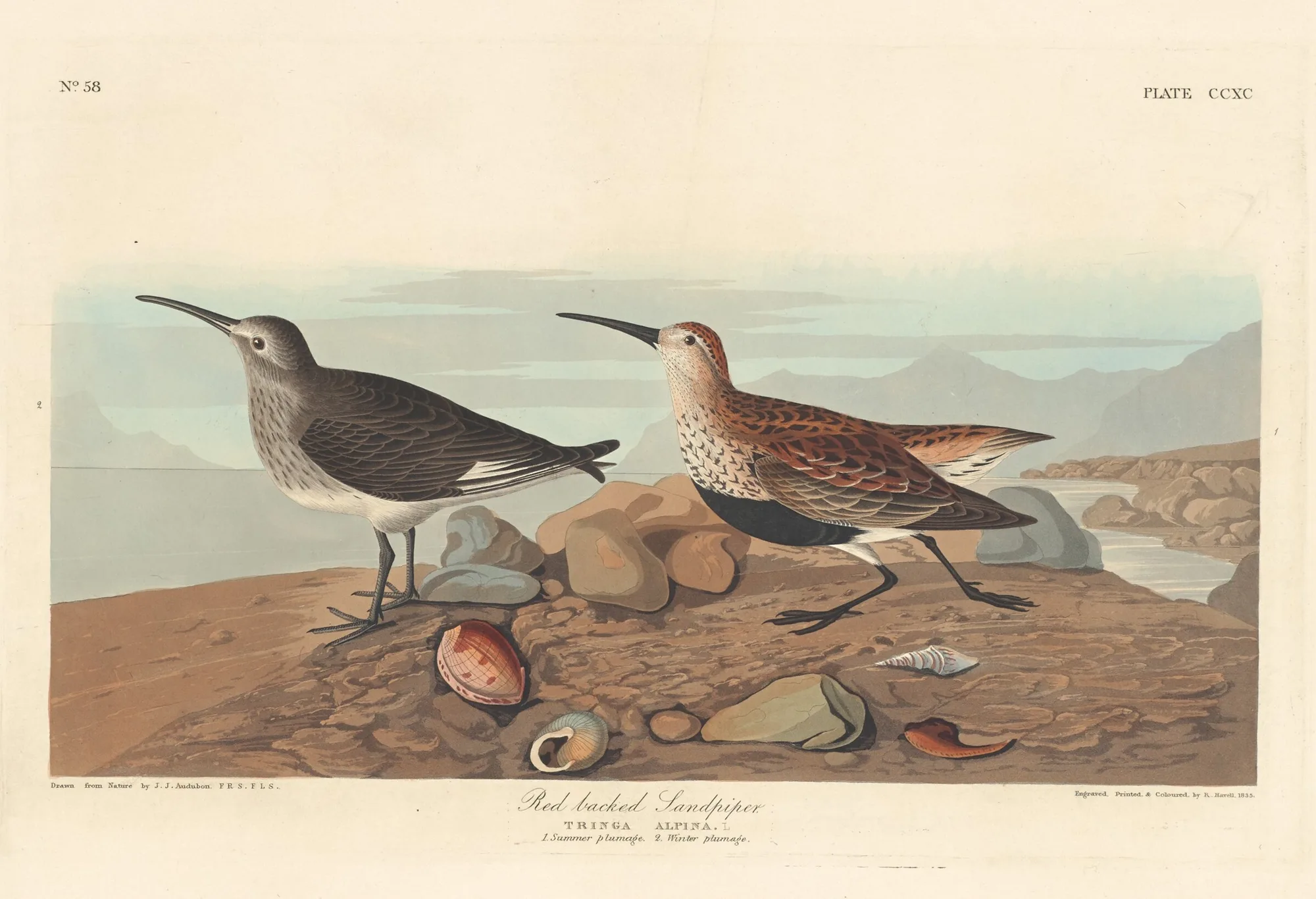
Audubon's “Red-backed Sandpiper”, The Birds of America, plate CCXC
Click or press Enter to enlarge
Open the full-resolution image (2768 px, National Gallery of Art)
| Plate | 290 (CCXC) |
|---|---|
| Audubon's name | Red-backed Sandpiper |
| Modern name | Dunlin |
| Scientific name | Calidris alpina |
| Status | Least Concern |
| Engraved by | Robert Havell, after Audubon's watercolor |
| Date | 1836 |
| Medium | Hand-colored engraving and aquatint on Whatman wove paper |
| Collections | Shorebirds, Rails and Cranes |
| This impression | National Gallery of Art, Washington, 1945.8.290; Gift of Mrs. Walter B. James |
About this plate
Plate 290 shows the Dunlin in its two plumages. The summer male has a rusty red back and a black patch on the belly, which gave Audubon's name, Red-backed Sandpiper. The winter adult is plain grey-brown above and white below. Both have the long bill that droops slightly at the tip.
The bird is Calidris alpina, called the Dunlin in Britain and now in North America too. Audubon's chapter quotes his Scottish collaborator William MacGillivray on its breeding in the Hebrides. There it was called the Purre and was known as the Plover's Page for its habit of following Golden Plovers on the moors.
Dunlins breed on wet Arctic and sub-Arctic tundra around the world. Several races are recognized, and the North American breeders winter along both coasts of the United States and Mexico. Flocks of thousands wheel and turn together over mudflats in winter, flashing white and dark as they turn. The IUCN lists the species as Least Concern.
Audubon found it abundant along the coast from Maine to the Mississippi in autumn and winter but never far inland. In Florida his party shot many for the table. He noted that males in spring raise their wings and run a few steps, then nod to a female, and that the females took no notice.
In Audubon's words
There seems to be a kind of impatience in this bird that prevents it from remaining any length of time in the same place, and you may see it scarcely alighted on a sand-bar, fly off without any apparent reason to another, where it settles, runs for a few moments, and again starts off on wing. When searching for food they run with great agility, following the retiring waves, and retreating as they advance, probing the wet sands, and picking up objects from their surface, ever jerking up the tail, and now and then uttering a faint cry, pleasant to the ear, and differing from the kind of scream which they emit while on wing.
John James Audubon, Ornithological Biography, vol. 3 (1835), “The Red-backed Sandpiper”. Read the full chapter.



