Pectoral Sandpiper (Plate 294)
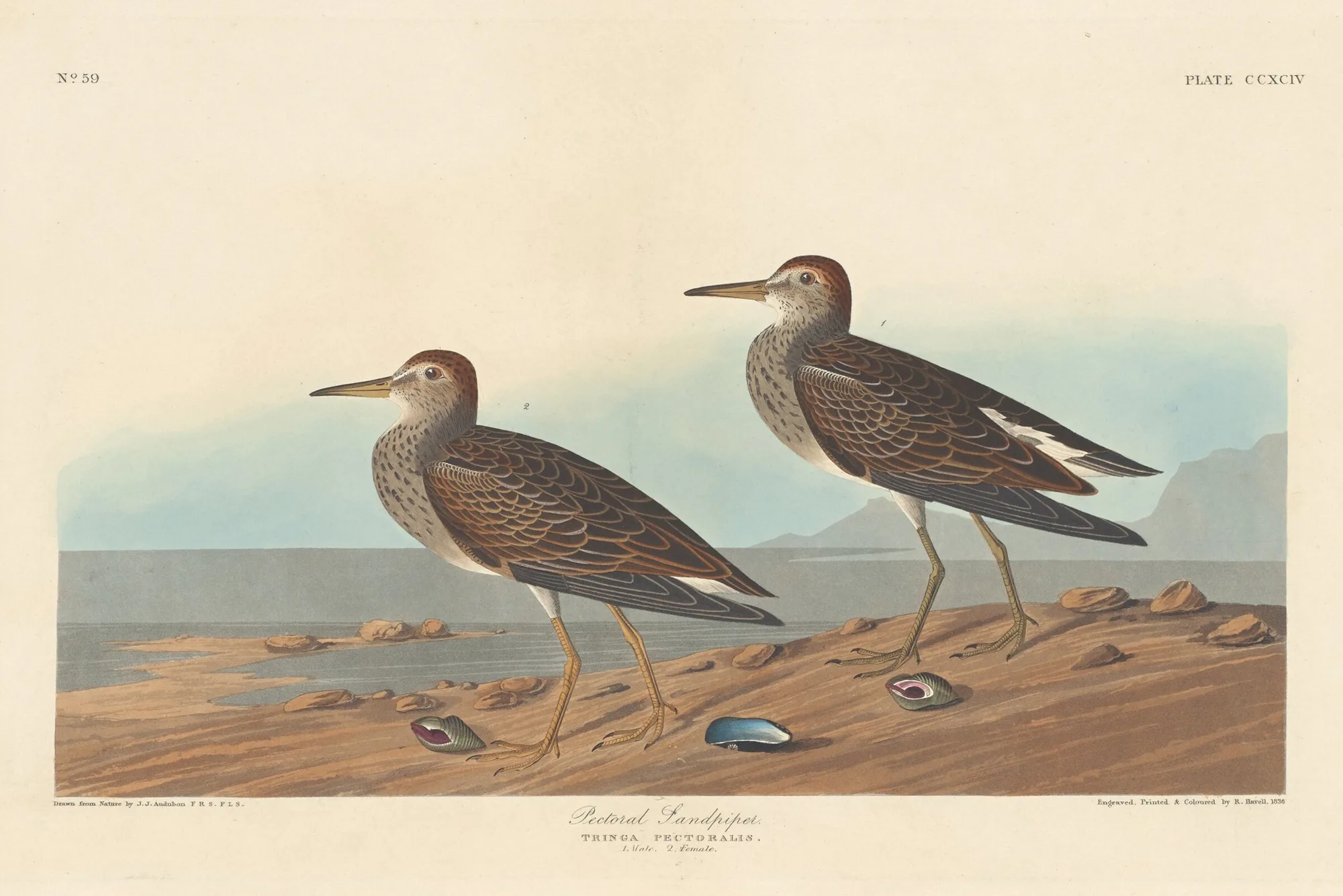
Audubon's “Pectoral Sandpiper”, The Birds of America, plate CCXCIV
Click or press Enter to enlarge
Open the full-resolution image (2722 px, National Gallery of Art)
| Plate | 294 (CCXCIV) |
|---|---|
| Audubon's name | Pectoral Sandpiper |
| Modern name | Pectoral Sandpiper |
| Scientific name | Calidris melanotos |
| Status | Least Concern |
| Engraved by | Robert Havell, after Audubon's watercolor |
| Date | 1836 |
| Medium | Hand-colored engraving and aquatint on Whatman wove paper |
| Collections | Shorebirds, Rails and Cranes |
| This impression | National Gallery of Art, Washington, 1945.8.294; Gift of Mrs. Walter B. James |
About this plate
Plate 294 shows a male and female Pectoral Sandpiper. Both have a brown, streaked breast that ends in a sharp line against the white belly, the mark that gives the bird its name. The male is the larger, and in the breeding season it can inflate an air sac in its breast.
Audubon used Bonaparte's name, Tringa pectoralis. The modern name is Calidris melanotos. Audubon wrote that its breeding grounds and its changes of plumage were unknown. It is now known to breed on wet Arctic tundra in Alaska, northern Canada and Siberia. There the males perform hooting display flights and mate with several females.
Pectoral Sandpipers winter in southern South America, mainly in Argentina, Chile and Bolivia. Birds from the Siberian breeding range also travel to South America, which makes this one of the longest migrations of any bird. On passage they favour wet grassy fields and marsh edges rather than open beaches, and hunters once knew them as grass snipe. They turn up as vagrants in Europe more often than almost any other American shorebird. The IUCN lists the species as Least Concern.
Audubon first met the bird near Dennysville, Maine, feeding on rocky river bars at low water. He saw a specimen in London owned by William Yarrell that had been shot near the city, one of the early British records. He also quoted Thomas Nuttall on the numbers sold fat in the Boston market.
In Audubon's words
This Sandpiper is not uncommon along the shores of our Eastern States in autumn and winter. It has also lately been found in England, and I have seen a specimen of it in the possession of William Yarrell, Esq. of London, who received it from a person who had shot it not far from the metropolis. I first met with this species in the immediate vicinity of Dennisville, in the State of Maine, feeding on the rocky bars of the river at low water. In the neighbourhood of Boston it is more abundant than elsewhere. Mr Nuttall states, that "they are killed in abundance on the shores of Cohasset, and other parts of Massachussetts Bay, and are brought in numbers to the market of Boston, being very fat and well-flavoured."
John James Audubon, Ornithological Biography, vol. 3 (1835), “The Pectoral Sandpiper”. Read the full chapter.