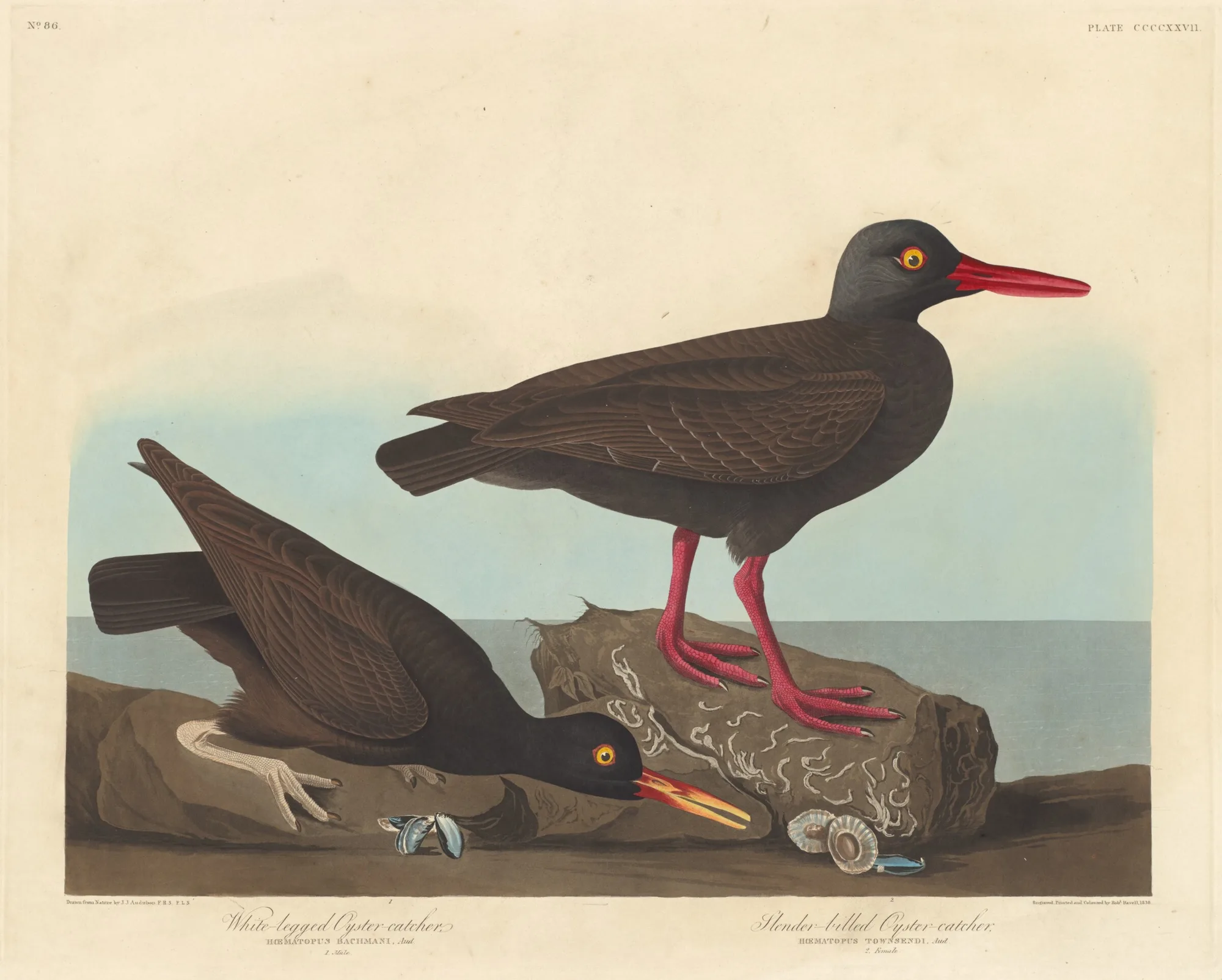
Black Oystercatcher and Townsend's Oystercatcher (Plate 427)
Audubon's “White-Legged Oyster-Catcher and Slender-Billed Oyster-Catcher”, The Birds of America, plate CDXXVII
Click or press Enter to enlarge
Open the full-resolution image (3922 px, National Gallery of Art)
| Plate | 427 (CDXXVII) |
|---|---|
| Audubon's name | White-Legged Oyster-Catcher and Slender-Billed Oyster-Catcher |
| Modern names | Black Oystercatcher, Townsend's Oystercatcher (unidentified; possibly a mislabelled South American Blackish Oystercatcher) |
| Scientific names | Haematopus bachmani, Haematopus townsendi (unresolved) |
| Status | Least Concern |
| Engraved by | Robert Havell, after Audubon's watercolor |
| Date | 1838 |
| Medium | Hand-colored engraving and aquatint on Whatman wove paper |
| Collections | Shorebirds, Rails and Cranes |
| This impression | National Gallery of Art, Washington, 1945.8.427; Gift of Mrs. Walter B. James |
About this plate
Plate 427 shows dark oystercatchers from Townsend's collections on the Pacific coast. Audubon described two new species from them. Bachman's Oyster-catcher was a male shot in June 1836 and named for his friend the Rev. John Bachman of Charleston. Townsend's Oyster-catcher was a larger bird with a slightly upturned bill, named for its collector.
Bachman's Oyster-catcher is the Black Oystercatcher, and Audubon's name stands as its scientific name, Haematopus bachmani. Townsend's Oyster-catcher has never been matched to a known North American bird. It is usually thought to be a specimen of a different oystercatcher with confused labelling, possibly the Blackish Oystercatcher of South America, and the name is not used today. The engraved titles, White-legged and Slender-billed Oyster-catcher, do not match the names in the text.
The Black Oystercatcher lives only on rocky shores of the Pacific coast, from the Aleutians to Baja California. It pries limpets and mussels off the rocks with its long red bill and nests just above the tide line. Its world population is small, perhaps around ten thousand birds, but it is listed as Least Concern.
Townsend told Audubon the bird was abundant along the north-west coast but rare inside Cape Disappointment. Audubon used the chapter to point out that no American oystercatcher resembled the European species. He argued that Wilson had figured a stuffed European bird from Peale's Museum.
Birds on this plate
- Black Oystercatcher Haematopus bachmani: Audubon's Bachman's Oyster-catcher (male). Least Concern
- Townsend's Oystercatcher (unidentified; possibly a mislabelled South American Blackish Oystercatcher) Haematopus townsendi (unresolved): Audubon's Townsend's Oyster-catcher (male). Unknown
In Audubon's words
According to my friend Dr Townsend, this species is abundant along the whole of the north-west coast of America, as well as in Regent's Sound, but is rarely seen on the shores within Cape Disappointment. The specimen sent to me by him is ticketed as a male, shot in June 1836; but as in this genus there is no difference as to colour between the male and the female, it may be supposed that in this case the female differs only in being somewhat smaller. The discovery of two new species is very remarkable, especially when it is seen by the figures given in this plate, compared with the other, that not one of our three Oyster-catchers resembles the Haematopus Ostralegus of Europe, which for a long time was supposed to exist in America, on account of the figure given of this latter bird by Wilson, who must have taken it from a stuffed European specimen in Peale's Museum in Philadelphia.
John James Audubon, Ornithological Biography, vol. 5 (1839), “Bachman's Oyster-Catcher”. Read the full chapter.