Surfbird (Plate 428)
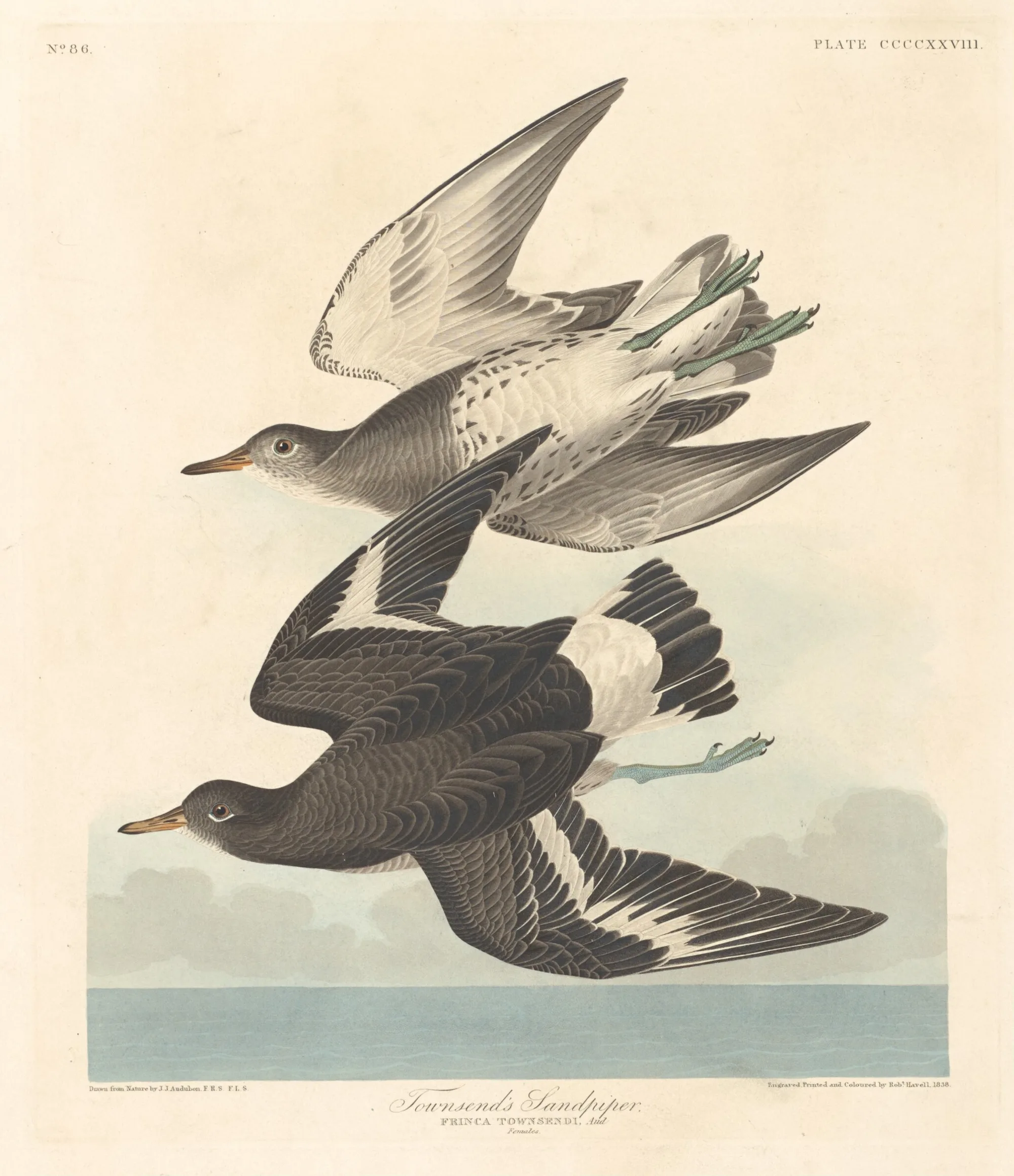
Audubon's “Townsend's Sandpiper”, The Birds of America, plate CDXXVIII
Click or press Enter to enlarge
Open the full-resolution image (2757 px, National Gallery of Art)
| Plate | 428 (CDXXVIII) |
|---|---|
| Audubon's name | Townsend's Sandpiper |
| Modern name | Surfbird |
| Scientific name | Calidris virgata |
| Status | Least Concern |
| Engraved by | Robert Havell, after Audubon's watercolor |
| Date | 1838 |
| Medium | Hand-colored engraving and aquatint on Whatman wove paper |
| Collections | Shorebirds, Rails and Cranes |
| This impression | National Gallery of Art, Washington, 1945.8.428; Gift of Mrs. Walter B. James |
About this plate
Plate 428 shows a single female Surfbird in two flying views, one from above and one from below. Audubon chose this arrangement to show the bold white wing stripe and the white tail base with a black tip. Townsend shot the bird at Cape Disappointment, at the mouth of the Columbia River, and it was the only one he ever saw.
Audubon engraved it as Townsend's Sandpiper and in the text called it Townsend's Surf-bird. He created a new genus for it, Aphriza, 'sea-foam lover.' That genus was used for the Surfbird until genetic work showed it was a close relative of the knots. It is now Calidris virgata, in the same genus as most sandpipers.
The Surfbird has an unusual life. It breeds on rocky alpine tundra in the mountains of Alaska and the Yukon, far from the sea, where its nest was not found until 1926. In winter it lives on wave-washed rocks along the Pacific coast as far south as Chile, feeding on barnacles and small mussels. It is listed as Least Concern.
Townsend's note describes the bird feeding on rocks while the surf sprayed over it, then flying off with quick, jerking wingbeats. Its strong gizzard held fragments of a small black shellfish.
In Audubon's words
I shot this bird, the only one I have ever seen, on Cape Disappointment, at the entrance of the Columbia River. It was sitting on the edge of the steep rocks, and the heavy surf frequently dashed its spray over it as it foraged among the retreating waves. When it started, it flew with a quick, jerking motion of its wings, and alighted again at a short distance. It was a female. The stomach was remarkably strong and muscular, and contained fragments of a small black shell-fish which adheres to the rocks in this neighbourhood.
John James Audubon, Ornithological Biography, vol. 5 (1839), “Townsend's Surf-Bird”. Read the full chapter.