Manx Shearwater (Plate 295)
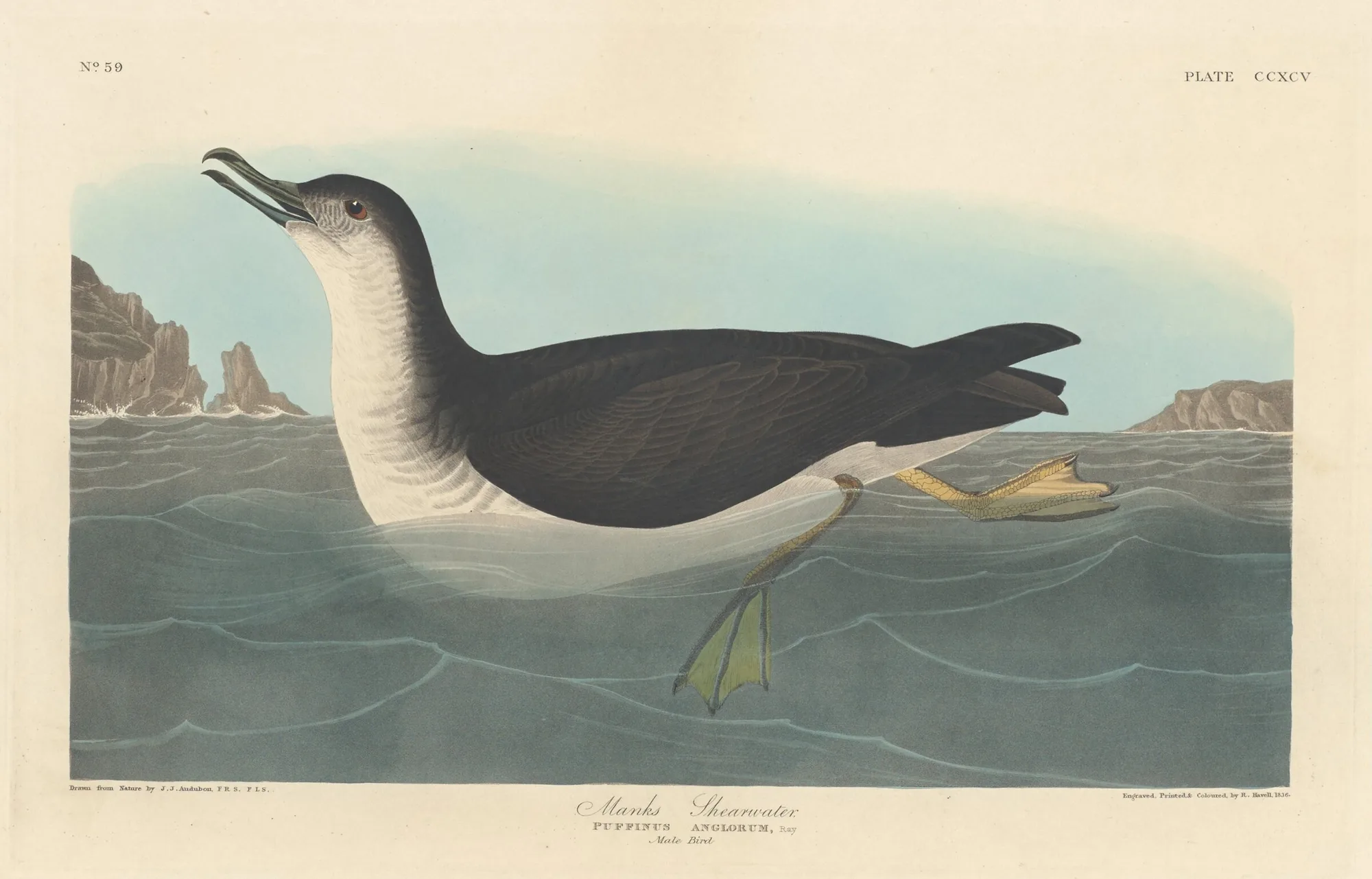
Audubon's “Manks Shearwater”, The Birds of America, plate CCXCV
Click or press Enter to enlarge
Open the full-resolution image (2821 px, National Gallery of Art)
| Plate | 295 (CCXCV) |
|---|---|
| Audubon's name | Manks Shearwater |
| Modern name | Manx Shearwater |
| Scientific name | Puffinus puffinus |
| Status | Least Concern |
| Engraved by | Robert Havell, after Audubon's watercolor |
| Date | 1836 |
| Medium | Hand-colored engraving and aquatint on Whatman wove paper |
| Collections | Seabirds |
| This impression | National Gallery of Art, Washington, 1945.8.295; Gift of Mrs. Walter B. James |
About this plate
Plate 295 shows one adult Manx Shearwater, a small, slim seabird that is black above and white below, with a thin hooked bill and tube nostrils. Audubon's chapter says nothing about the setting of the figure.
Audubon's Puffinus anglorum is now Puffinus puffinus. The scientific name is a historical tangle. Puffin was first the name for the fat young shearwaters taken from burrows on the Calf of Man and salted for food, and the word later passed to the auk with the coloured bill. Audubon spelled the English name Manks, an old spelling of Manx.
Manx Shearwaters nest in burrows on islands, mostly in Britain and Ireland, with smaller colonies in Iceland, the Faroes, France and since the 1970s in Newfoundland and Massachusetts. They visit the colonies only at night to avoid gulls. In autumn they cross the Atlantic to winter off Brazil and Argentina. Some ringed birds have lived more than fifty years. The IUCN lists the species as Least Concern.
Audubon wrote that he had collected the bird at sea west of the Newfoundland Banks but had little to say about it from his own observation. He relied on British writers for its habits. He noted that the colony that gave the bird its name, on a small islet close to the Isle of Man, had been deserted, while the species remained common in the Orkneys.
In Audubon's words
Although I have procured this species to the westward of the banks of Newfoundland, or between their soundings and the American coast, I am unable to say any thing of importance respecting its habits as observed by myself. This species formerly inhabited a small islet close to the Isle of Man, but appears to have now entirely deserted it. In the Orkneys, however, it is still abundant, and the eggs and young are in much request there. It arrives in March, and, when the young are able to fly, betakes itself to the open sea, disappearing towards the approach of winter. The British writers who have described it inform us, that it stands nearly erect, flies with great rapidity, feeds on marine animal substances of all kinds, and, when taken, squirts out an oily fluid from its nostrils in the manner of the Petrels.
John James Audubon, Ornithological Biography, vol. 3 (1835), “The Manks Shearwater”. Read the full chapter.



