Limpkin (Plate 377)
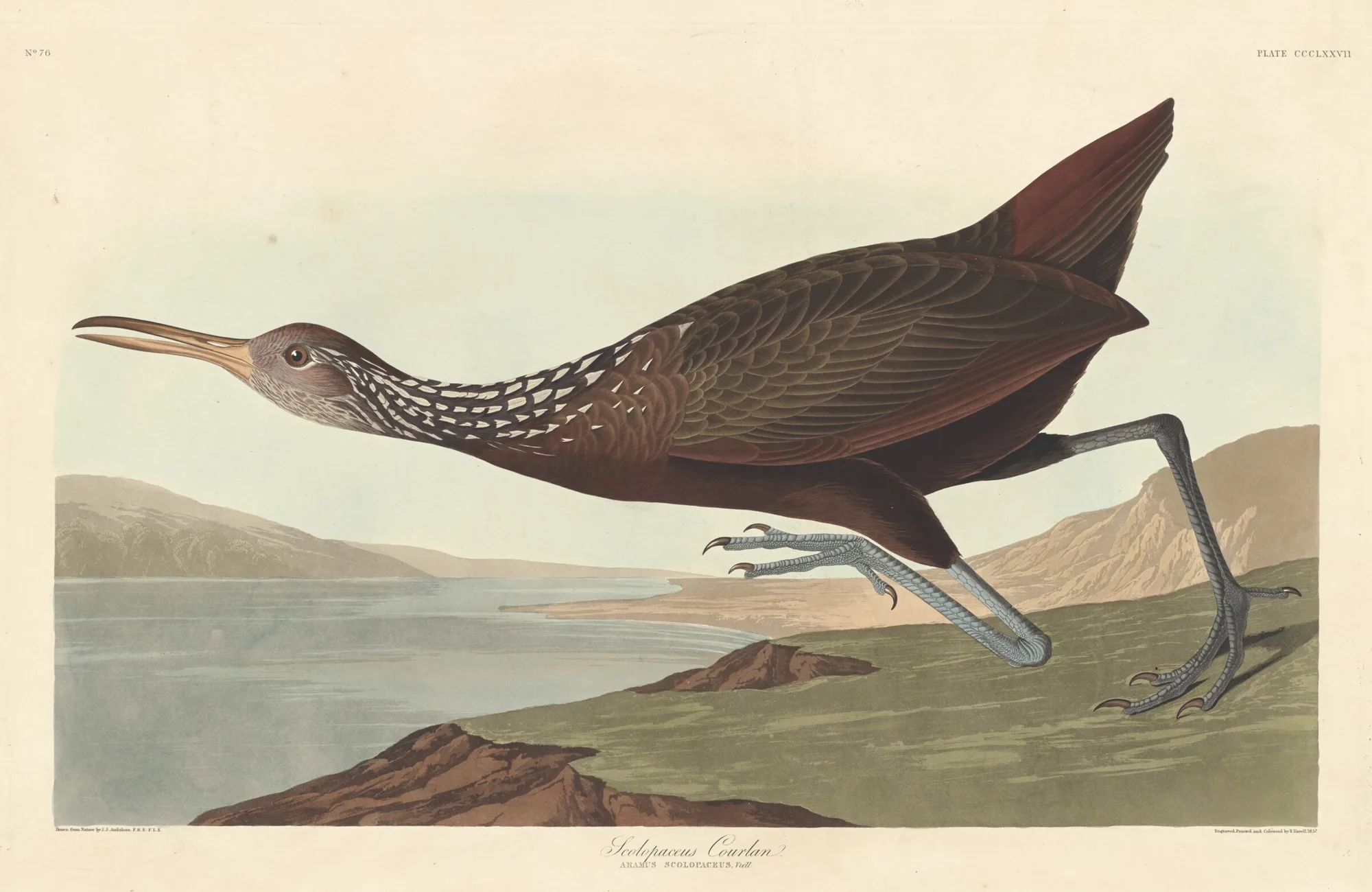
Audubon's “Scolopaceus Courlan”, The Birds of America, plate CCCLXXVII
Click or press Enter to enlarge
Open the full-resolution image (4670 px, National Gallery of Art)
| Plate | 377 (CCCLXXVII) |
|---|---|
| Audubon's name | Scolopaceus Courlan |
| Modern name | Limpkin |
| Scientific name | Aramus guarauna |
| Status | Least Concern |
| Engraved by | Robert Havell, after Audubon's watercolor |
| Date | 1837 |
| Medium | Hand-colored engraving and aquatint on Whatman wove paper |
| Collections | Shorebirds, Rails and Cranes, Florida and Wading Birds |
| This impression | National Gallery of Art, Washington, 1945.8.377; Gift of Mrs. Walter B. James |
About this plate
Plate 377 shows the Limpkin, a long-legged wading bird about the size of a small heron. It is dark brown streaked and spotted with white, with a long, slightly curved bill whose tip is often bent sideways.
Audubon's Scolopaceus Courlan reflects the old view that the bird was a kind of rail or curlew. It is now Aramus guarauna, the only member of the family Aramidae. Its closest relatives are the cranes and the rails. The name Limpkin refers to its halting, limping walk.
Limpkins live in freshwater marshes, swamps and spring-fed rivers from Florida and southern Georgia through the Caribbean and Central America to Argentina. They feed mostly on apple snails, which they extract with the bill. Their loud, wailing cries at night gave them the old name Crying Bird. Florida populations were reduced by hunting and drainage. Since the 2010s the bird has spread north and west, following introduced apple snails. The species is listed as Least Concern.
The Ornithological Biography chapter for this plate was not supplied, so details of where Audubon obtained or drew his specimen are not given here.