Barnacle Goose (Plate 296)
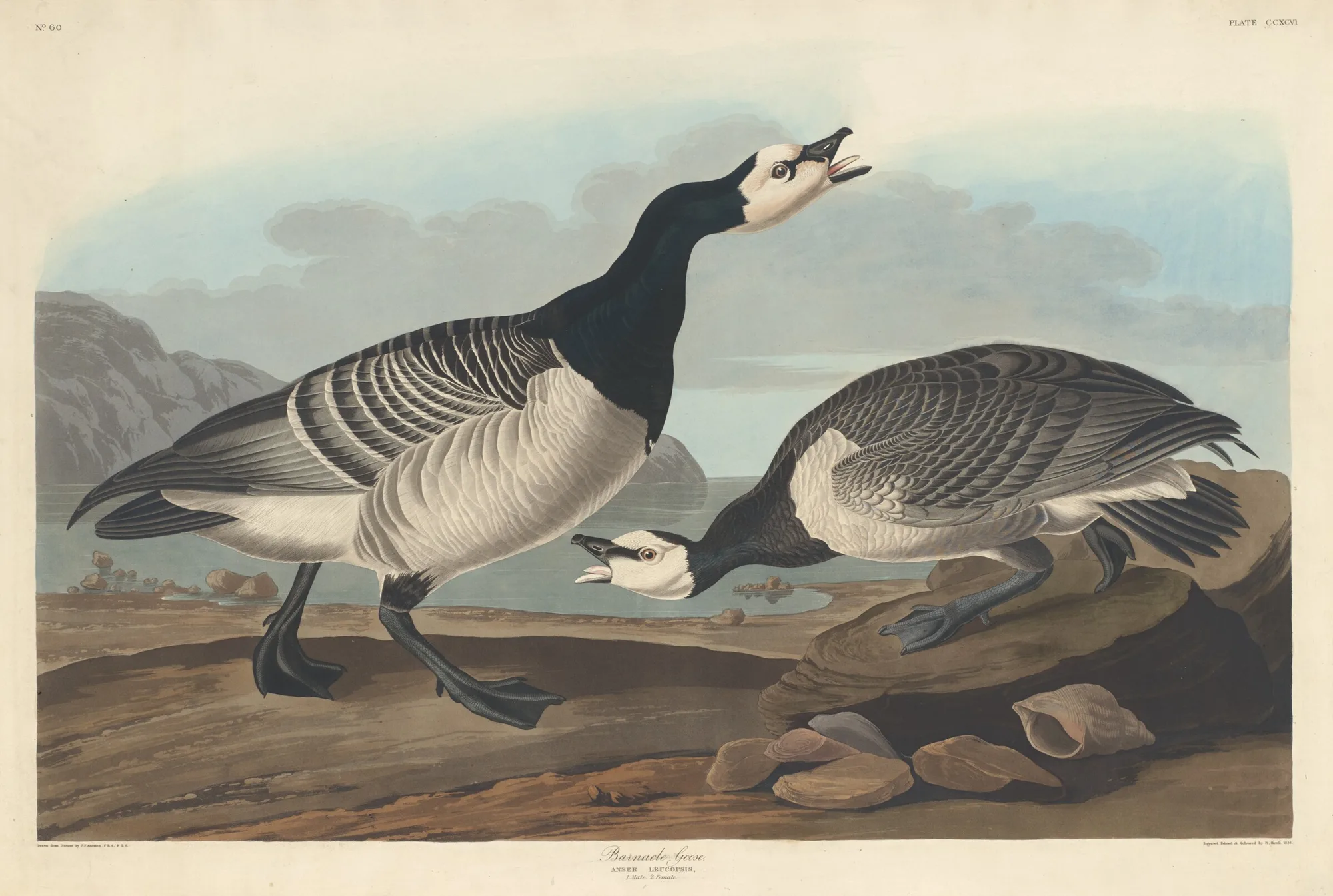
Audubon's “Barnacle Goose”, The Birds of America, plate CCXCVI
Click or press Enter to enlarge
Open the full-resolution image (5366 px, National Gallery of Art)
| Plate | 296 (CCXCVI) |
|---|---|
| Audubon's name | Barnacle Goose |
| Modern name | Barnacle Goose |
| Scientific name | Branta leucopsis |
| Status | Least Concern |
| Engraved by | Robert Havell, after Audubon's watercolor |
| Date | 1836 |
| Medium | Hand-colored engraving and aquatint on Whatman wove paper |
| Collections | Ducks, Geese and Swans |
| This impression | National Gallery of Art, Washington, 1945.8.296; Gift of Mrs. Walter B. James |
About this plate
Plate 296 shows a pair of Barnacle Geese: an adult male in spring and, in Audubon's words, a female of the preceding year. Both have the creamy white face, black neck and breast, and barred grey back of the species.
Audubon's Anser leucopsis is now Branta leucopsis. It is a close relative of the Brant and the Canada Goose. The old name comes from a medieval belief that these geese grew from goose barnacles on driftwood, because no one in Britain ever saw them nest.
Barnacle Geese breed on Arctic cliffs and islands in eastern Greenland, Svalbard and northern Russia. They winter in western Europe, mainly in Scotland, Ireland, the Netherlands and Germany. The young of cliff-nesting pairs jump from ledges many metres high soon after hatching. Protection has brought large increases since the mid-twentieth century, and new breeding colonies have formed around the Baltic. In North America the species is a rare vagrant, and many sightings are treated as possible escapes from collections. The IUCN lists it as Least Concern.
Audubon was candid. English-born gunners in Massachusetts and Maine told him they had shot Barnacles there, but he never met one himself, on the coast or inland. He figured the pair so as neither to add to nor take away from the American list, and he borrowed Prideaux John Selby's account of the bird's habits in Britain. He described its eggs from specimens in the museum of the University of Edinburgh.
In Audubon's words
Several old gunners on the coast of Massachusetts and Maine, who were Englishmen by birth, assured me that they had killed Barnacles there, and that these birds brought a higher price in the markets than the Common Brent Geese. The Prince of Musignano states in his Synopsis that they are very rare and accidental in the United States, and Mr Nuttall says that they are "mere stragglers" there. For my part, I acknowledge that I never met with one of them, either along the coast or in the interior, although I have seen beautiful mounted specimens in various parts. Being neither anxious to add to our Fauna, nor willing unnecessarily to detract from it, I have figured a pair of these birds, with the hope that ere long, the assertions of the gunners, and those of the authors above mentioned, may be abundantly verified by the slaughter of many geese.
John James Audubon, Ornithological Biography, vol. 3 (1835), “The Barnacle Goose”. Read the full chapter.