Harlequin Duck (Plate 297)
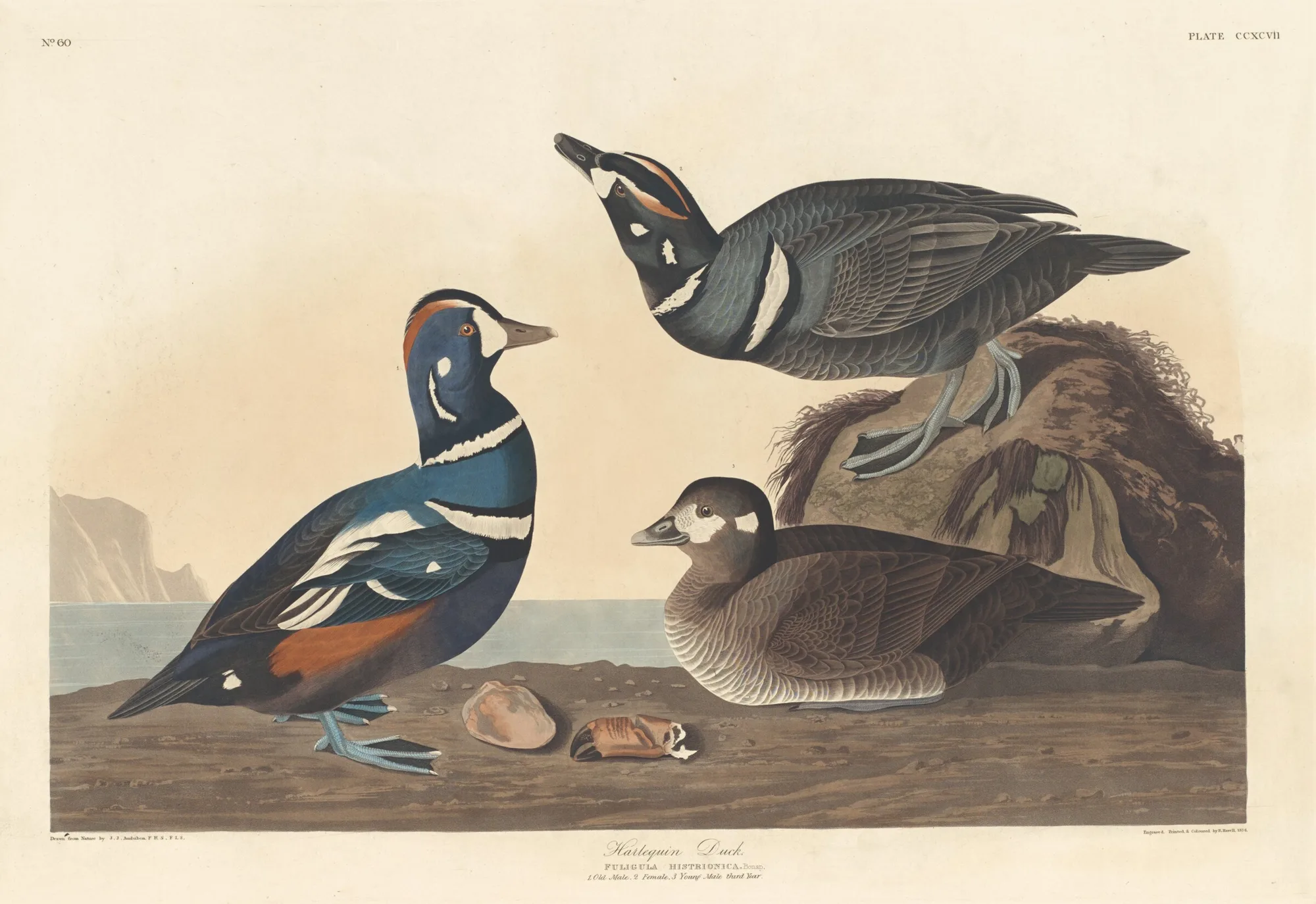
Audubon's “Harlequin Duck”, The Birds of America, plate CCXCVII
Click or press Enter to enlarge
Open the full-resolution image (4253 px, National Gallery of Art)
| Plate | 297 (CCXCVII) |
|---|---|
| Audubon's name | Harlequin Duck |
| Modern name | Harlequin Duck |
| Scientific name | Histrionicus histrionicus |
| Status | Least Concern |
| Engraved by | Robert Havell, after Audubon's watercolor |
| Date | 1836 |
| Medium | Hand-colored engraving and aquatint on Whatman wove paper |
| Collections | Ducks, Geese and Swans |
| This impression | National Gallery of Art, Washington, 1945.8.297; Gift of Mrs. Walter B. James |
About this plate
Plate 297 has three figures. Audubon describes them as an adult male in full spring plumage, a male two years old, and an adult female shot in the pairing season. The adult male is slate blue with chestnut flanks and bold white stripes and spots edged in black. The female is plain dusky brown with white spots on the face. Audubon believed no figures of the adult male or female had been published before.
The species is Histrionicus histrionicus, from histrio, an actor. It is the only member of its genus. Audubon recorded the New England name Lord and Lady Duck.
Harlequins breed along fast, rocky mountain streams in northwestern North America, the Canadian east, Greenland, Iceland and eastern Siberia. They winter in heavy surf along rocky coasts, diving for crabs, snails and other small animals among the rocks. The small eastern North American population declined badly in the twentieth century and has been listed under Canada's Species at Risk Act. The IUCN lists the species as Least Concern.
Audubon's party found Harlequins breeding on White Head Island in the Bay of Fundy on 31 May 1833, with nests under bushes or in grass twenty or thirty yards from the sea. He noted that in Newfoundland and Labrador they nested by small inland lakes instead. He found them very shy, but his party shot a number by waiting behind rocks where the flocks came to bask.
In Audubon's words
Not only is it at all seasons remarkably shy and vigilant, but even if approached when on rocks, it plunges into the water the moment its keen eye catches a glance of you, dives with all the agility of the Black Guillemot, and seldom rises within shot. If you shoot at it when passing on wing, even should it be beyond reach, it plunges into the water the moment it perceives the flash,—a habit which is also occasionally observed in the Black Guillemot. It being usually found in flocks of one or two families, or of from twelve to fifteen individuals, some one always acts as a watchful sentinel, whose single note of alarm is sufficient to induce the whole to move off without hesitation.
John James Audubon, Ornithological Biography, vol. 3 (1835), “The Harlequin Duck”. Read the full chapter.