Red-necked Grebe (Plate 298)
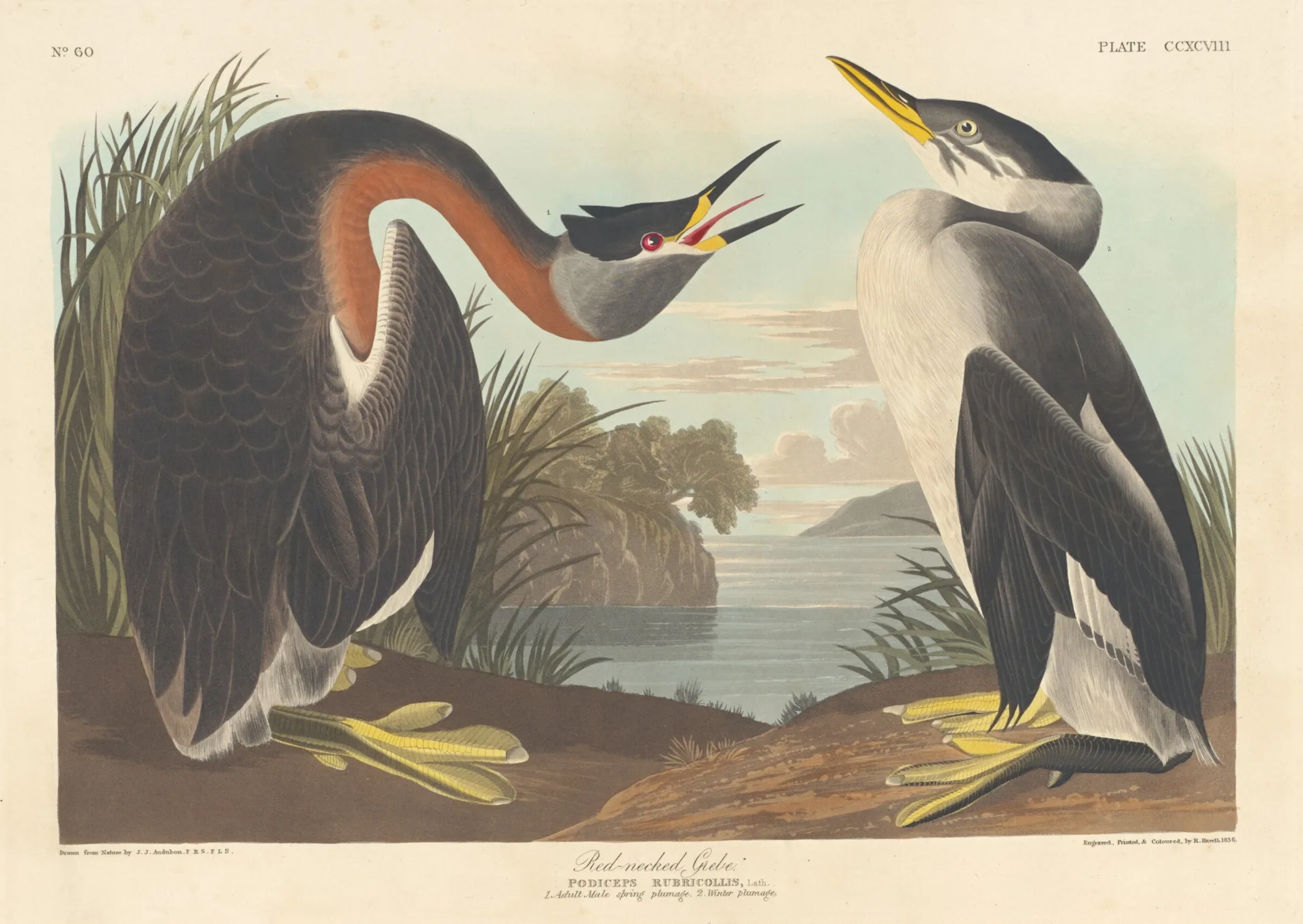
Audubon's “Red-necked Grebe”, The Birds of America, plate CCXCVIII
Click or press Enter to enlarge
Open the full-resolution image (2923 px, National Gallery of Art)
| Plate | 298 (CCXCVIII) |
|---|---|
| Audubon's name | Red-necked Grebe |
| Modern name | Red-necked Grebe |
| Scientific name | Podiceps grisegena |
| Status | Least Concern |
| Engraved by | Robert Havell, after Audubon's watercolor |
| Date | 1836 |
| Medium | Hand-colored engraving and aquatint on Whatman wove paper |
| Collections | Seabirds |
| This impression | National Gallery of Art, Washington, 1945.8.298; Gift of Mrs. Walter B. James |
About this plate
Plate 298 shows an adult male Red-necked Grebe and a young bird. The adult wears breeding plumage: a black cap, pale grey cheeks, a rich chestnut neck and a dagger bill with a yellow base. The young bird is greyer, with a striped face.
Audubon used Latham's Podiceps rubricollis. The current name is Podiceps grisegena. North American birds are larger and longer-billed than European ones and were once named Holboell's Grebe, now treated as a subspecies, P. g. holbollii.
Red-necked Grebes breed on lakes and marshy ponds with plenty of emergent plants, across Alaska, western and central Canada and the northern prairie states, and in Europe and Asia. Pairs defend their territory with loud braying and wailing calls and perform paired displays on the water. The striped chicks often ride on a parent's back. In winter the birds move to the sea, on both coasts of North America, and to the Great Lakes. The IUCN lists the species as Least Concern.
Audubon met them only on salt water. He saw them in winter from New York to Maine and procured several at Boston. In early May he saw them in spring plumage in the Bay of Fundy. There a pair surfaced a few yards from his boat, dived under it through a volley of shot and came up unhurt at a safe distance.
In Audubon's words
On the Bay of Fundy, and among the islands at its entrance, I saw these Grebes already in their spring plumage, it being then the beginning of May. On one occasion our boat was rowed over an eddy in which a pair had dived in search of food. On emerging they were only a few yards distant; but, although several guns were fired at them, they escaped unhurt, for they instantly dived again, passed under the boat at the depth of about a yard, and did not rise until at a safe distance. None of us could conceive how they had managed to elude us, for as they were so near, the shot threw up the water in its course, and I had expected to find them completely mangled.
John James Audubon, Ornithological Biography, vol. 3 (1835), “The Red-necked Grebe”. Read the full chapter.