Audubon's Shearwater (Plate 299)
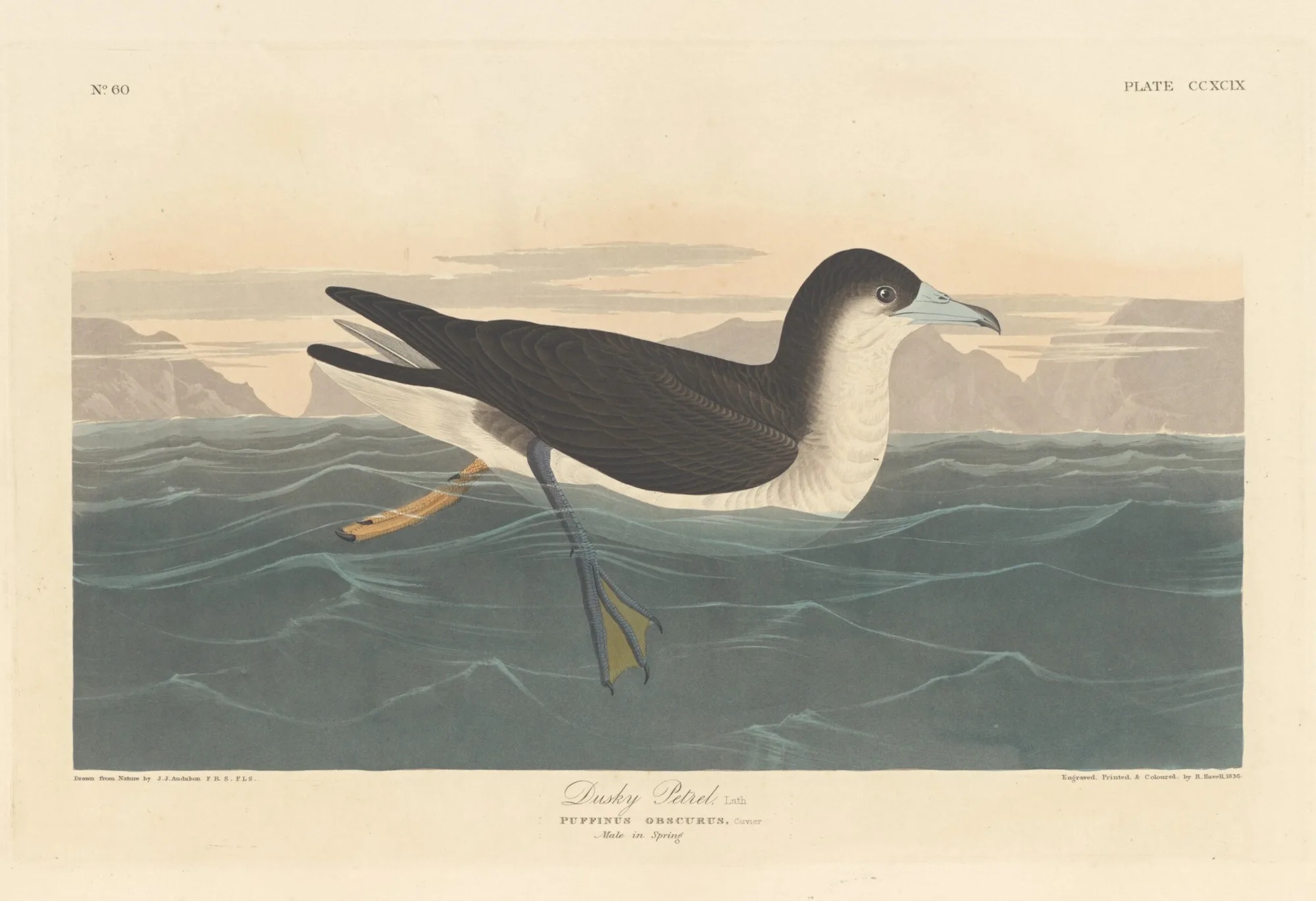
Audubon's “Dusky Petrel”, The Birds of America, plate CCXCIX
Click or press Enter to enlarge
Open the full-resolution image (2792 px, National Gallery of Art)
| Plate | 299 (CCXCIX) |
|---|---|
| Audubon's name | Dusky Petrel |
| Modern name | Audubon's Shearwater |
| Scientific name | Puffinus lherminieri |
| Status | Least Concern |
| Engraved by | Robert Havell, after Audubon's watercolor |
| Date | 1836 |
| Medium | Hand-colored engraving and aquatint on Whatman wove paper |
| Collections | Seabirds |
| This impression | National Gallery of Art, Washington, 1945.8.299; Gift of Mrs. Walter B. James |
About this plate
Plate 299 shows one small shearwater, dark brown above and white below, with a short dark bill. Audubon drew it from a bird killed in the Gulf of Mexico on 26 June 1826, during his voyage from New Orleans to Liverpool to find an engraver for The Birds of America. The ship was becalmed off the west coast of Florida, and the mate shot four of the birds at once.
Audubon used Cuvier's name Puffinus obscurus and called it the Dusky Petrel. The bird now carries his own name. It is Audubon's Shearwater, Puffinus lherminieri. Authorities differ on how to divide the group, and several island populations elsewhere in the world, once included in this species, are now often treated as separate species.
Audubon's Shearwaters nest in rock crevices and burrows on islands in the Bahamas and the Caribbean. Outside the breeding season they range over warm water, especially the Gulf Stream off the southeastern United States. They feed close to rafts of floating Sargassum weed, as Audubon saw, diving for small fish and squid. The IUCN lists the species as Least Concern, though some colonies have suffered from introduced rats and cats.
Audubon kept the skins of all four birds. He sent one to the Academy of Natural Sciences of Philadelphia and gave two to Dr Thomas Traill when he first met him in Liverpool. He tasted the flesh, as he usually did, and found it tough and fishy, like porpoise.
In Audubon's words
They skim very low over the sea in search of the floating bunches of marine plants, usually called the Gulf Weed, so abundant here as sometimes to occupy a space of half an acre or more. In proceeding, they flap their wings six or seven times in succession, and then sail for three or four seconds with great ease, having their tail much spread, and their long wings extended at right angles with the body. On approaching a mass of weeds, they raise their wings obliquely, drop their legs and feet, run as it were on the water, and at length alight on the sea, where they swim with as much ease as ducks, and dive freely, at times passing several feet under the surface in pursuit of the fishes, which, on perceiving their enemy, swim off, but are frequently seized with great agility.
John James Audubon, Ornithological Biography, vol. 3 (1835), “The Dusky Petrel”. Read the full chapter.