American Golden-Plover (Plate 300)
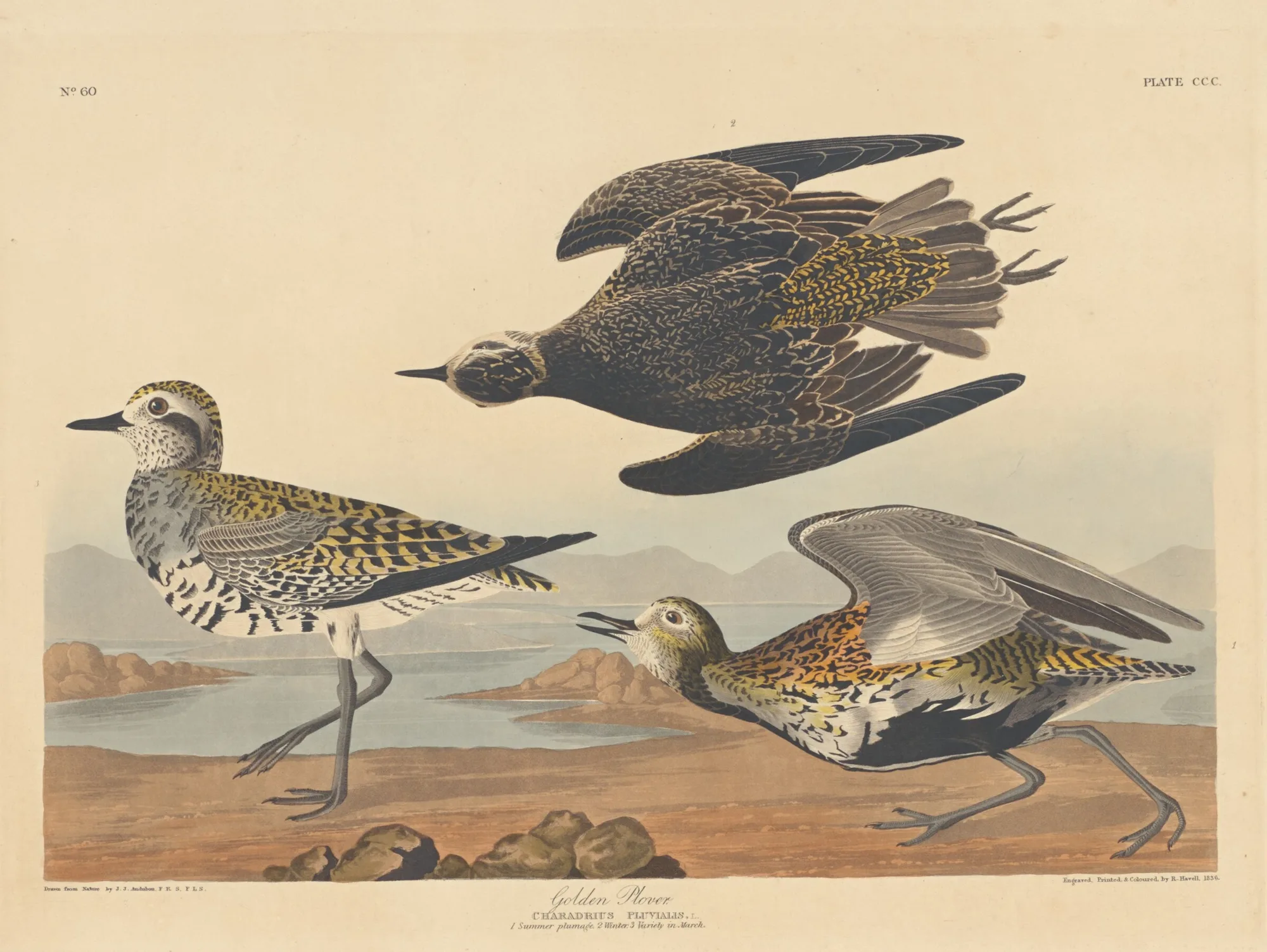
Audubon's “Golden Plover”, The Birds of America, plate CCC
Click or press Enter to enlarge
Open the full-resolution image (2905 px, National Gallery of Art)
| Plate | 300 (CCC) |
|---|---|
| Audubon's name | Golden Plover |
| Modern name | American Golden-Plover |
| Scientific name | Pluvialis dominica |
| Status | Least Concern |
| Engraved by | Robert Havell, after Audubon's watercolor |
| Date | 1836 |
| Medium | Hand-colored engraving and aquatint on Whatman wove paper |
| Collections | Shorebirds, Rails and Cranes |
| This impression | National Gallery of Art, Washington, 1945.8.300; Gift of Mrs. Walter B. James |
About this plate
Plate 300 shows several Golden Plovers. The figures line lists adults in spring and in winter plumage and a variety. The spring bird has black underparts from face to belly, edged with white, and a back spangled with gold. The winter bird is plain buff and grey-brown.
Audubon used Linnaeus's Charadrius pluvialis and insisted that the American and European Golden Plovers were the same bird, against Selby. Here he was wrong. The American bird is now Pluvialis dominica, the American Golden-Plover, separate from the European Golden Plover, P. apricaria. The Pacific Golden-Plover was split from the American species in 1993.
American Golden-Plovers breed on Arctic tundra in Alaska and Canada. They fly to the grasslands of Argentina and Uruguay for the winter. Most adults take an ocean route over the western Atlantic in autumn and return north through the Mississippi valley in spring. Market hunting in the late nineteenth century cut their numbers sharply, alongside the Eskimo Curlew that often flew with them. Protection under the Migratory Bird Treaty of 1918 allowed a partial recovery. The IUCN lists the species as Least Concern.
On 16 March 1821 French gunners at New Orleans took Audubon to watch a spring flight near Lake St John. He saw flocks of a hundred cut to five or six by lines of guns. One man killed sixty-three dozen. Audubon estimated that forty-eight thousand plovers fell that day.
In Audubon's words
At the first appearance of the birds early in the morning, the gunners had assembled in parties of from twenty to fifty at different places, where they knew from experience that the Plovers would pass. There stationed, at nearly equal distances from each other, they were sitting on the ground. When a flock approached, every individual whistled in imitation of the Plover's call-note, on which the birds descended, wheeled, and passing within forty or fifty yards, ran the gauntlet as it were. Every gun went off in succession, and with such effect that I several times saw a flock of a hundred or more reduced to a miserable remnant of five or six individuals. The game was brought up after each volley by the dogs, while their masters were charging their pieces anew. This sport was continued all day, and at sunset, when I left one of these lines of gunners, they seemed as intent on killing more as they were when I arrived. A man near the place where I was seated had killed sixty-three dozens.
John James Audubon, Ornithological Biography, vol. 3 (1835), “The Golden Plover”. Read the full chapter.