Canvasback (Plate 301)
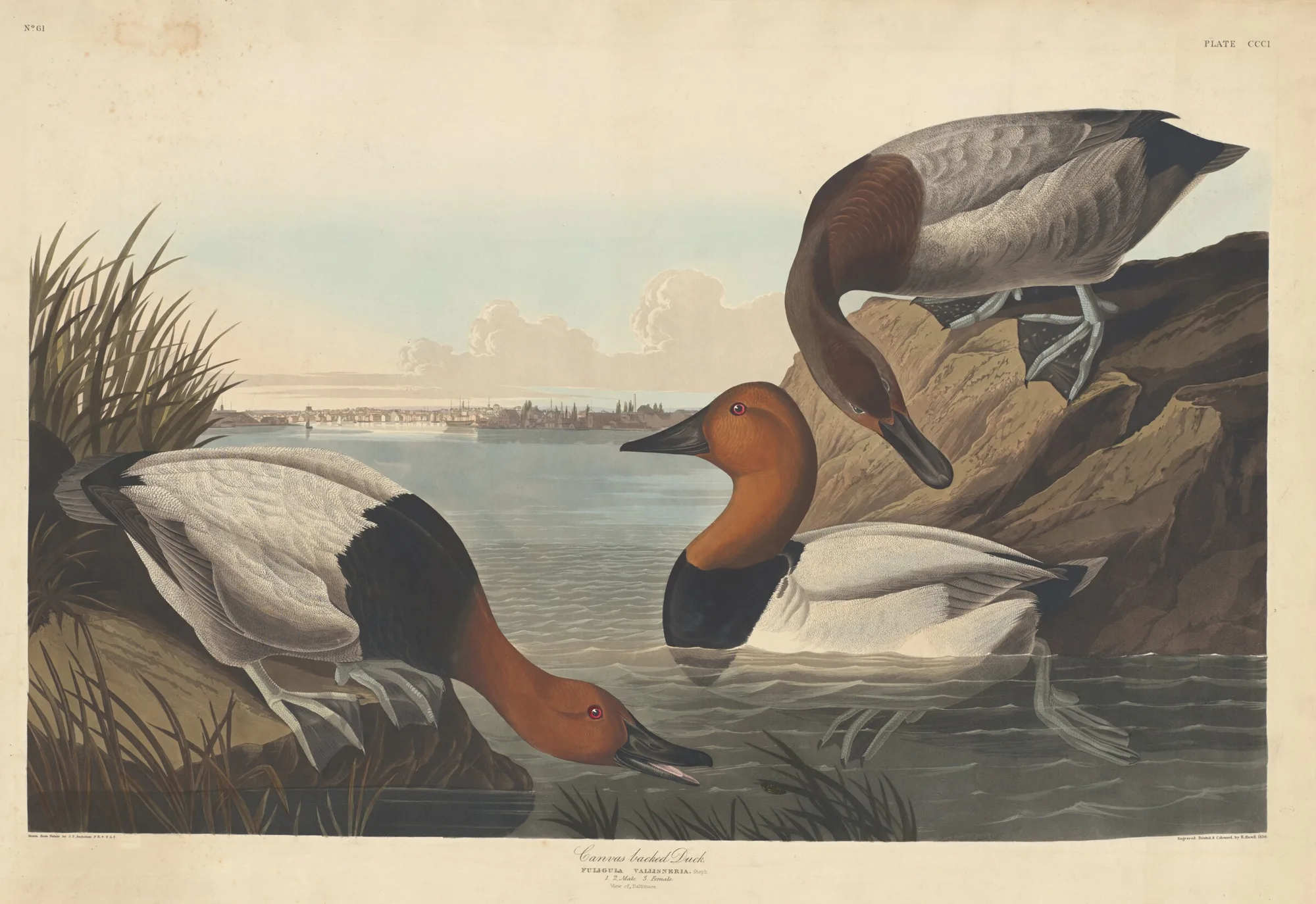
Audubon's “Canvas-backed Duck”, The Birds of America, plate CCCI
Click or press Enter to enlarge
Open the full-resolution image (5309 px, National Gallery of Art)
| Plate | 301 (CCCI) |
|---|---|
| Audubon's name | Canvas-backed Duck |
| Modern name | Canvasback |
| Scientific name | Aythya valisineria |
| Status | Least Concern |
| Engraved by | Robert Havell, after Audubon's watercolor |
| Date | 1836 |
| Medium | Hand-colored engraving and aquatint on Whatman wove paper |
| Collections | Ducks, Geese and Swans |
| This impression | National Gallery of Art, Washington, 1945.8.301; Gift of Mrs. Walter B. James |
About this plate
Plate 301 shows male and female Canvasbacks. The male has a chestnut head, red eye, black breast and a pale whitish back finely lined like canvas. The female is greyish brown. Both have the long, sloping wedge-shaped profile of head and bill that sets this duck apart. The background is generally described as a distant view of Baltimore, a nod to the Chesapeake shooting the bird was famous for.
Audubon's Fuligula valisneriana is now Aythya valisineria. The name refers to wild celery, Vallisneria americana, the underwater plant whose roots the birds dug up on the Chesapeake flats. That food was thought to give their meat its prized flavour.
Canvasbacks breed in prairie potholes and marshes of the northern plains and western Canada and Alaska. They winter on large bays and lakes, especially Chesapeake Bay, San Francisco Bay and the Gulf coast. Market hunting and the loss of wild celery beds cut their numbers in the nineteenth and twentieth centuries. Under modern hunting rules the population has recovered. The IUCN lists the species as Least Concern.
Audubon's chapter opens volume four of the Ornithological Biography. He was sceptical of the bird's fame. He noted that in March 1837 it sold for two dollars a pair at New Orleans, where it was called Canard Cheval, and that Canvasbacks shot in the South, away from wild celery, tasted poor and fishy. He also printed a long account of Chesapeake duck shooting by Dr J. J. Sharpless of Philadelphia.
In Audubon's words
This alleged pre-eminence has indeed become so deeply impressed on the minds of many of our Southerns, that they have on various occasions procured the transportation of numbers of Canvass-backs from Baltimore to Charleston in South Carolina, and even to Savannah in Georgia, although this species is by no means uncommon within a few miles of the latter city, as well as on the Great Santee River. I well remember that on my pointing out to a friend, now alas dead, several dozens of these birds in the market of Savannah, he would scarcely believe that I was not mistaken, and assured me that they were looked upon as being poor, dry, and very fishy, in short not half so good as Mallards, or Blue-winged Teals. With this I cordially agreed, for there, at that season, they are not better than represented.
John James Audubon, Ornithological Biography, vol. 4 (1838), “Canvass-back Duck”. Read the full chapter.