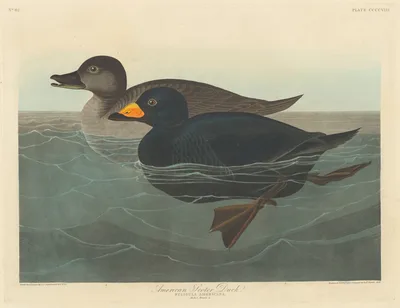
American Black Duck (Plate 302)
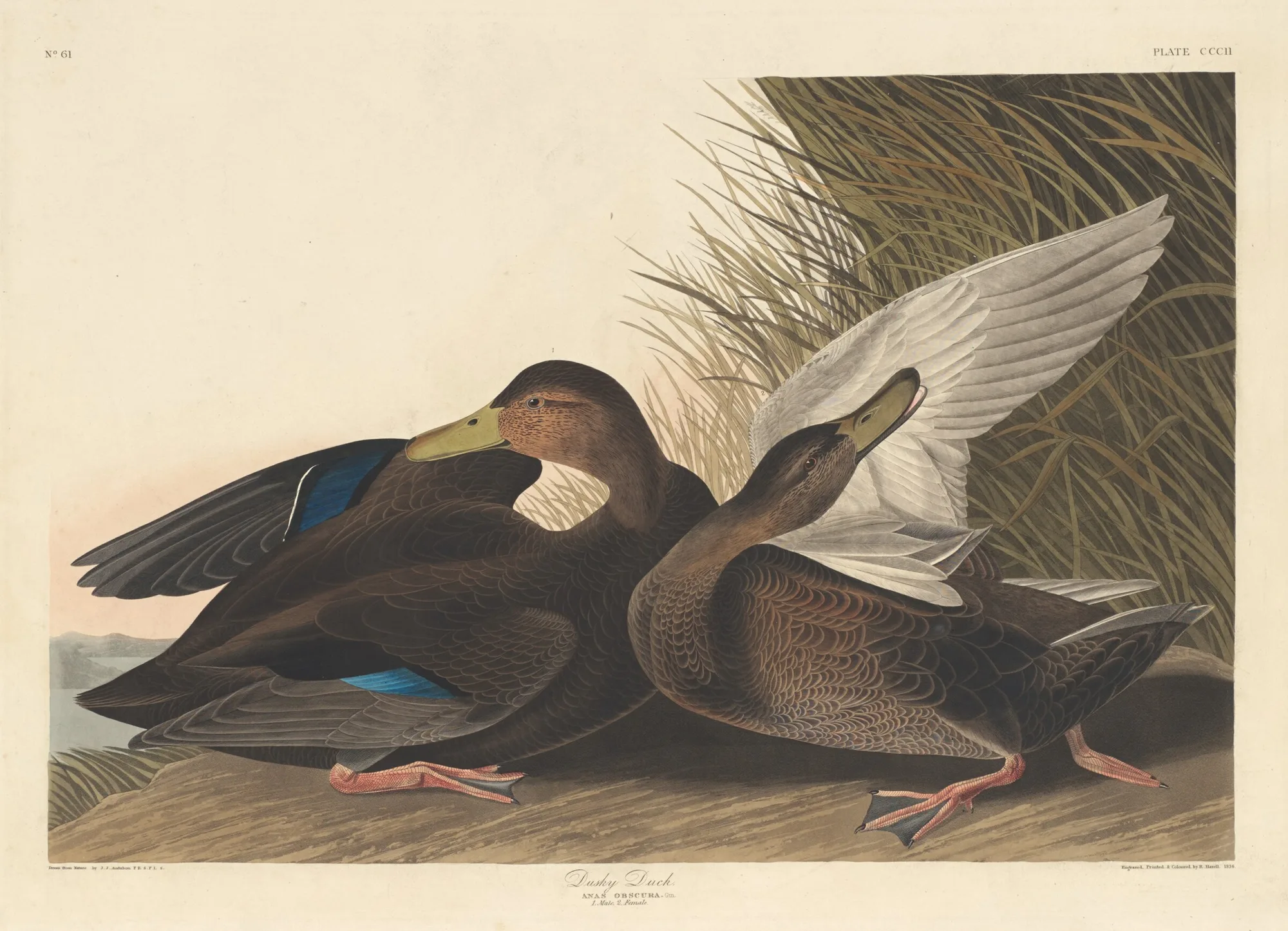
Audubon's “Dusky Duck”, The Birds of America, plate CCCII
Click or press Enter to enlarge
Open the full-resolution image (4286 px, National Gallery of Art)
| Plate | 302 (CCCII) |
|---|---|
| Audubon's name | Dusky Duck |
| Modern name | American Black Duck |
| Scientific name | Anas rubripes |
| Status | Least Concern |
| Engraved by | Robert Havell, after Audubon's watercolor |
| Date | 1836 |
| Medium | Hand-colored engraving and aquatint on Whatman wove paper |
| Collections | Ducks, Geese and Swans |
| This impression | National Gallery of Art, Washington, 1945.8.302; Gift of Mrs. Walter B. James |
About this plate
Plate 302 shows a male and female American Black Duck. Both are dark sooty brown with a paler, finely streaked head and neck. In flight they show violet-blue wing patches and flashing white underwings. The male has a yellow bill and the female a duller greenish one.
Audubon used Gmelin's Anas obscura, the Dusky Duck, but noted that everyone in the United States called it the Black Duck. The scientific name is now Anas rubripes, which means red-footed. The species is closely related to the Mallard. Since the mid-twentieth century the two have hybridized widely as Mallards spread east, and the hybrids are a conservation concern.
American Black Ducks breed in marshes, beaver ponds and woodland lakes from Manitoba to Labrador and south to the mid-Atlantic coast. They winter from the Great Lakes and New England south to the Gulf coast, many of them on coastal salt marshes. Numbers fell sharply between the 1950s and 1980s and have since steadied. The IUCN lists the species as Least Concern.
Audubon recorded the bird breeding at both ends of a huge range. On 10 May 1833 he found it nesting by pools near the Bay of Fundy, and in Labrador that June the females were incubating. On 30 April 1837 his son found a nest with eight eggs on Galveston Island, Texas, in tall grass more than a hundred yards from water. Black Ducks are no longer known to breed in Texas, so that record is doubted.
In Audubon's words
On the 30th of April 1837, my son discovered a nest on Galveston Island, in Texas. It was formed of grass and feathers, the eggs eight in number, lying on the former, surrounded with the down and some feathers of the bird, to the height of about three inches. The internal diameter of the nest was about six inches, and its walls were nearly three in thickness. The female was sitting, but flew off in silence as he approached. The situation selected was a clump of tall slender grass, on a rather sandy ridge, more than a hundred yards from the nearest water, but surrounded by partially dried salt-marshes. On the same island, in the course of several successive days, we saw many of these ducks, which, by their actions, shewed that they also had nests.
John James Audubon, Ornithological Biography, vol. 4 (1838), “Dusky Duck”. Read the full chapter.