Upland Sandpiper (Plate 303)
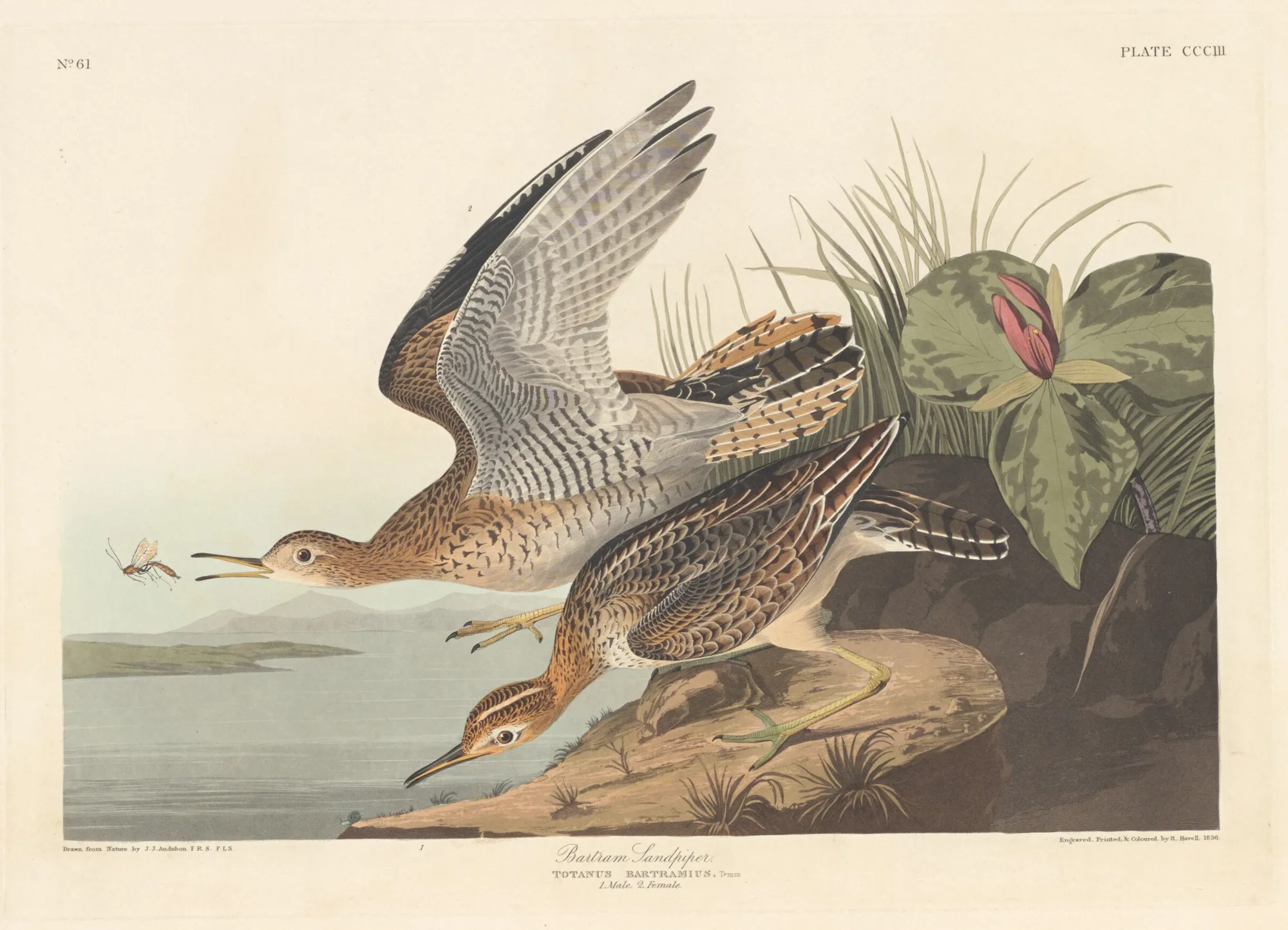
Audubon's “Bartram Sandpiper”, The Birds of America, plate CCCIII
Click or press Enter to enlarge
Open the full-resolution image (3030 px, National Gallery of Art)
| Plate | 303 (CCCIII) |
|---|---|
| Audubon's name | Bartram Sandpiper |
| Modern name | Upland Sandpiper |
| Scientific name | Bartramia longicauda |
| Status | Least Concern |
| Engraved by | Robert Havell, after Audubon's watercolor |
| Date | 1836 |
| Medium | Hand-colored engraving and aquatint on Whatman wove paper |
| Collections | Shorebirds, Rails and Cranes |
| This impression | National Gallery of Art, Washington, 1945.8.303; Gift of Mrs. Walter B. James |
About this plate
Plate 303 shows a male and female Upland Sandpiper, a buff, finely barred shorebird with a small head, large dark eye, thin neck and long tail. Audubon called it the most truly terrestrial of its tribe. He said it never waded, though its long legs made people take it for a wading bird.
Audubon's name honoured William Bartram, the Philadelphia naturalist, and it survives in the genus name, Bartramia longicauda. It is not a true sandpiper of the genus Tringa, as Audubon thought, but the only member of its own genus, related to the curlews. For many years American hunters and birders called it the Upland Plover.
Upland Sandpipers breed on prairies, hayfields and other open grassland, from Alaska and the northern plains east to New England. They often perch on fence posts and give a long rising and falling wolf-whistle. They winter on the pampas of Argentina, Uruguay and southern Brazil. Market shooting in the late nineteenth century made them scarce, and the loss of grassland has since caused declines in the East. Several northeastern states list them as endangered or threatened. The IUCN lists the species as Least Concern.
Audubon wrote that great flocks arrived each March on the dry plains of the Opelousas and Attakapas districts of Louisiana. Around New Orleans the French called it the Papabote. He noted that it was lean and tame in spring but fat and very wary on its return in August.
In Audubon's words
It has been supposed that the Bartramian Sandpiper never forms large flocks, but this is not correct, for in the neighbourhood of New Orleans, where it is called the "Papabote," it usually arrives in great bands in spring, and is met with on the open plains and large grassy savannahs, where it generally remains about two weeks, though sometimes individuals may be seen as late as the 15th of May. I have observed the same circumstances on our western prairies, but have thought that they were afterwards obliged to separate into small flocks, or even into pairs, as soon as they are ready to seek proper places for breeding in, for I have seldom found more than two pairs with nests or young in the same field or piece of ground. On their first arrival, they are generally thin, but on their return southward, in the beginning of August, when they tarry in Louisiana until the first of October, they are fat and juicy.
John James Audubon, Ornithological Biography, vol. 4 (1838), “Bartramian Sandpiper”. Read the full chapter.



