Common Loon (Plate 306)
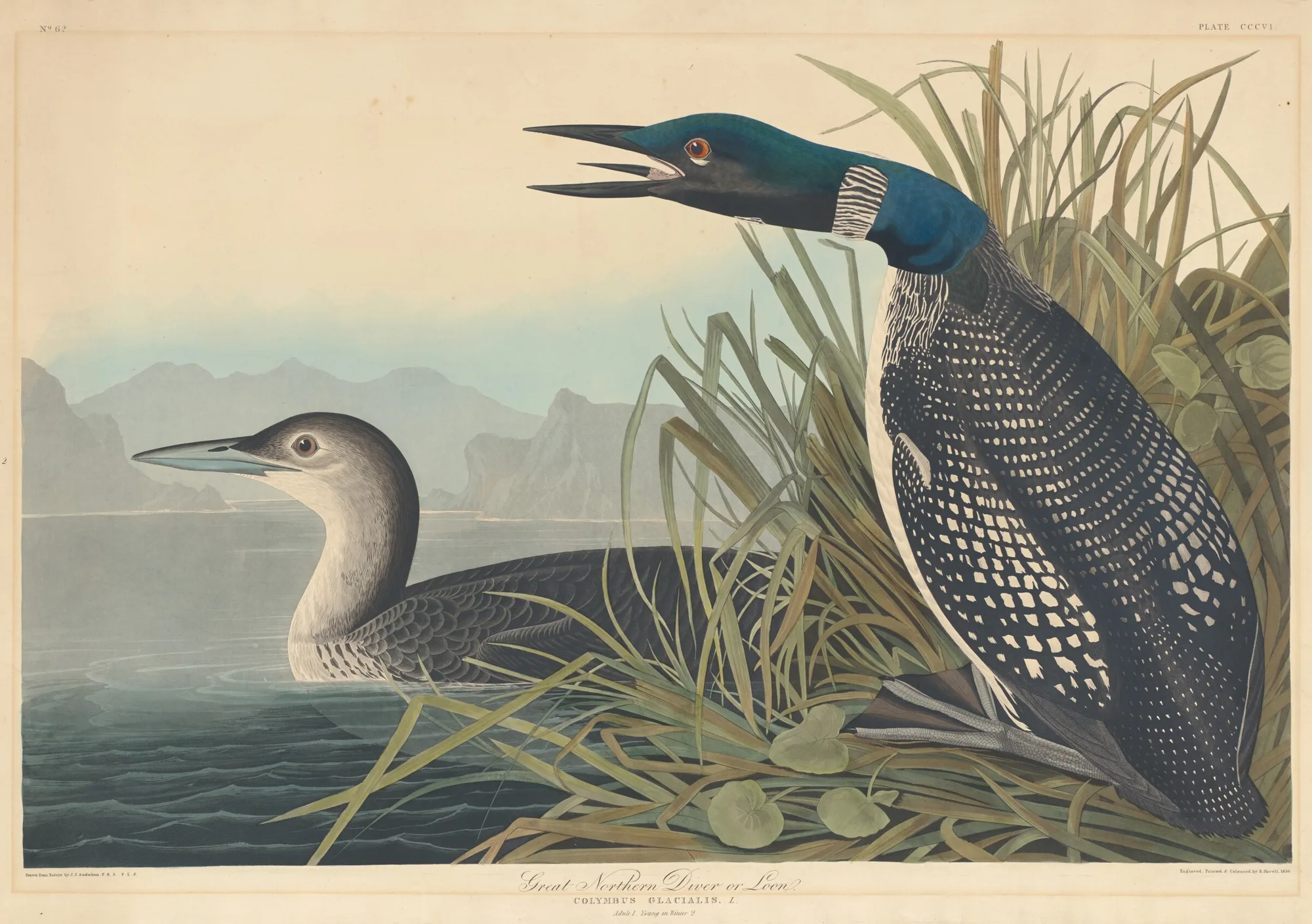
Audubon's “Great Northern Diver or Loon”, The Birds of America, plate CCCVI
Click or press Enter to enlarge
Open the full-resolution image (5112 px, National Gallery of Art)
| Plate | 306 (CCCVI) |
|---|---|
| Audubon's name | Great Northern Diver or Loon |
| Modern name | Common Loon |
| Scientific name | Gavia immer |
| Status | Least Concern |
| Engraved by | Robert Havell, after Audubon's watercolor |
| Date | 1836 |
| Medium | Hand-colored engraving and aquatint on Whatman wove paper |
| Collections | Seabirds |
| This impression | National Gallery of Art, Washington, 1945.8.306; Gift of Mrs. Walter B. James |
About this plate
Plate 306 shows an adult male Common Loon in breeding plumage and a young male. The adult has a glossy black head, a striped white necklace and a back checkered with white spots, which Audubon admired for the singular regularity of the unnumbered spots. The young bird is plain grey-brown above and white below.
Audubon's Colymbus glacialis is now Gavia immer. In Britain the bird is still called the Great Northern Diver, and the AOS name is Common Loon. Loons are not related to ducks or grebes. Their legs are set so far back that they can barely walk on land, but they are powerful divers that chase fish underwater.
Common Loons breed on clear lakes across Canada, Alaska and the northern United States, as well as Greenland and Iceland. They nest close to the water's edge, often on islands. They winter on both coasts of North America and in northwestern Europe. Their wailing and yodelling calls are among the best-known sounds of northern lakes. Acid rain, mercury, lead fishing weights and shoreline building have caused local declines, but the IUCN lists the species as Least Concern.
Audubon saw loons in winter on rivers across the United States and along the coast from Maine to Texas. On Galveston Island in April 1837 he saw birds in the plumage of their second moult. He noted that young birds drift downstream on the rivers in autumn while older birds fly straight across the bends.
In Audubon's words
View it as it buoyantly swims over the heaving billows of the Atlantic, or as it glides along deeply immersed, when apprehensive of danger, on the placid lake, on the grassy islet of which its nest is placed; calculate, if you can, the speed of its flight, as it shoots across the sky; mark the many plunges it performs in quest of its finny food, or in eluding its enemies; list to the loud and plaintive notes which it issues, either to announce its safety to its mate, or to invite some traveller of its race to alight, and find repose and food; follow the anxious and careful mother-bird, as she leads about her precious charge; and you will not count your labour lost, for you will have watched the ways of one of the wondrous creations of unlimited Power and unerring Wisdom. You will find pleasure too in admiring the glossy tints of its head and neck, and the singular regularity of the unnumbered spots by which its dusky back and wings are checkered.
John James Audubon, Ornithological Biography, vol. 4 (1838), “Great Northern Diver or Loon”. Read the full chapter.



