Little Blue Heron (Plate 307)
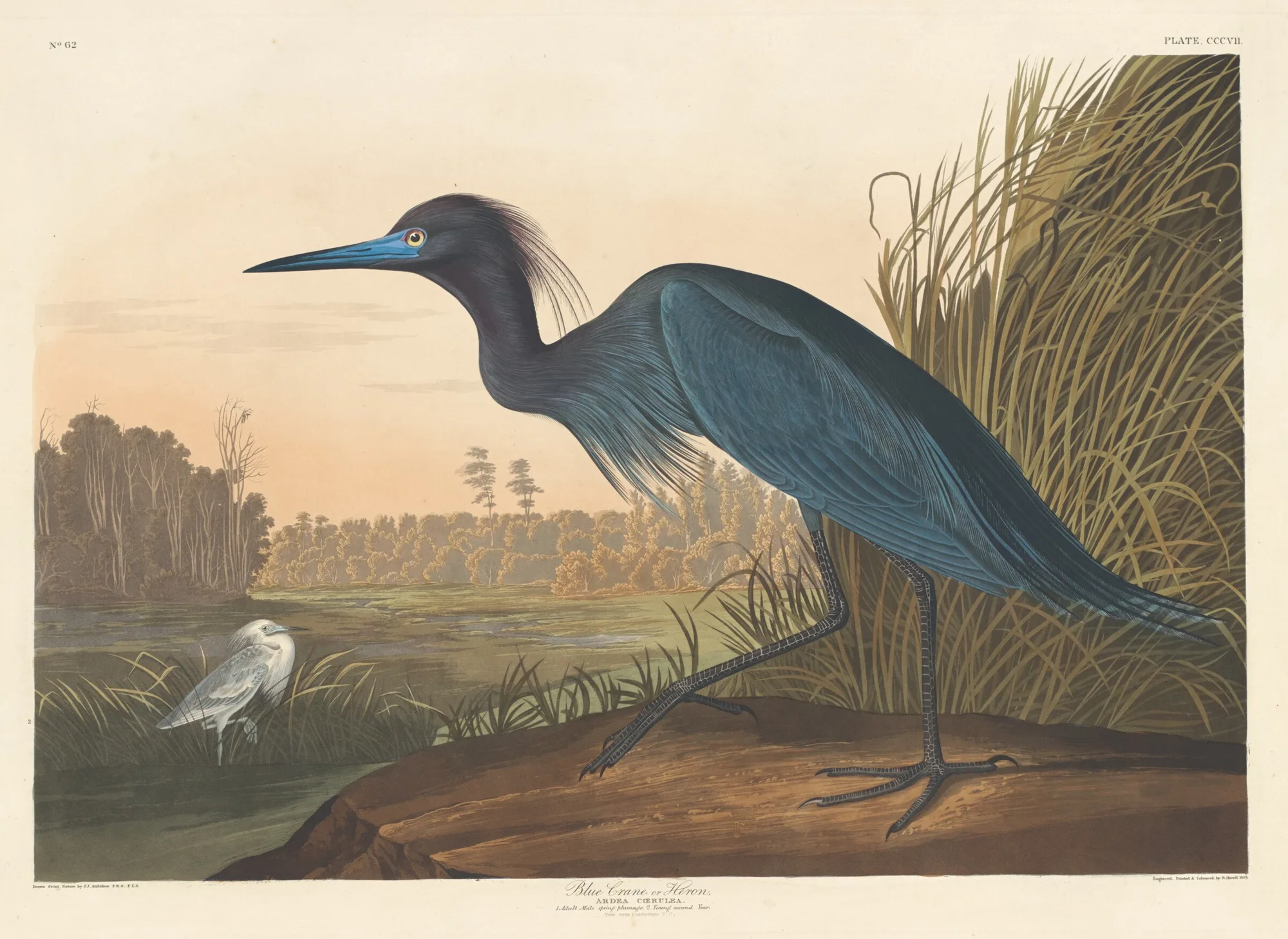
Audubon's “Blue Crane or Heron”, The Birds of America, plate CCCVII
Click or press Enter to enlarge
Open the full-resolution image (4234 px, National Gallery of Art)
| Plate | 307 (CCCVII) |
|---|---|
| Audubon's name | Blue Crane or Heron |
| Modern name | Little Blue Heron |
| Scientific name | Egretta caerulea |
| Status | Least Concern |
| Engraved by | Robert Havell, after Audubon's watercolor |
| Date | 1836 |
| Medium | Hand-colored engraving and aquatint on Whatman wove paper |
| Size | plate: 54.1 x 77.6 cm (21 5/16 x 30 9/16 in.) sheet: 67.5 x 100.7 cm (26 9/16 x 39 5/8 in.) |
| Collections | Herons and Egrets, Florida and Wading Birds |
| This impression | National Gallery of Art, Washington, 1945.8.307; Gift of Mrs. Walter B. James |
About this plate
Plate 307 shows an adult male Little Blue Heron and a young bird. The adult is dark slate blue with a maroon-purple head and neck and a two-toned bill, blue-grey at the base and black at the tip. Audubon remarked on the singular white plumage of the young, which sets it apart from the young of nearly every other heron.
Audubon's Ardea caerulea is now Egretta caerulea, the Little Blue Heron. His name Blue Crane reflects a common habit of the time of calling herons cranes. The white first-year birds look much like Snowy Egrets. In their second spring they moult into a patchy pied plumage before turning fully blue as adults. Young white birds are thought to gain some safety by feeding among flocks of white egrets.
Little Blue Herons breed in colonies in swamps and coastal thickets from the southeastern United States through the Caribbean and Central America to Peru and Brazil. After breeding, many young wander north in late summer. The species feeds slowly in shallow fresh and salt water on fish, crabs, frogs and insects. The IUCN lists it as Least Concern.
Audubon wrote that in Florida in winter the Blue Herons roosted with Great Egrets and Tricoloured Herons in low evergreen bushes on the coastal islands. They left at sunrise for inland waters and mud banks where fiddler crabs were plentiful. He also traced their range north to Long Island and noted that few went up the Mississippi beyond Natchez.
In Audubon's words
When in the Floridas, during winter, I observed that the Blue Herons associated with other species, particularly the White Heron, Ardea alba, and the Louisiana Heron, Ardea Ludoviciana, all of which were in the habit of roosting together in the thick evergreen low bushes that cover the central parts of the islands along the coast. Their passage to and from their feeding places, is as regular as the rising and setting of the sun, and, unless frequently disturbed, they betake themselves every night to the same locality, and almost to the same spot. In the morning, they rise with one accord from the roosts on which they have been standing all night on one leg, the other drawn up among the feathers of the abdomen, their neck retracted, and their head and bill buried beneath their scapulars.
John James Audubon, Ornithological Biography, vol. 4 (1838), “Blue Heron”. Read the full chapter.