Purple Gallinule (Plate 305)
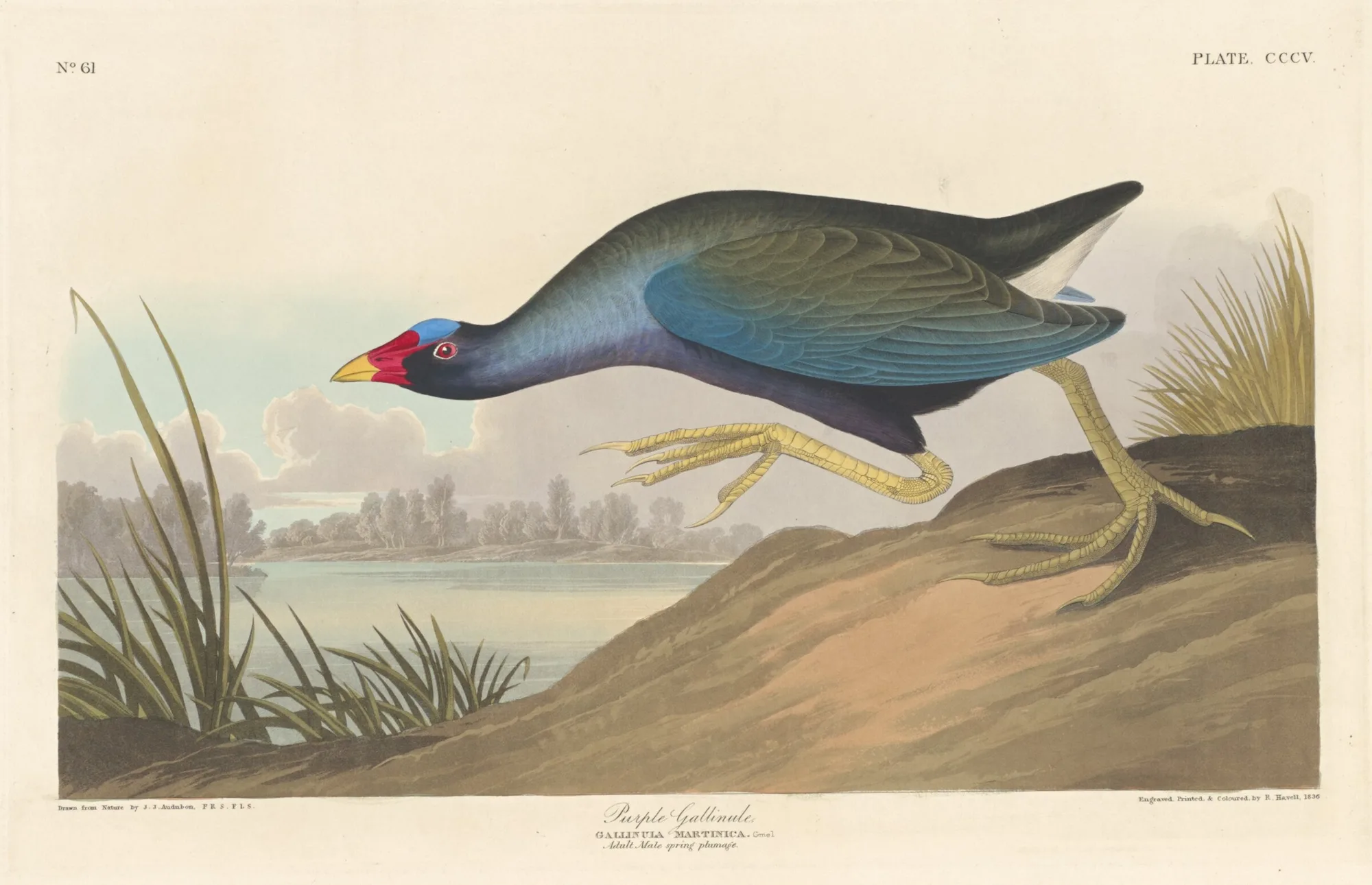
Audubon's “Purple Gallinule”, The Birds of America, plate CCCV
Click or press Enter to enlarge
Open the full-resolution image (2781 px, National Gallery of Art)
| Plate | 305 (CCCV) |
|---|---|
| Audubon's name | Purple Gallinule |
| Modern name | Purple Gallinule |
| Scientific name | Porphyrio martinica |
| Status | Least Concern |
| Engraved by | Robert Havell, after Audubon's watercolor |
| Date | 1836 |
| Medium | Hand-colored engraving and aquatint on Whatman wove paper |
| Collections | Shorebirds, Rails and Cranes, Florida and Wading Birds |
| This impression | National Gallery of Art, Washington, 1945.8.305; Gift of Mrs. Walter B. James |
About this plate
Plate 305 shows one male Purple Gallinule. It has a deep violet-blue head and underparts, a green back, a red bill tipped yellow, a pale sky-blue frontal shield and long yellow legs. Its very long toes let it walk across floating leaves. Audubon wrote of watching it flirt its tail while moving over the broad leaves of water-lilies.
Audubon's Gallinula martinica is now Porphyrio martinica, in the swamphen genus. It is related to the Common Gallinule and the coots and belongs to the rail family. It is a different bird from the Western Swamphen, once called the Purple Swamphen, of the Old World.
Purple Gallinules live in freshwater marshes and ponds with dense floating plants, from the southeastern United States through Central America and the Caribbean to northern Argentina. Northern birds move south in winter, and the species is famous for straying far out of range. Lost birds have turned up as far as Canada, Iceland, South Africa and Tristan da Cunha. The IUCN lists it as Least Concern.
The chapter opens with one of Audubon's most lyrical passages. In it he recalls watching the courtship of the birds on the bayous of his "native Louisiana". He wrote that he studied the species most closely around New Orleans and the mouths of the Mississippi, and in May 1837 he saw birds arriving from the south on the Gulf coast.
In Audubon's words
Methinks I now see the charming creature gliding sylph-like over the leaves that cover the lake, with the aid of her lengthened toes, so admirably adapted for the purpose, and seeking the mate, who, devotedly attached as he is, has absented himself, perhaps in search of some secluded spot in which to place their nest. Now he comes, gracefully dividing the waters of the tranquil pool, his frontal crest glowing with the brightest azure. Look at his wings, how elegantly they are spread and obliquely raised; see how his expanded tail strikes the water; and mark the movements of his head, which is alternately thrown backward and forward, as if he were congratulating his mate on their happy meeting. Now both birds walk along clinging to the stems and blades, their voices clearly disclosing their mutual feelings of delight, and they retire to some concealed place on the nearest shore, where we lose sight of them for a time.
John James Audubon, Ornithological Biography, vol. 4 (1838), “Purple Gallinule”. Read the full chapter.