Common Tern (Plate 309)
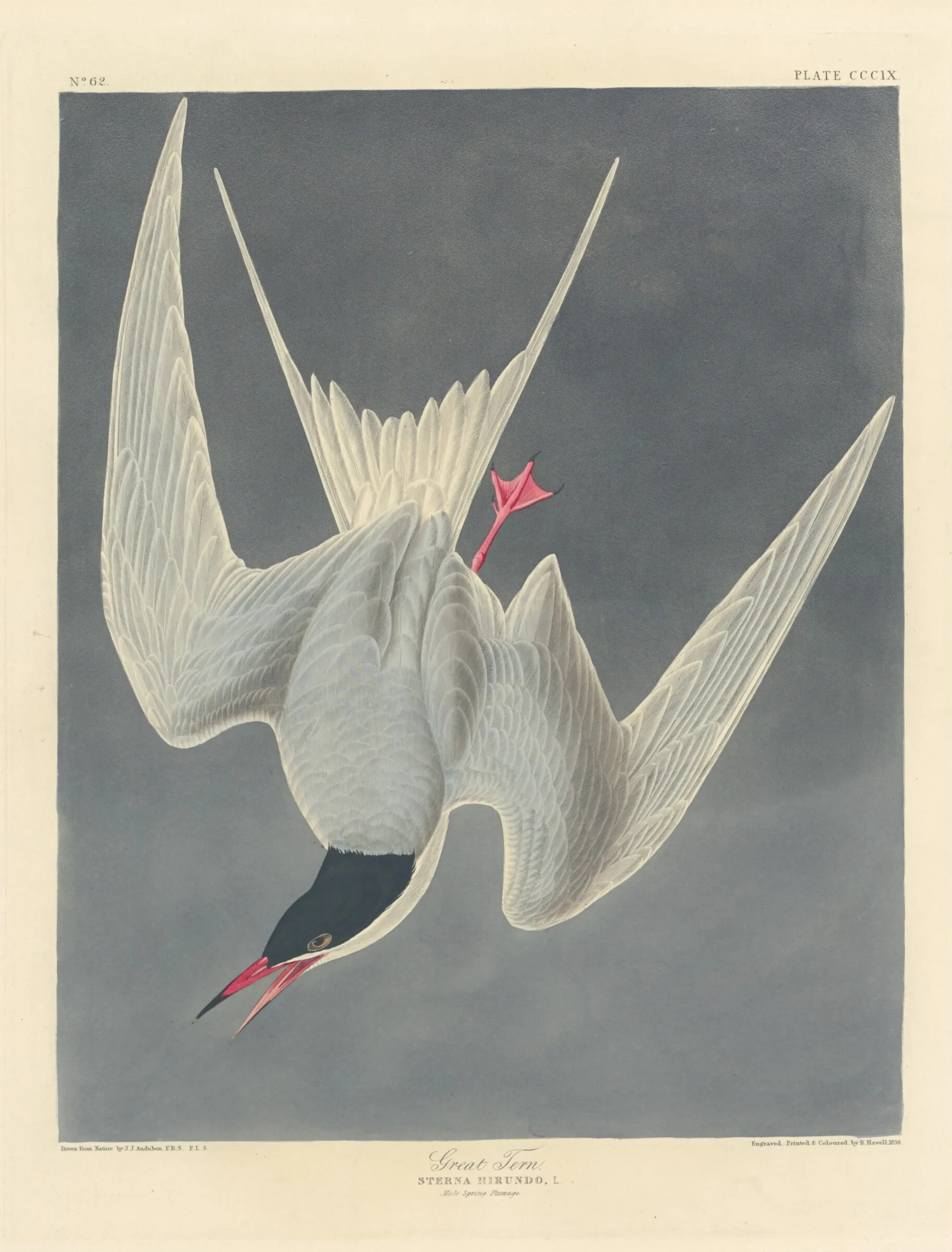
Audubon's “Great Tern”, The Birds of America, plate CCCIX
Click or press Enter to enlarge
Open the full-resolution image (2863 px, National Gallery of Art)
| Plate | 309 (CCCIX) |
|---|---|
| Audubon's name | Great Tern |
| Modern name | Common Tern |
| Scientific name | Sterna hirundo |
| Status | Least Concern |
| Engraved by | Robert Havell, after Audubon's watercolor |
| Date | 1836 |
| Medium | Hand-colored engraving and aquatint on Whatman wove paper |
| Collections | Seabirds |
| This impression | National Gallery of Art, Washington, 1945.8.309; Gift of Mrs. Walter B. James |
About this plate
Plate 309 shows one adult Common Tern in breeding plumage, with a black cap, pale grey back, deeply forked white tail and a red bill tipped black. The plate was engraved with the name Great Tern, but the Ornithological Biography chapter calls it the Common Tern.
The species is Sterna hirundo, the name Audubon used. Bonaparte had renamed the American birds Wilson's Tern, thinking them different from the European Common Tern. Audubon disagreed. He pointed out that bill colour, tail length and other small features vary among individuals in both countries, and he warned against naming species on such slight differences. Here modern taxonomy agrees with him: the Common Terns of both continents are one species.
Common Terns breed in colonies on beaches, islands and marshes across much of the Northern Hemisphere, in North America from the Great Lakes and the Atlantic coast to the Canadian interior. They winter along the coasts of South America and Africa. In the 1880s and 1890s the colonies on the Atlantic coast were badly hit by plume hunters, who sold the birds for women's hats. The IUCN lists the species as Least Concern.
Audubon met it from Galveston to the Strait of Belle Isle. On the Galveston Bay islands in May 1837 he watched large flocks arrive from the east and start nesting at once. He found its eggs on the Magdalen Islands on his 1833 voyage to Labrador.
In Audubon's words
I have observed this species along the Atlantic coast of North America, from Galveston Island in Texas to the Straits of Belle Isle on the coast of Labrador, both in spring and in early autumn. But when on the islands in Galveston Bay, in the month of April, I saw only a few arriving there from the west; whereas, in the beginning of May great numbers arrived there from the east, settled at once, and commenced breeding. I felt convinced that the numbers which came from the direction of the Floridas were much greater than those which arrived from the westward, and judged it probable that vast numbers had at the same time left the Peninsula on their way northward.
John James Audubon, Ornithological Biography, vol. 4 (1838), “Common Tern”. Read the full chapter.



