Spotted Sandpiper (Plate 310)
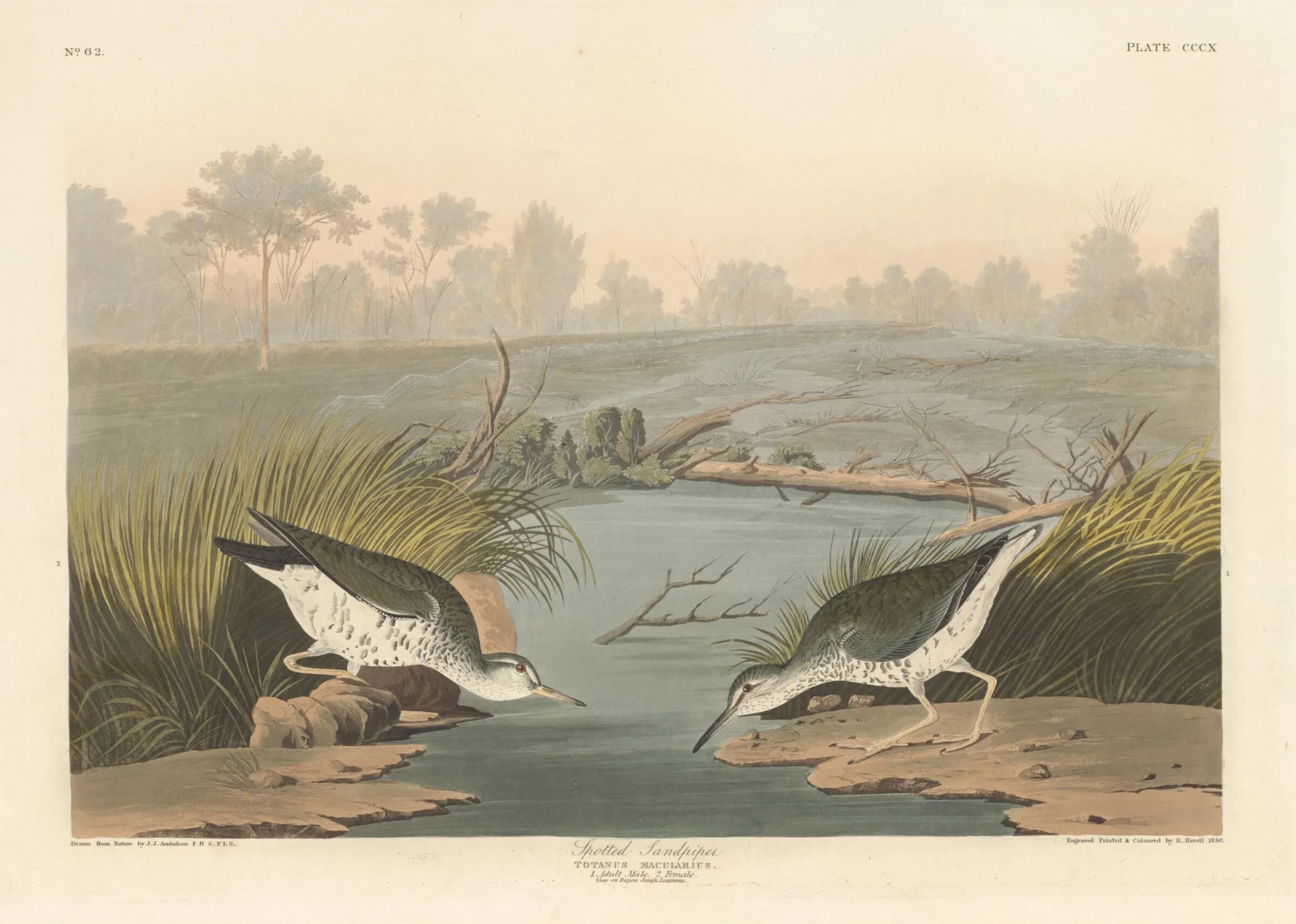
Audubon's “Spotted Sandpiper”, The Birds of America, plate CCCX
Click or press Enter to enlarge
Open the full-resolution image (3019 px, National Gallery of Art)
| Plate | 310 (CCCX) |
|---|---|
| Audubon's name | Spotted Sandpiper |
| Modern name | Spotted Sandpiper |
| Scientific name | Actitis macularius |
| Status | Least Concern |
| Engraved by | Robert Havell, after Audubon's watercolor |
| Date | 1836 |
| Medium | Hand-colored engraving and aquatint on Whatman wove paper |
| Collections | Shorebirds, Rails and Cranes |
| This impression | National Gallery of Art, Washington, 1945.8.310; Gift of Mrs. Walter B. James |
About this plate
Plate 310 shows a male and female Spotted Sandpiper in breeding plumage, olive-brown above and white below with bold round black spots, and with orange bills tipped black. Audubon described the nests in detail: on Jestico Island in the Gulf of St Lawrence, among tall grass, and in Labrador, hidden under overhanging rock ledges and lined with eider feathers.
Audubon's Totanus macularius is now Actitis macularius. Its constant bobbing of the rear body gave it folk names such as teeter-tail. Spotted Sandpipers are known for a reversal of the usual sex roles. Females arrive first, defend territories and may mate with several males in a season. The males do most of the incubating and caring for the young.
This is the most widespread breeding sandpiper in North America. It nests by streams, lakes and shores from Alaska and northern Canada south to the central United States. It winters from the southern United States to southern South America. It flies low over water on stiff, shallow, flickering wingbeats. The IUCN lists it as Least Concern.
Audubon was struck by how breeding times differed across its range. On Buffalo Bayou in Texas he saw well-grown broods on 5 May 1837, and near Indian Key, Florida, on the same date in 1832. In Labrador he found it breeding on 17 June 1833, and in Newfoundland the young were only just fledged on 11 August.
In Audubon's words
On the Island of Jestico, in the Gulf of St Lawrence, about twenty pairs had nests and eggs on the 11th of June; and the air was filled with the pleasing sound of their voices while we remained there. The nests were placed among the tall slender grass that covered the southern part of the island. They were more bulky and more neatly constructed than any that I have examined southward of the Gulf of St Lawrence; and yet they were not to be compared with those found in Labrador, where, in every instance they were concealed under ledges of rocks extending for several feet over them, so that I probably should not have observed them, had not the birds flown off as I was passing.
John James Audubon, Ornithological Biography, vol. 4 (1838), “Spotted Sandpiper”. Read the full chapter.



