Greater Yellowlegs (Plate 308)
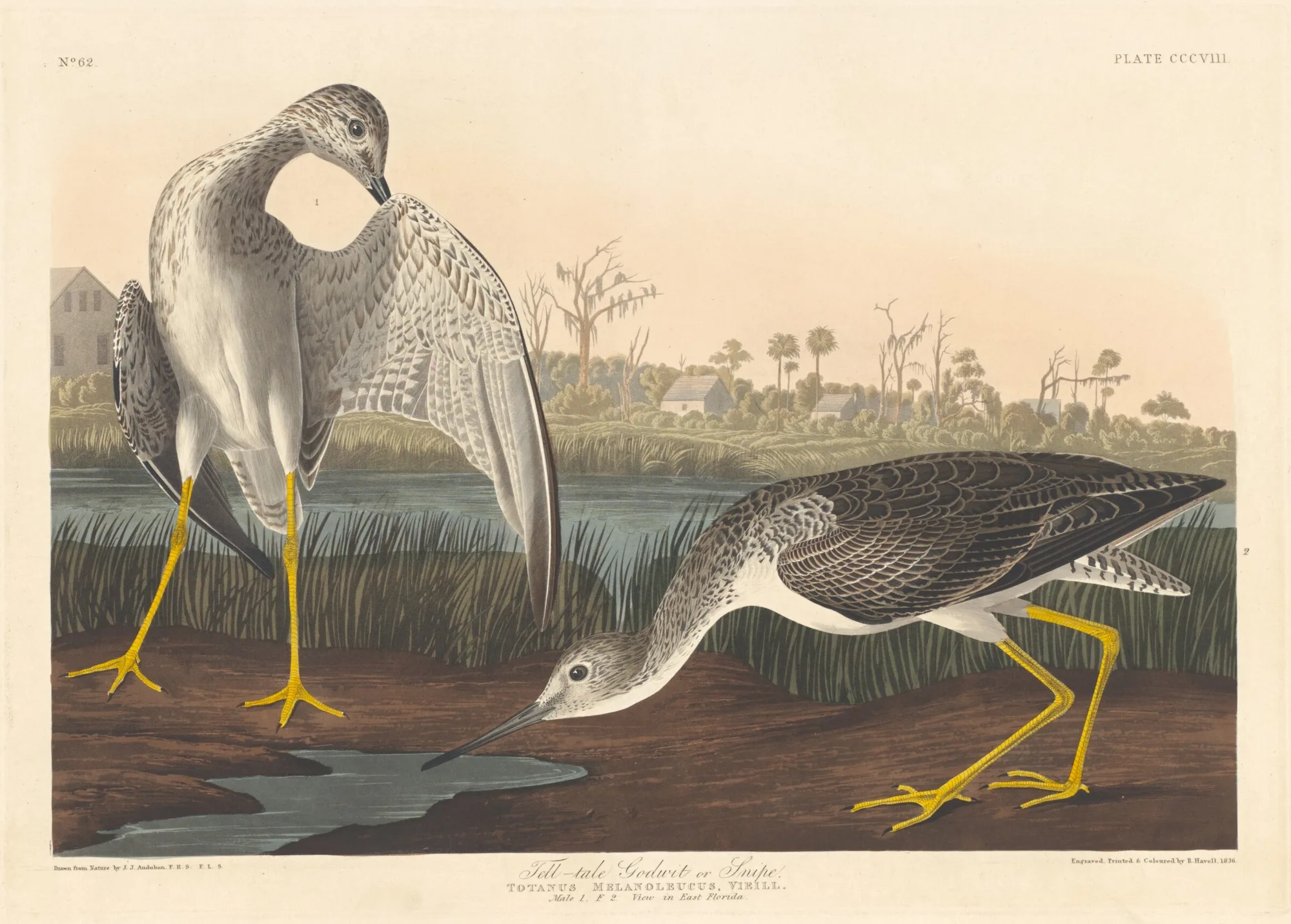
Audubon's “Tell-tale Godwit”, The Birds of America, plate CCCVIII
Click or press Enter to enlarge
Open the full-resolution image (2997 px, National Gallery of Art)
| Plate | 308 (CCCVIII) |
|---|---|
| Audubon's name | Tell-tale Godwit |
| Modern name | Greater Yellowlegs |
| Scientific name | Tringa melanoleuca |
| Status | Least Concern |
| Engraved by | Robert Havell, after Audubon's watercolor |
| Date | 1836 |
| Medium | Hand-colored engraving and aquatint on Whatman wove paper |
| Collections | Shorebirds, Rails and Cranes |
| This impression | National Gallery of Art, Washington, 1945.8.308; Gift of Mrs. Walter B. James |
About this plate
Plate 308 shows a male and female Greater Yellowlegs, tall grey-brown shorebirds spotted with white above, with long bright yellow legs and a long, slightly upturned bill. The NGA title gives Tell-tale Godwit, and the plate list adds Audubon's alternative name, or Snipe.
Audubon's Totanus melanoleucus is now Tringa melanoleuca. It is not a godwit. It is the larger cousin of the Lesser Yellowlegs, his Yellow Shank of plate 288. It is best told by its longer, often slightly upturned bill and by its loud call of three or four ringing notes. That call gave it the names tell-tale and tattler, since hunters believed it alerted other birds to the gunner.
Greater Yellowlegs breed in boreal forest bogs and muskeg from Alaska to Newfoundland. They winter from the coasts of the United States south to southern South America, and they feed in marshes, mudflats and flooded fields, often chasing small fish. The IUCN lists the species as Least Concern.
Audubon argued that the bird's warnings served only itself, not the ducks. He found it in almost every part of the country, from Texas in April and May 1837 to Eastport, Maine, on 11 May 1833 and Labrador that June. In Newfoundland in August the fat young made good eating. He noted that in Maine and New Brunswick it was oddly called Humility.
In Audubon's words
It is true that the Tell-tale is quite loquacious enough; nay, you, Reader, and I, may admit that it is a cunning and watchful bird, ever willing to admonish you or me, or any other person whom it may observe advancing towards it with no good intent, that it has all along watched us. But then, when one has observed the habits of this bird for a considerable time, in different situations, and when no other feathered creatures are in sight, he will be convinced that the Tell-tale merely intends by its cries to preserve itself, and not generously to warn others of their danger. So you may safely banish from your mind the apprehension, which the reading of books may have caused, that duck-shooting in the marshes of our Middle Districts, is as hopeless a pursuit as "a wild goose chase."
John James Audubon, Ornithological Biography, vol. 4 (1838), “Tell-tale Godwit”. Read the full chapter.



